




Borivali MLA Sanjay Upadhyay recently met the Mumbai Police Commissioner to raise concerns over law and order in parts of suburban Mumbai. Among the issues discussed was the recurring problem of illegal encroachments that continue to resurface despite repeated civic action. The development has once again drawn attention to a long-standing urban challenge that affects both public safety and the character of the city.
Mumbai’s municipal authorities conduct anti-encroachment drives throughout the year. The Brihanmumbai Municipal Corporation regularly deploys teams to remove illegal hawkers, temporary structures and unauthorised stalls from roads, pavements and public spaces. According to civic data released in past years, the BMC conducted over 35,000 anti-encroachment actions across wards in 2023. In 2024, the figure rose to around 38,000, reflecting intensified enforcement. However, internal civic assessments indicated that barely 40 percent of cleared locations remained free of re-encroachment after three months. By contrast, ward-level monitoring reports in 2025 suggested that sustained success rates improved modestly to around 48 percent in select zones with regular follow-up patrols.
Ward-level figures illustrate the scale of the problem. In 2025, the P North ward, which covers parts of Goregaon and Malad, recorded more than 2,300 anti-encroachment operations. In the R Central ward, which includes Borivali, over 1,800 drives were conducted in the same year. Civic officers admitted that without daily supervision, many stretches reverted to their previous condition within weeks.
Enforcement also involves penalties. Under provisions of the Mumbai Municipal Corporation Act and related laws, hawkers operating in prohibited zones can face fines and seizure of goods. Civic data from 2024 showed that over 12,000 hawkers were fined during anti-encroachment operations across the city, generating several crores in penalty collections. Police records from the same period indicated that more than 1,500 individuals were detained for obstructing officials or reoccupying cleared spaces. Repeat offenders in certain cases faced short-term judicial custody. Yet officials concede that fines often function as temporary costs rather than effective deterrents.
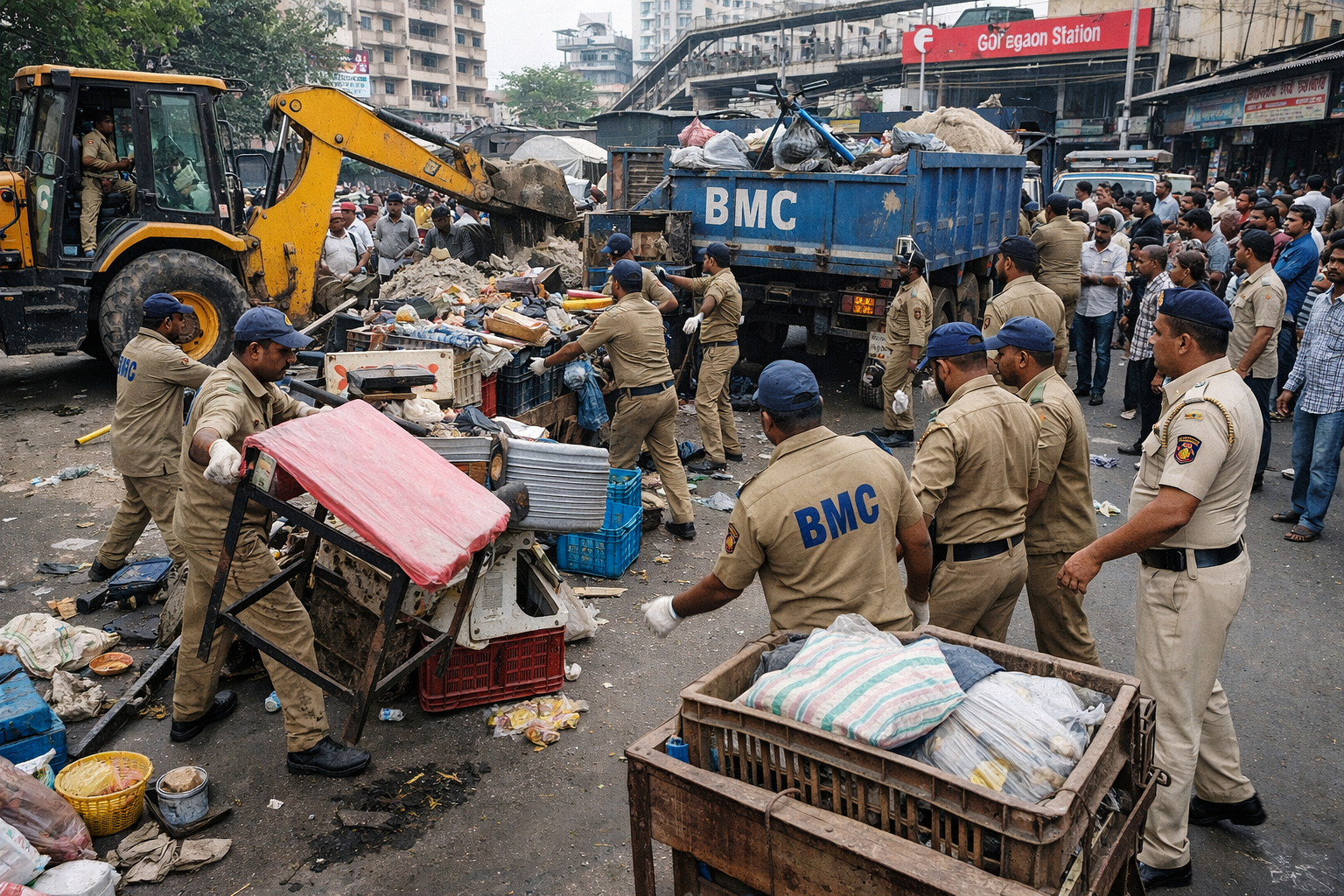
In early 2026, major drives were carried out in Goregaon, Borivali and Dadar. In Goregaon West, civic teams cleared large stretches outside the railway station and along SV Road. The area outside Goregaon Railway Station (W) had become chaotic. Footpaths were nearly invisible under layers of makeshift stalls. Commuters were forced onto the carriageway. Traffic congestion worsened during peak hours. Residents described the situation as deeply frustrating. After the February 2026 drive, pedestrian access improved and traffic flow stabilised for a period. However, smaller clusters of hawkers gradually reappeared in adjoining lanes.
Borivali witnessed similar action near the station precinct and market areas. In Dadar, long-standing illegal stalls near major junctions were dismantled. Portions of Dadar TT and parts of Borivali East remain relatively clear due to continuous patrols and installation of physical barriers after clearance. These examples suggest that persistent enforcement and structural safeguards can yield results.
The Street Vendors (Protection of Livelihood and Regulation of Street Vending) Act, 2014 was enacted to create a structured framework for identifying legitimate vendors and demarcating vending zones. However, enforcement gaps remain evident in Mumbai. Town Vending Committees have faced delays in comprehensive surveys and issuance of vending certificates. The functioning and composition of certain TVCs have been subject to ongoing litigation in courts, with disputes over vendor enumeration, zoning criteria and eviction procedures. These legal proceedings have slowed full implementation of vending plans in some wards, contributing to administrative uncertainty and periodic crackdowns instead of stable regulation.
Encroachments block pavements, force pedestrians onto busy roads and increase accident risks. Informal clusters can attract anti-social elements and strain sanitation systems. Many ordinary citizens purchase goods from illegal hawkers because prices are lower and access is convenient. This steady demand strengthens the informal ecosystem and encourages rapid reoccupation after each drive.
The recent political attention to the issue signals renewed urgency. Yet unless municipal authorities, police and policymakers combine sustained monitoring with effective implementation of the Street Vendors Act and clarity emerging from ongoing TVC litigation, the cycle is unlikely to end. Repeated anti-encroachment drives also impose significant financial and administrative costs on the civic body, diverting manpower and public funds that could otherwise support long-term urban planning and infrastructure improvements.
Subscribe Deshwale on YouTube
