




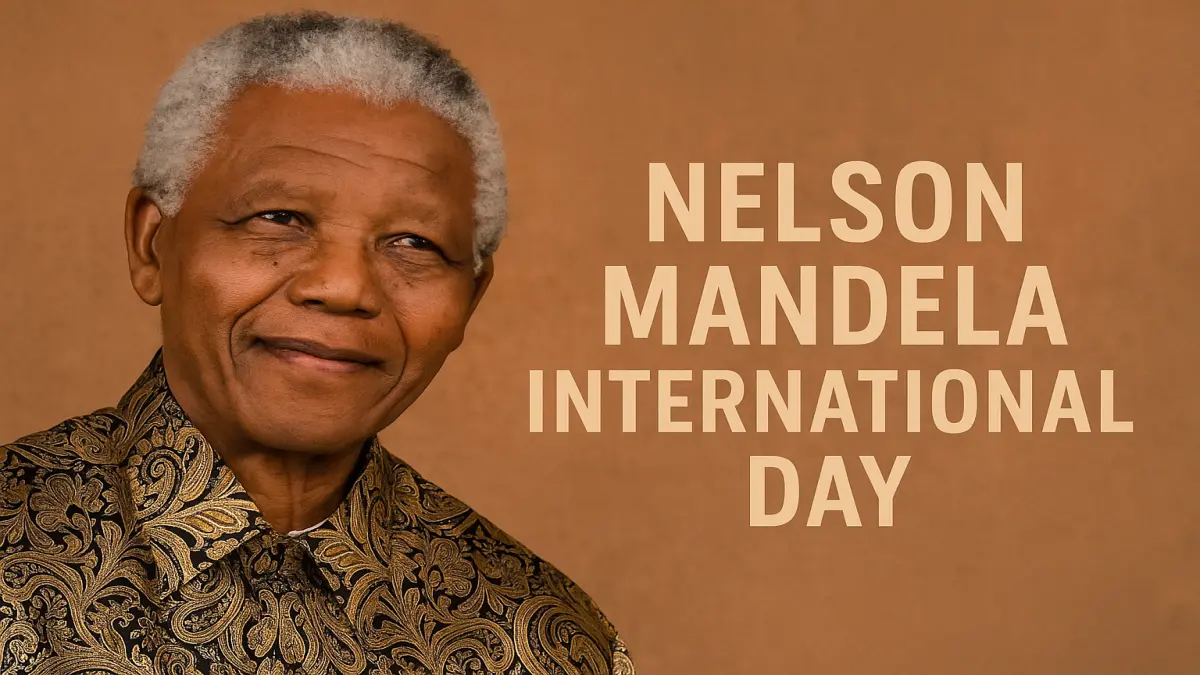
On 18 July each year, the world pauses to honour a man whose name echoes hope. Nelson Mandela International Day is not just a remembrance. It is a quiet call to act. To serve. To reflect on justice, compassion, and courage. In 2025, as the world faces deepening divides, Mandela’s spirit feels even more urgent. Not only for South Africa. For India too. Because Mandela was not merely a leader for his nation. He was a global symbol of resistance without hate, forgiveness without forgetting, and leadership without ego. And those are ideals India, with its layered struggles and promise, must embrace once again.
Nelson Mandela spent 27 years behind bars and walked out not with bitterness but with vision. He could have sought revenge. Instead, he sought reconciliation. He did not build walls of blame. He built bridges of dignity. In a world craving quick wins, this patience and moral clarity feel extraordinary. But what’s remarkable is how much of his journey mirrors ours. India too fought colonialism. India too knows the price of silence and submission. Yet somewhere along the way, we’ve let our fights turn personal and our freedom get fragmented.
Mandela’s leadership was grounded in deep listening. He read Indian thinkers. He admired Mahatma Gandhi, drawing from the same well of non-violence. When he visited India, he called it his “second home.” That wasn’t just political courtesy. It was spiritual kinship. Gandhi’s influence in South Africa during his early years helped shape the young Mandela. But where Gandhi stopped, Mandela continued—through armed resistance when needed, through prison walls, and then through statecraft that never lost its moral core.
This is where India must pause. In 2025, we are loud, informed, and increasingly divided. Social media debates replace social service. Activism often ends at hashtags. And true leadership, the kind Mandela lived, feels rare. He didn’t scream slogans. He worked silently for decades. When he had power, he gave it up. He stepped down after one term as president. Not because he had to. Because he believed in institutions, not personal empires. How many Indian leaders today can say the same?
Mandela Day encourages every citizen to give 67 minutes to service, honouring the 67 years he spent fighting for human rights. This isn’t about token charity. It’s about understanding that every drop of kindness creates ripples. Indians, by nature, understand the value of seva. But what stops us from transforming that instinct into structured social change? We have the spirit. What we need is the system. We celebrate heroes posthumously. But rarely do we nurture them while alive. Mandela’s life reminds us that greatness grows in humility, not popularity.
In India, Mandela’s story is often reduced to school essays and public functions. But few really reflect on what he did after power came. He invited his jailers to his inauguration. He wore the Springboks rugby jersey, uniting black and white South Africans. He visited the poorest villages, even as president. He knew symbolism matters. But action matters more. In 2025, Indian society needs such unity. Not forced sameness. But mutual respect rooted in shared dreams. Caste, religion, region, language—these are real divisions. But they don’t have to be permanent. Mandela taught the world how to forgive with courage, not cowardice.
For young Indians, especially students and first-time voters, Mandela’s journey is a case study in resilience. In an age of instant gratification, his life teaches endurance. He wrote letters in prison when the world forgot him. He studied law by candlelight. He turned Robben Island into a university of ideas. That kind of commitment is rare. But it’s not unreachable. If our youth could embrace even part of that spirit, India’s future would shine brighter. Because the truth is, democracies aren’t built by speeches. They’re built by choices. Daily, deliberate, difficult choices.
Mandela also believed in dialogue. Not just with friends. With enemies. He met the apartheid government in secret talks. Risked everything. But never lost his dignity. In India, where political debates turn toxic and public discourse grows shallow, this is a timely lesson. Disagreement is not betrayal. Dialogue is not defeat. We must relearn how to argue without hating, how to question without mocking, and how to lead without dominating.
His commitment to equality extended to gender, poverty, education, and health. He saw rights as interconnected. When one suffers, all do. In 2025, as India grapples with inequality, unemployment, and ecological stress, Mandela’s holistic thinking offers a roadmap. He didn’t compartmentalise justice. He lived it across domains. That’s how transformation begins. Not by fixing one problem at a time, but by creating systems that heal together.
Mandela also smiled. That may sound simple, even silly. But in a world scarred by trauma, a smiling leader who carries pain with grace is revolutionary. His warmth, his humour, his ability to dance at rallies—all of that humanised him. He was not a saint. He was flawed, tired, and often unsure. But he remained human. In Indian politics, where arrogance sometimes hides as authority, humility becomes a quiet revolution.
India and South Africa share deep cultural bonds, from Gandhi’s early experiments to BRICS diplomacy. But the emotional connection needs renewal. Mandela Day should not be limited to school functions. It should inspire town halls, street plays, community kitchens, prison reforms, and student activism. It should make every Indian ask: What am I doing for justice in my lane, my street, my city?
In a world flooded with leadership books and motivational quotes, Mandela’s life remains raw and real. He didn’t lead from behind a screen. He led from behind bars. Then from behind people. He taught that freedom is not the absence of oppression. It’s the presence of dignity. That’s a message India must carry forward—not in theory, but in policy, in parenting, in partnerships.
On 18 July 2025, light a candle. Not just in memory. But in commitment. Give 67 minutes. Or more. Listen to someone across the divide. Volunteer. Read Mandela’s letters. Write one to your local leader. Teach a child about unity. Support a cause. Share your privilege. That’s how nations grow. That’s how Madiba lives on.
Because the legacy of Nelson Mandela is not carved in statues. It’s etched in every hand that heals, every voice that speaks, and every foot that marches forward. Not for the past. But for a future rooted in justice, equality, and the most powerful tool of all—hope.
