




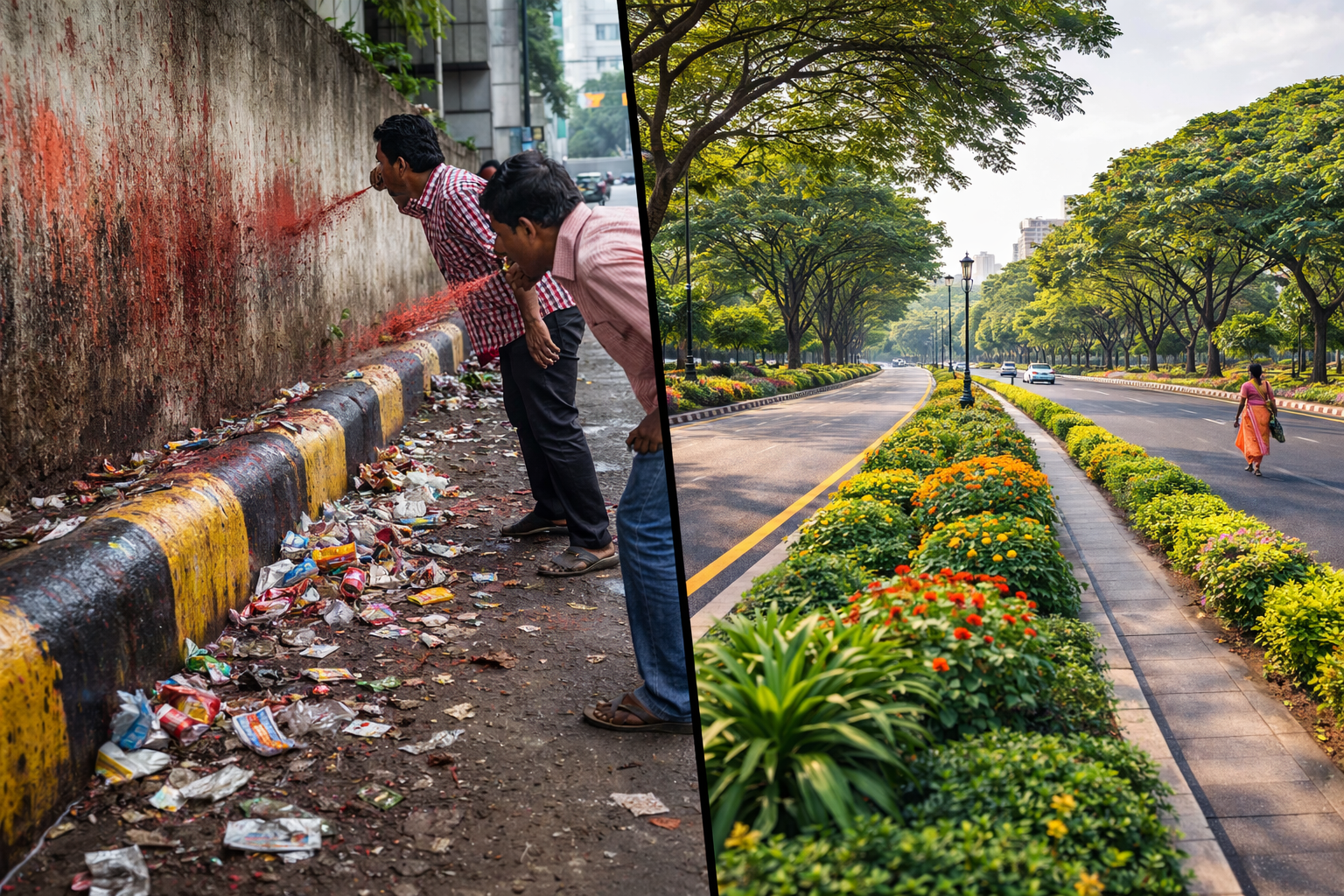
In many Indian cities and towns, spitting gutkha, chewing paan, and discarding packets of snacks on roads and walls has become a familiar sight. Despite decades of campaigns against public spitting and littering, these habits remain deeply entrenched. Understanding why this occurs requires looking beyond surface behaviour to cultural, psychological and civic factors as well as global and historical efforts to curb similar issues.
On one level, there is a clear contradiction. Many Indians take pride in their motherland and revere it as sacred, particularly within Hindu theology, which regards the land itself as holy. Yet, on this very soil, gutkha and paan residues stain streets and walls. This behaviour persists in part because cleanliness in public spaces is often treated as someone else’s responsibility. Households are generally kept clean, aided by domestic help, while the same effort rarely extends to communal areas. The idea that municipal sanitation workers are paid to clean streets, funded by taxpayer money, has inadvertently reinforced this mindset. While paying salaries for sanitation is essential, it cannot justify casual spitting, littering, or the indiscriminate disposal of packets and wrappers.
Municipal authorities across India have taken punitive measures in recent years. For example, civic bodies in Pune and Mumbai have imposed fines ranging from ₹500 to ₹2,000 for public spitting and littering. The Swachh Bharat Mission identified public spitting as a key target and urged cities to deploy anti‑spitting bylaws along with signage and public awareness campaigns. In Ahmedabad, surveillance cameras have been used to identify repeat offenders and fines were enforced under municipal regulations. Despite these efforts, yellow‑and‑black road dividers in many cities are routinely reddened by gutkha spitting, creating unsightly stains that local bodies must repeatedly clean. Some urban planners have suggested that painting dividers in red or brown tones might hide these marks more effectively as a temporary solution while longer‑term behavioural change takes root.
Psychologically, public spitting and littering have become normalised in many urban areas. For some, gutkha chewing or tossing a packet is almost subconscious. It is tied to a broader social acceptance where littering is widespread and often goes unchallenged. Cultural factors also play a role. In India, noise and liveliness are highly visible aspects of daily life. Loud behaviour, including music or mobile phones without earphones, is often tolerated or glamorised. Just as loudness has become normalised, casual spitting and littering have become culturally overlooked.
Historically, foreign nations have grappled with similar challenges. In late nineteenth‑century London, public spitting was a major health concern during cholera and tuberculosis outbreaks. The city introduced fines, public education campaigns and dedicated street cleaning teams. New York City faced a similar problem in the early twentieth century; municipal authorities used anti‑littering bylaws and public awareness posters to promote civic behaviour, encouraging residents not to throw garbage from elevated trains or streets. These campaigns took years to show results, reflecting the difficulty of changing ingrained habits. European cities also invested in public toilets and ashtrays to reduce street spitting and waste, viewing infrastructure as part of the solution.
Singapore provides a modern case study of how strict enforcement and civic education can change public behaviour. In the 1960s and 1970s, the city‑state was notorious for littered streets, chewing gum spitting and general disregard for public cleanliness. The government introduced heavy fines for spitting, littering and gum disposal offences, combined with public campaigns in schools and workplaces about civic pride. Over decades, this multifaceted approach helped Singapore transform from a littered city to one of the cleanest in the world. The Singapore example demonstrates that punitive measures, when paired with sustained public education, can alter social norms over time.
This behaviour has social consequences. Tourists and Indians living abroad often report being judged based on these habits. Loud public behaviour and visible littering can invite critical taunts abroad, creating unfair stereotypes for many Indians who do not follow these practices. Such patterns highlight the need for public awareness campaigns that combine civic responsibility with cultural pride.
Municipal authorities play a key role. Alongside sanitation workers, local bodies must enforce regulations, provide accessible dustbins, and run sustained awareness drives in schools, workplaces and public transport. Individual responsibility is equally crucial. Citizens must internalise that public spaces are extensions of their homes. Respecting the soil, walls and roads of India is not merely a civic duty but a cultural and ethical one.
Behavioural change is possible, as seen in cities that have implemented strict anti‑littering policies with visible enforcement combined with education. Encouraging small, consistent acts such as disposing of packets in bins, refraining from spitting in public, and keeping noise levels in check can cumulatively transform urban spaces. Public cleanliness, when paired with reverence for the land, has the potential to redefine the experience of Indian cities for residents and visitors alike.
Subscribe Deshwale on YouTube
