




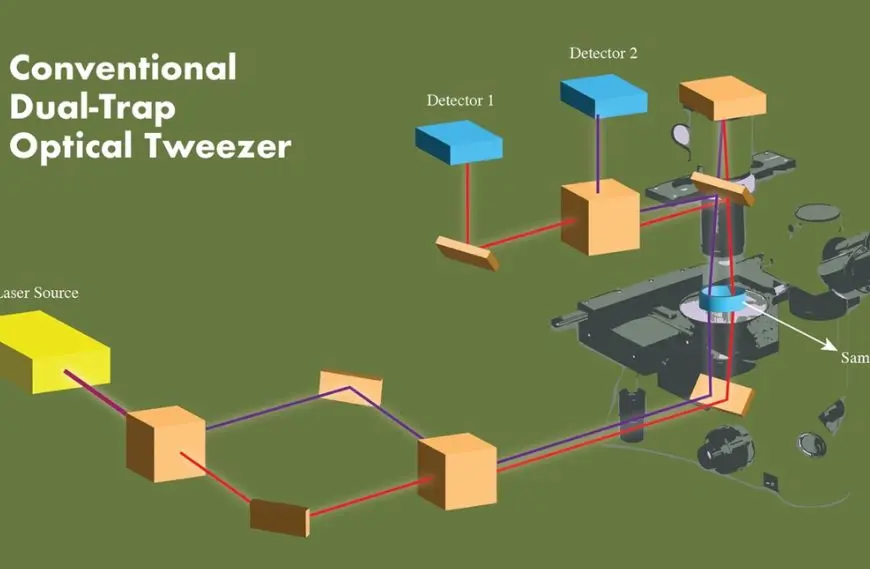
Raman Research Institute (RRI), supported by the Department of Science and Technology, has created a breakthrough dual-trap optical tweezers system. This new design makes the advanced technology accessible to Indian scientists and opens fresh possibilities in neuroscience, drug discovery, biology, and nanoscience.
Optical tweezers, awarded the Nobel Prize in 2018, allow scientists to trap and move tiny objects using light. They are vital in research areas like bioengineering, materials science, and molecular biology. Yet, traditional dual-trap systems still face major hurdles such as interference, high costs, and complex integration with microscopes.
The RRI team has solved these problems with a confocal detection method. Each detector reads only the back-scattered light from its own trap, removing cross-talk. The detectors remain aligned even when the traps move, enabling stable, precise measurements without interference.
Md Arsalan Ashraf, PhD scholar at RRI, explained, “This design uses scattered laser light to detect particle position. It overcomes long-standing issues in dual-trap systems and integrates easily with standard microscopes.”
Unlike older designs that disrupt other imaging methods or demand constant repositioning, this module is compact, modular, and user-friendly. It works seamlessly with techniques like fluorescence and phase contrast, while staying stable under temperature variations. Traps can be displaced freely without losing measurement accuracy.
Lead researcher Pramod A Pullarkat said, “This new module makes high-precision force measurements, molecular studies, and micromanipulation of biological samples much more convenient and cost effective.”
The innovation also carries strong patent potential. It eliminates interference in a simple way, while improving precision, robustness, and compatibility. RRI now plans to commercialize the design as a plug-and-play add-on for existing commercial microscopes.
With this advancement, dual-trap optical tweezers could drive a new wave of discoveries across medicine, neuroscience, and nanotechnology.
