



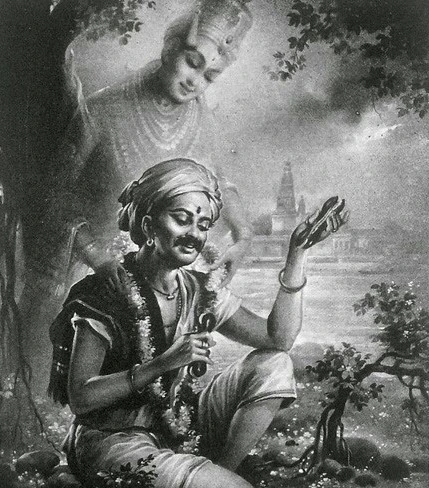
In the heart of Maharashtra’s devotional tradition, few figures shine as powerfully as Sant Chokhamela. Born in the 14th century into the Mahar caste, a group labelled “untouchable” under the rigid Brahmanical hierarchy, Chokhamela challenged the spiritual and social norms of his time. His life stands as a defiant testament to the power of devotion over discrimination and love over exclusion.
Chokhamela’s unwavering faith in Vitthal of Pandharpur not only transformed his own life but also inspired generations to see beyond caste and status. Through his abhangs – poetic hymns sung in Marathi – he gave voice to the pain of the marginalized and revealed that God cares not for lineage, but for sincerity of heart.
Early Life: Growing Up in Marginalisation
Chokhamela was born in the town of Mangalvedha, near Pandharpur, in a society where his very touch was considered impure by the upper castes. Like many of his community, he worked as a farm labourer and performed menial tasks, facing daily insults and systemic humiliation.
Yet, amidst the harshness of this life, Chokhamela found solace in the name of Vitthal. From a young age, he began chanting the deity’s name and composing verses that poured out his anguish and yearning. For him, devotion was not a privilege, but a necessity, a lifeline in a world that denied his humanity.
In one of his abhangs, he pleads:
“Aamhi dnyan heen, aamhala patit.
Tari Vitthal karishi uddhar.”
(We are ignorant and fallen;
Yet Vitthal, lift us up.)
This simple cry reveals a soul seeking compassion, not validation.
Pandharpur: Living in the Shadow of the Temple
Determined to be close to his beloved deity, Chokhamela moved with his wife Soyarabai to Pandharpur, home to the revered Vitthal temple. However, the sacred town proved no more accepting. Chokhamela was barred from entering the temple, a reminder that social exclusion persisted even at the doorstep of the divine.
Undaunted, he built a small hut opposite the temple gates. There, he sang to Vitthal day and night. His voice became a constant echo of devotion at the temple’s threshold. The hut, modest in appearance, became a spiritual landmark – an enduring symbol of resistance and faith.
Divine Response and Recognition
The Bhaktavijaya, a classic text chronicling the lives of saints, records how Chokhamela’s intense bhakti moved even the divine. One account tells of how the murti (idol) of Vitthal physically leaned forward so Chokhamela could glimpse it from his hut, as priests refused to offer him prasad. In another tale, a sceptical Brahmin dreamt of Vitthal embracing Chokhamela, awakening him to the folly of caste-based arrogance.
These stories illustrate a profound truth: that divine love does not recognise human hierarchies.
The Abhangs: Raw Devotion and Social Protest
Unlike many saint-poets whose verses focused solely on divine love, Chokhamela’s abhangs are grounded in the pain of exclusion. He questioned not God, but the cruelty of the social order. Yet, even in his lamentations, his devotion never wavered.
He once wrote:
“Aamhi shudra, aamhi ati,
Pari Vitthalacha bhakta.”
(We are shudra, we are lowly;
Yet we are Vitthal’s devotees.)
These lines resonate deeply with those who have faced oppression. Chokhamela gave the voiceless a language of dignity.
Sant Namdev: Brotherhood Beyond Caste
One of the most touching aspects of Chokhamela’s story is his relationship with Sant Namdev, another renowned Varkari saint. Despite being born into a higher caste, Namdev saw Chokhamela’s spiritual light. Their bond defied convention and affirmed the inclusive ideals of the bhakti movement.
Namdev wrote of his companion:
“Chokha dora payi padle,
Tethe bhagavanta uthale.”
(Chokha bowed at God’s feet,
And there God lifted him up.)
Their friendship remains a powerful symbol of unity in a deeply divided world.
Soyarabai: Partner in Devotion
Chokhamela’s wife, Soyarabai, was not merely a supporter, but a saint and poet in her own right. Her abhangs, though fewer in number, carry an intense clarity and protest against injustice. Together, the couple embodied one of the earliest examples of spiritual equality between man and woman in Indian devotional literature.
Their partnership served as a model for both marital and religious unity.
The Tragic End
Chokhamela’s life ended in sorrow. While working on a construction site near Pandharpur, a wall collapsed and killed him. Legend says that even in death, his bones continued to chant “Vitthal, Vitthal.” His remains were interred opposite the temple that once denied him entry, and today his samadhi (memorial shrine) stands as a site of pilgrimage.
Every Ashadhi Ekadashi, thousands of Varkaris, especially Dalits, gather at his samadhi to honour a man who found God in suffering.
A Shrine of Revolution
More than a place of prayer, Chokhamela’s samadhi is a symbol of social transformation. Leaders like Dr. B. R. Ambedkar held him up as a saint who defied caste-based oppression with the purity of his bhakti. It remains a rallying point for those fighting caste injustice.
Pilgrims of all backgrounds gather there, singing his abhangs. In that shared music, centuries of inequality seem to dissolve – if only for a while.
Cultural Impact and Literary Legacy
Chokhamela’s poetry continues to be sung across Maharashtra, particularly during the annual wari (pilgrimage). His verses are featured in anthologies of Dalit literature and Marathi devotional poetry. Modern plays, films, and performances revisit his life, keeping his legacy alive for younger generations.
His voice, full of pain and hope, has found a permanent place in the cultural memory of Maharashtra.
Scholarly Views
Historians and scholars have long recognised the unique role Chokhamela played in shaping devotional discourse. In her book Saints, Goddesses, and Kings, Anne Feldhaus describes his bhakti as “both a personal cry for acceptance and a collective voice against injustice.”
Eleanor Zelliot, a leading scholar on Dalit history, wrote that Chokhamela gave Maharashtra “a conscience,” compelling society to face the human cost of caste discrimination.
Such academic reflections validate what Chokhamela’s followers have always known, that his spiritual path was also a form of resistance.
Relevance in Today’s World
The story of Sant Chokhamela continues to inspire in a world still plagued by inequality. His life reminds us that true faith does not recognise barriers of caste, class, or background. His devotion challenges the idea that holiness is inherited or reserved for a few.
In an age where identity politics can divide and faith is often misused, Chokhamela’s example urges us to return to the basics: sincerity, humility, and compassion.
Conclusion
Sant Chokhamela lived in a time that told him he was less than human. Yet, he answered not with bitterness, but with bhakti. He turned his suffering into song and his marginalisation into a mission. His abhangs still echo in the streets of Pandharpur and in the hearts of all who seek a more just, loving world.
He broke barriers not by rebellion, but by love – and in doing so, he made space for many to follow.
