




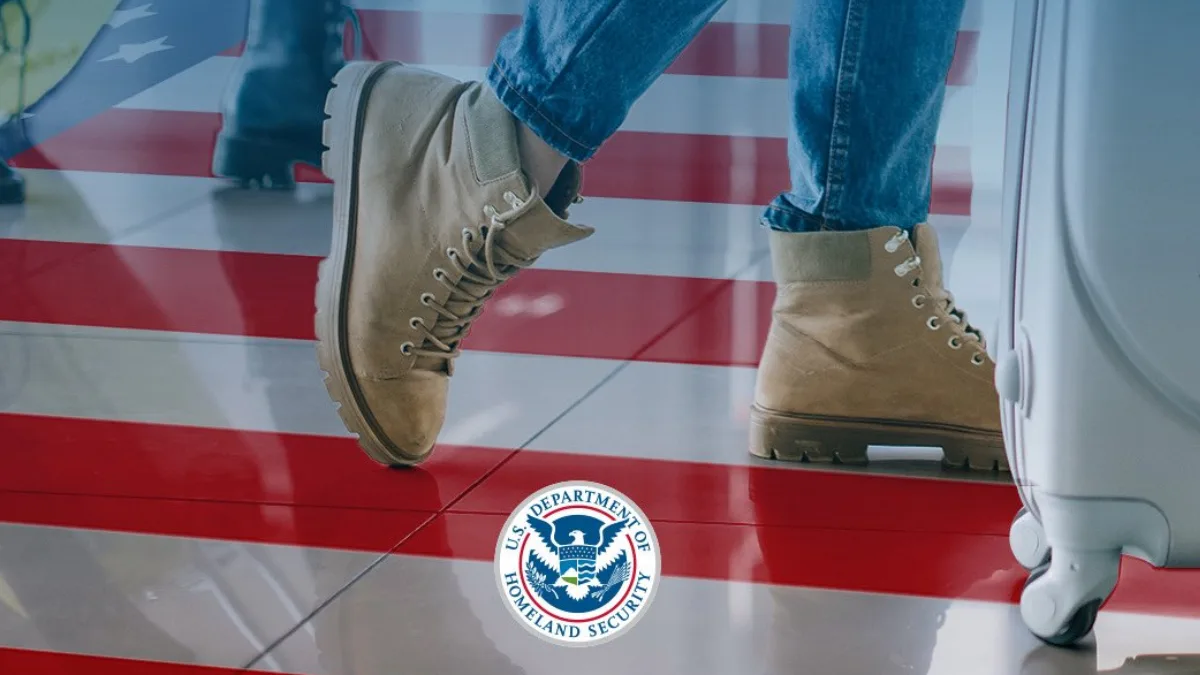
After nearly two decades, the United States has officially ended its mandatory airport shoe removal rule. Introduced in 2006 after the infamous “shoe bomber” incident, the policy was a cornerstone of post-9/11 aviation security. Homeland Security Secretary Kristi Noem announced the change, citing advanced screening technologies and multi-layered security protocols. While the move streamlines passenger experience, it also prompts a global rethink. Countries like India, the UK, and Japan never fully adopted the rule, relying instead on targeted screening. The decision marks a symbolic shift from fear-driven protocols to tech-enabled pragmatism.
In the annals of aviation security, few rules have been as universally loathed and as oddly symbolic as the shoe removal mandate. For nearly twenty years, American travellers have shuffled barefoot through TSA checkpoints, clutching laptops and liquids, muttering kya musibat hai under their breath. But as of July 2025, that ritual has been retired. Homeland Security Secretary Kristi Noem declared the end of the policy, stating that “advancements in screening technology” now allow shoes to stay on.
The rule’s origin traces back to a chilling moment in December 2001. Richard Reid, a British national and Al-Qaeda operative, boarded American Airlines Flight 63 from Paris to Miami with explosives hidden in his shoes. His attempt to ignite the bomb mid-air failed, thanks to alert passengers and crew. But the incident triggered a seismic shift in airport security. By 2006, the Transportation Security Administration (TSA) had made shoe removal mandatory across all US airports.
For many, the rule became synonymous with post-9/11 paranoia. It was not just about footwear; it was about fear. The idea that a shoe could bring down a plane was unsettling, and the policy served as a visible reminder of invisible threats. Yet critics often labelled it security theatre, a performance of safety rather than its guarantee.
Over the years, exceptions crept in. Children under 12, seniors over 75, and TSA PreCheck members were allowed to keep their shoes on. But for the average janta, the rule remained a nuisance. Long queues, awkward balancing acts, and the indignity of walking barefoot on cold tiles became part of the American airport experience.
Now, with the rollout of Computed Tomography (CT) scanners and AI-assisted threat detection systems, the TSA believes it can maintain security without shoe removal. These machines generate 3D, rotatable images, allowing officers to detect anomalies with surgical precision. The shift is not just technological; it is philosophical. It signals a move from blanket suspicion to targeted trust.
Globally, the rule was never universally adopted. In Europe, the EU’s unified security guidelines do not mandate shoe removal, though airports like Heathrow and Dublin may enforce it for US-bound flights. In Asia, practices vary. Airports in Manila and Bangkok often require shoe removal, while Japan and South Korea generally do not. China’s policies are stricter, especially at high-traffic hubs like Beijing and Shanghai.
India, interestingly, never embraced the shoe rule as standard. At airports like Delhi’s IGI or Mumbai’s T2, passengers are rarely asked to remove shoes unless flagged by metal detectors. The Central Industrial Security Force (CISF), which oversees airport security, relies on behavioural profiling and layered screening. The Indian approach is pragmatic – jaisa threat, waisa response. Shoes come off only when necessary.
Security experts argue that India’s model balances efficiency with vigilance. “We don’t need to copy everything the West does,” says retired CISF officer R.K. Sharma. “Our threat matrix is different. Our response must be indigenous.” His words echo a broader sentiment: that security should be sankat-mukt, not sankat-badhak.
The US decision has implications beyond convenience. It challenges the orthodoxy of airport security and invites a global reassessment. If America, with its high-risk profile and vast aviation network, can drop the shoe rule, why should others cling to it?
Yet caution remains. TSA officials clarify that passengers may still be asked to remove shoes during secondary screening or if scanners flag anomalies. The rule’s end is not carte blanche; it is calibrated flexibility.
For Indian travellers, the news is both amusing and affirming. Hamare desh mein toh pehle se hi chappal pehen ke nikal jaate hain. But it also raises questions about the future of security protocols. Will biometric ID checks, AI-driven behaviour analysis, and smart lanes become the norm? Will dar ke aage jeet finally apply to airport queues?
As global aviation gears up for mega-events like the 2026 FIFA World Cup and the 2028 Olympics, security will remain paramount. But the tools and tone are changing. The end of the shoe rule is not just a policy update; it is a cultural pivot. It says that security can be smart, not just strict. That passengers deserve dignity, not just scrutiny.
In the words of Benjamin Franklin, “Those who would give up essential liberty to purchase a little temporary safety deserve neither liberty nor safety.” The TSA’s move suggests that liberty and safety need not be adversaries. With the right tech and intent, they can walk side by side, shoes on.
