




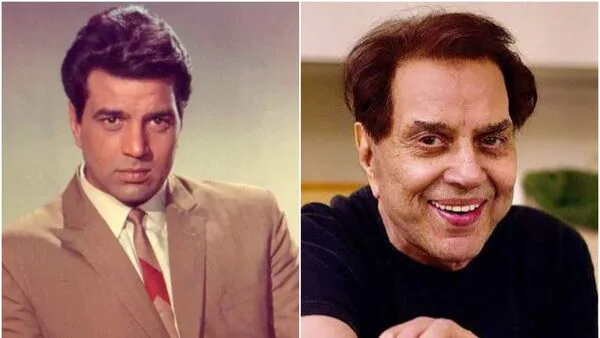
The boy who dreamt of becoming an actor in Class 9 turned that ambition into reality with absolute conviction. Dharam Paaji didn’t just achieve his dream—he carved his name into Bollywood with a force and permanence very few ever manage.
“Ma, I want to be a hero. I’ll go to Mumbai.” “Have you lost your mind? You’re the eldest son. You carry responsibility.”
In a tiny, barely noticeable village named Dangon in Punjab’s Ludhiana district lived the Deol family. The father, Kaival Krishan, was a schoolteacher, and the mother, Satwant, managed the home. They had seven children, and Dharam was the eldest. As a teenager, he was obsessed with Dilip Kumar and Suraiya. He would stand in front of a mirror and imitate scenes. The first time he watched a film—while in Class 9—he wondered, “Where is this paradise where such beautiful people live?” He decided he belonged to that world. But when he told his mother, she firmly pulled him back to reality.
Time moved on. Dharam turned 19. In 1954, his parents married him to Prakash Kaur. In 1957, their son Sunny was born. The family thought Dharam was now settled.
But in 1958, Filmfare announced a national talent contest to discover new actors, with the promise of a lead role in a film. Dharam approached his mother again. She jokingly said, “Fine, apply.” She believed the worst that could happen was—he wouldn’t win and the dream would fade.
Dharam travelled to Mumbai by Frontier Mail for the contest, and he won. Ashaparekh and Sadhana also won in the female categories. The win put him on the radar of legendary filmmakers like Bimal Roy and Guru Dutt. Even superstar Dev Anand invited Dharam to his makeup room and shared a meal with him.
After the win, Dharam returned home expecting a call for a film shoot. It never came. Filmfare never made the promised film.
Then came a call from producer Sashadhar Mukherjee. Dharam travelled to Mumbai for a screen test for Love in Shimla, but was rejected. Mukherjee told him, “We need a hero, not a hockey player.” That film eventually launched his son Joy Mukherjee, while Sadhana got the female lead.
Now, going back home wasn’t an option. Dharam had decided he would become a hero. The struggle began—finding films and surviving Mumbai. He took a job in a drilling company. With no place to live, he stayed in director Arjun Hingorani’s garage. Wherever he went for auditions, people mocked him, telling him to try wrestling instead. Finally, Hingorani cast him in Dil Bhi Tera Hum Bhi Tere (1960). The film flopped. His second film and then Shola Aur Shabnam (1961) did moderately well. Recognition came with Bandini (1963), and real notice with Ayee Milan Ki Bela (1964), even though he played a negative role.
In 1969, Rajesh Khanna’s arrival with Aradhana shook the entire industry. Many stars faded instantly. Only two held steady: Dharmendra and Dev Anand. In 1971 came Raj Khosla’s action-packed Mera Gaon Mera Desh, which smashed the romance trend and kickstarted Bollywood’s long action era. Success followed—Seeta Aur Geeta, Raja Jani, Samadhi. Dharmendra hit the No. 1 spot.
1973 was a blockbuster year for him—Loafer, Jheel Ke Us Paar, Jugnu (a huge success even in Russia), Kimat, Jwar Bhata, Yadon Ki Baraat, Kahani Kismat Ki, and Vijay Anand’s Blackmail—critically praised later despite weak box office.
In 1975, Dharmendra and Amitabh Bachchan delivered two iconic films: Chupke Chupke and Sholay, which ran in theatres for a record 283 weeks—broken only by Dilwale Dulhania Le Jayenge in 1995.
Post-Sholay, Ramesh Sippy planned the grand film Shaan. Dharmendra was supposed to star with Hema Malini. But he wasn’t happy with his Sholay role—felt he wasn’t used fully—so he walked out of Shaan, and Hema followed. Despite big expectations, Shaan never became a hit.
1987 became a landmark year—Dharmendra delivered seven hits in a single year: Insaniyat Ke Dushman, Loha, Hukumat, Aag Hi Aag, Watan Ke Rakhwale, Insaf Kaun Karega, Insaf Ki Pukar, along with the average Dadagiri. Probably no Bollywood star has matched that streak.
He earned ₹51 for his first film. If acting didn’t work, he had bought a Fiat to run as a taxi driver—but his acting career didn’t just run, it soared. He acted in over 300 films, with an unmatched hit average.
Dharmendra met Hema Malini in 1965. He once told Shashi Kapoor, “She’s a beautiful girl,” as Hema later wrote. Despite working with more than 70 heroines, the Dharam–Hema pair became legendary. They fell in love. Hema’s family opposed the marriage—naturally so, as Dharam was already married with children. Still, in 1980, they married. Some say Dharam converted and took the name Dilawar Khan. From this marriage, he had two daughters—Esha and Ahana.
Dharmendra often performed his own stunts. He also did several films with Meena Kumari—reportedly because she was fond of him during her troubled marriage. Despite multiple nominations since 1965, he never won the Best Actor Filmfare Award, though Ghayal (1991) won Best Film, and he received the Lifetime Achievement Award in 1997.
His action films earned him the title “He-Man.” He did only one on-screen kiss in his career—with Dimple Kapadia in Dushman Ka Devta.
If a biopic is ever made, Dharmendra once said, “Salman would fit best. We share similar personality and style.”
His final major film is likely to be Sriram Raghavan’s Ikkis, releasing on December 25.
Bollywood and audiences will always miss you, Dharam Paaji.
Dharmendra on OTT Platforms
Many of his films are available on Prime Video and YouTube—such as Mera Gaon Mera Desh, Seeta Aur Geeta, Aankhen, Batwara, Hukumat, Chupke Chupke, Phool Aur Patthar, Sholay, Dharam Veer, and Apne.
Seeta Aur Geeta is also on Jio Hotstar; Mera Gaon Mera Desh on ZEE5; Satyakam on Plex; Sultanat and Ghulami on YouTube; Yamla Pagla Deewana on ZEE5, Prime Video, Hotstar, and MX Player.
Subscribe Deshwale on YouTube
