



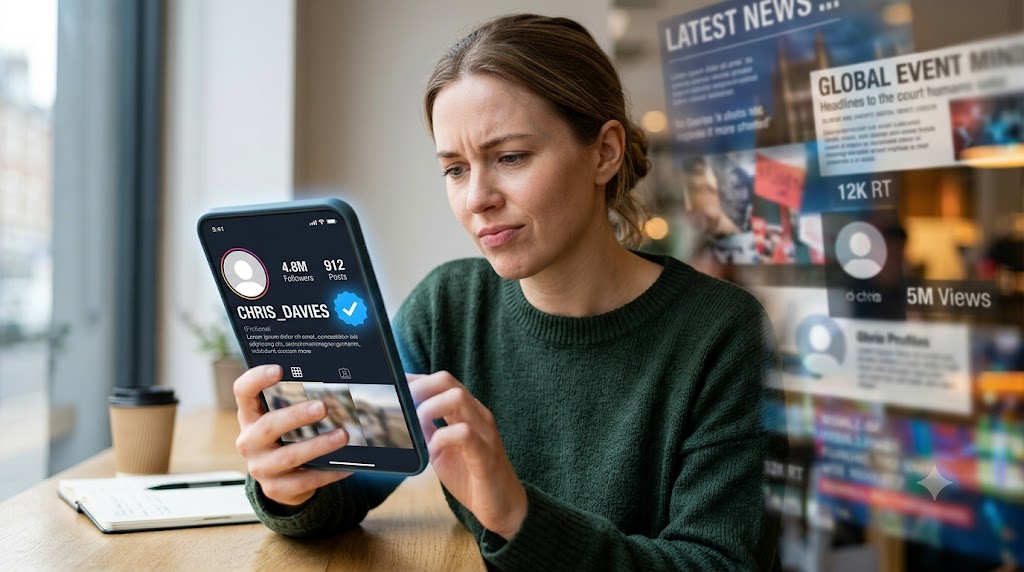
Somewhere along the way, a small blue badge next to a name became more convincing than facts, context, or common sense. See a blue tick, and the brain quietly relaxes. This must be real. This person must know what they are talking about. No proof needed. Just a symbol.
That small habit says a lot about how the human mind actually works, and it has very little to do with technology and everything to do with psychology.
The Badge That Was Never Meant To Mean “Trustworthy”
The blue checkmark started in June 2009, introduced by Twitter’s then-CEO Biz Stone, after a string of celebrity impersonation problems. Sports figures and public personalities were being faked online, and one high-profile lawsuit over a fake account pushed the platform to act. The badge was meant to answer one simple question: is this account really who it claims to be. It was never designed to say the person is smart, honest, or correct. It only confirmed identity.
Somewhere between 2009 and today, that meaning quietly expanded in people’s minds. A badge meant for identity slowly turned into a badge for credibility. That shift did not happen because platforms redefined it. It happened because human brains are wired to do exactly that.
Blame The Brain, Not The Badge
Psychologists call this pattern the halo effect, first named more than a century ago by psychologist Edward Thorndike in 1920. It is the tendency to assume that if one trait about a person is positive, other unrelated traits must be positive too. If someone looks official, the mind assumes they are also correct. If someone appears verified, the mind assumes they must be knowledgeable, careful, or honest. None of that is guaranteed by a checkmark, but the brain fills in the gap anyway, because doing so is faster than thinking things through.
There is also authority bias at play, a mental shortcut where people give more weight to information simply because it comes from a source that looks official or important. A blue tick quietly signals authority, even when the account behind it has no real expertise on the subject being discussed.
Add to this a very human trait: mental laziness, or more kindly put, cognitive efficiency. Verifying a claim takes effort. Checking sources, cross-referencing facts, and pausing to think all cost time and mental energy. A badge offers a shortcut. It lets the brain skip the hard part and jump straight to belief.
When The System Changed, The Trust Didn’t
The story became more complicated in late 2022, after Elon Musk’s acquisition of Twitter. The badge that once required proof of identity and notability became something anyone could buy for a monthly fee. By 2023, verification had shifted from an editorial check to a subscription feature under X Premium. A blue tick could now belong to a journalist, a business, a joke account, or someone with no connection to the identity they claimed.
Yet old habits did not disappear overnight. Even after the badge stopped meaning “verified as authentic,” many users kept reacting to it the way they always had. That gap between what a symbol used to mean and what people still feel about it is exactly why misinformation spreads so easily through verified-looking accounts. The badge changed. The instinct to trust it did not.
The Real Problem Isn’t The Tick, It’s The Shortcut
None of this makes people careless or foolish. It makes them human. Every single day, the brain processes far too much information to examine each piece carefully, so it relies on shortcuts, symbols, and signals to move faster. A blue tick is just one of many such signals, alongside things like a polished profile picture, a large follower count, or confident language. All of these create an impression of credibility that may or may not be backed by actual accuracy.
The fix is not to distrust every verified account or to assume every badge is meaningless. It is simply to separate two very different questions that the brain often merges into one: is this account real, and is this information correct. A checkmark can reasonably answer the first question. It was never built to answer the second, and no platform update will ever make it do so.
The next time a blue tick makes a claim feel instantly more believable, that reaction is worth noticing rather than acting on immediately. It is not proof of truth. It is simply the mind taking the easiest path available, choosing a badge over a pause, and a symbol over a second thought.
Subscribe Deshwale on YouTube
