




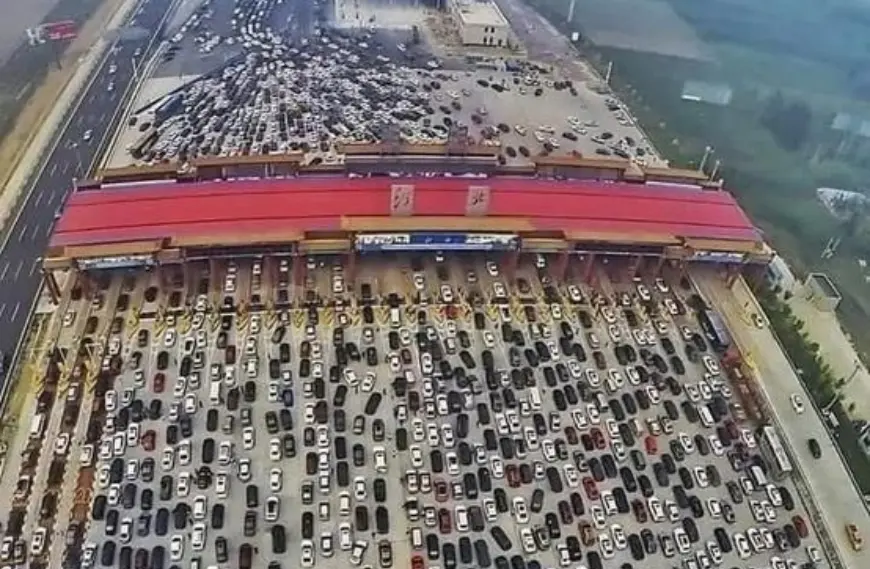
- Date: 14–26 August 2010
- Location: Beijing–Tibet Expressway (China National Highway 110)
- Length: 100 km (62 miles)
- Duration: 12 days
- Cause: Overloaded coal trucks, roadworks, breakdowns
- Impact: Thousands stranded, makeshift markets, inflated prices, health risks
- Legacy: A cautionary tale in urban planning and infrastructure stress
It began not with a crash, but with a crawl. On 14 August 2010, a stretch of China’s Beijing–Tibet Expressway transformed into a surreal tableau of immobility. Vehicles, mostly coal-laden trucks from Inner Mongolia, lined up for over 100 kilometres, inching forward at barely one kilometre per day. For twelve days, the highway became a purgatory of honking horns, frayed tempers and desperate improvisation. This was not just a traffic jam, it was a logistical apocalypse.
The jam’s epicentre lay on China National Highway 110, a vital artery connecting Beijing to the resource-rich north. The region had seen a surge in coal production, with over 730 million tonnes transported in 2010 alone. With rail capacity stretched thin, trucks became the default carriers. But the highway, designed for far fewer vehicles, buckled under pressure. Roadworks reduced capacity by 50%, and breakdowns compounded the chaos.
Drivers found themselves trapped in a slow-motion nightmare. Some slept under their lorries to guard against fuel theft. Others played cards or read books to pass time. A few, overcome by exhaustion and dehydration, required medical attention. The jam birthed a micro-economy: locals sold water at ten times the usual rate, instant noodles at triple, and cigarettes at near-luxury prices. Opportunism flourished, but so did desperation.
Authorities scrambled to respond. Over 400 police officers were deployed to manage the gridlock and curb theft. Trucking companies were asked to suspend operations or reroute. Eventually, traffic was halted on adjacent roads to prioritise clearance. By 26 August, the jam had dissipated, but not before leaving a scar on China’s infrastructure psyche.
Ironically, the jam was caused by trucks delivering materials to ease congestion. Roadworks meant to improve flow ended up paralysing it. The incident exposed the fragility of urban planning under industrial strain. It also highlighted the human cost of unchecked growth, drivers stranded without food, water or toilets, enduring what one might call jeevan ki sabse lambi rukawat.
Though Guinness World Records cites a 109-mile jam in France (1980) as the longest by distance, China’s 2010 standstill remains unmatched in duration and disruption. It wasn’t just a jam, it was a metaphor for modernity’s unintended consequences.
For Indian cities like Bengaluru, Delhi or Mumbai, where traffic is a daily ordeal, this tale offers sobering lessons. Infrastructure must evolve with demand, not lag behind it. Carpooling, public transport and smart logistics aren’t luxuries, they’re necessities. Otherwise, the next mega-jam might not be a distant headline, but a local reality.
