



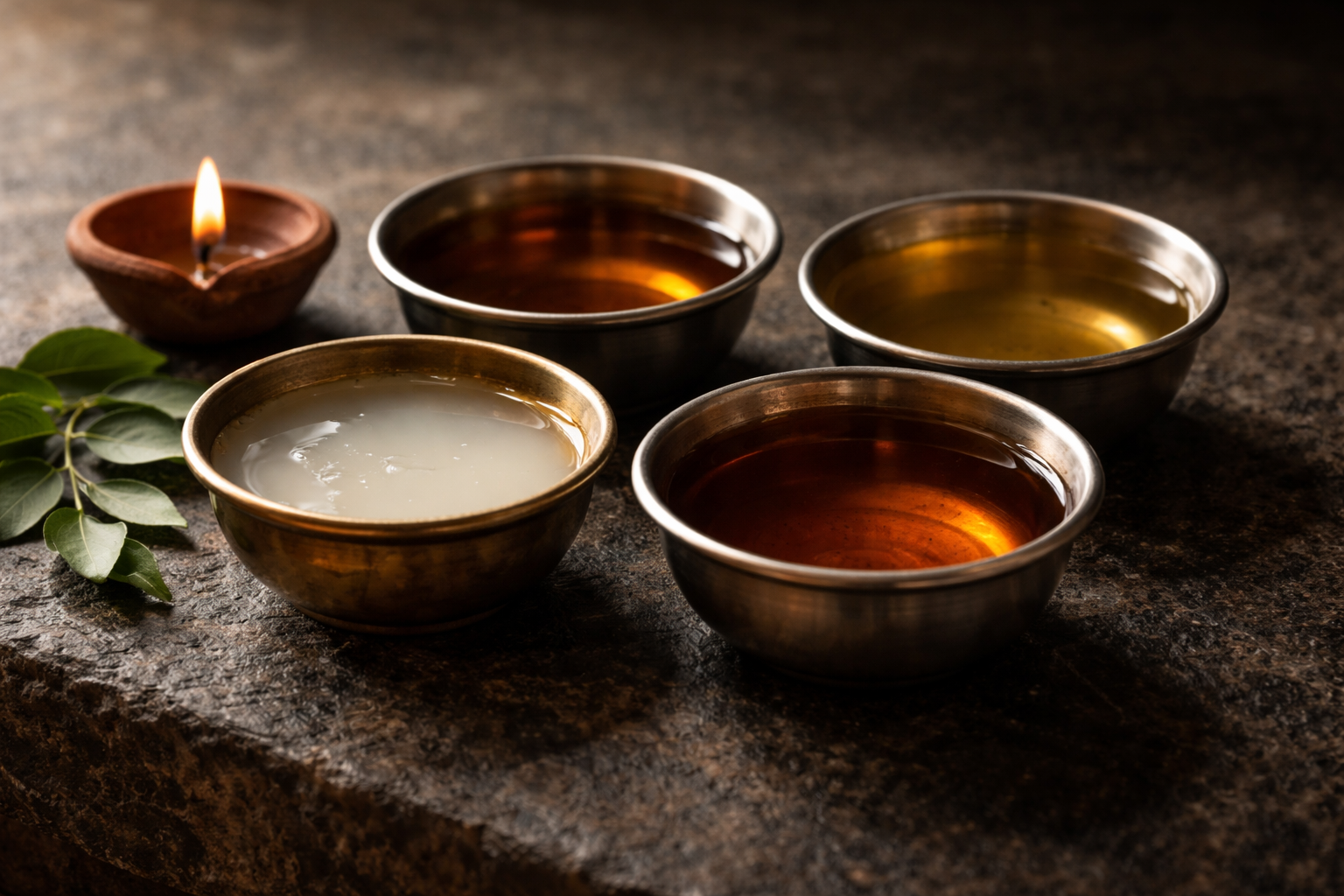
The story of Indian food does not begin with spices. It begins with oil.
In a modest kitchen in Kerala, coconut oil warms slowly in a steel kadai. Curry leaves crackle and release a bright green aroma. The scent is gentle but unmistakable. In Kolkata, mustard oil smokes briefly before fish touches the pan. The sharp smell fills the room. Someone coughs. That is normal. In Kolhapur, groundnut oil carries a fierce red chilli paste across a pan. The heat builds slowly and deeply. Elsewhere in North India, ghee melts into a ladle of cumin and garlic before being poured over Tadka Dal. The fragrance spreads quickly across the room.
Each kitchen is cooking the same thing in one sense: dinner. Yet the oil in the pan changes the entire grammar of the meal. It changes texture, aroma, and even the rhythm of cooking. India’s culinary diversity is therefore not just about spices or recipes. It is also about oils. Coconut oil, mustard oil, sesame oil, groundnut oil and ghee form the invisible foundation of regional cuisines.
In recent decades, however, some food historians and chefs have begun asking an interesting question. As North Indian restaurant cuisine spreads across the country, is one culinary style slowly becoming the national default? The answer is complicated. But the oil in the pan tells part of the story.
South India and the quiet intelligence of coconut and sesame oil
Southern cuisines rely on oils that complement acidity and fermentation. Coconut oil carries the flavours of curry leaves, coconut paste and mild spices without overwhelming them. Sesame oil appears often in tamarind-based gravies and lentil dishes, its deep, nutty aroma working beautifully with sour ingredients.
Classic dishes illustrate this clearly:
- Avial uses coconut oil to bind vegetables, yoghurt and coconut into a light, fragrant preparation.
- Thoran combines vegetables with grated coconut in coconut oil, creating a dry dish that is aromatic but never heavy.
These dishes are gentle on the palate. They depend less on thick gravies and more on balance. One cook in a small Kerala household once said something simple that stays in the mind: “The oil should support the vegetable. It should not shout.” She did not explain further. She just smiled and continued cooking. That quiet philosophy shapes much of southern food.
East India and the bold personality of mustard oil
Eastern India speaks a different culinary language. Mustard oil is the foundation of flavour in Bengal, Odisha and parts of Assam. It is sharp, pungent and slightly bitter. It wakes up the senses almost immediately.
The technique also differs from other regions. The oil is heated until it just begins to smoke, which reduces bitterness and releases a nutty fragrance. Signature dishes show how this works:
- Shorshe Bata coats fish in a mustard paste that becomes simultaneously creamy and sharp.
- Many Bengali fish preparations finish with a few drops of raw mustard oil, a technique that gives the dish its final, decisive punch.
The result is food that feels vibrant and alive. The flavour can surprise people encountering it for the first time. That is part of the charm.
West India and the versatility of groundnut oil
Western India sits at an interesting culinary crossroads. Groundnut oil dominates many kitchens, but coconut oil also appears along the Konkan coast. Groundnut oil has a high smoke point and a neutral flavour, making it ideal for slow cooking and frying.
In Gujarat, Undhiyu relies on groundnut oil to cook a mixture of winter vegetables, spices and fenugreek dumplings. The oil binds the flavours without overshadowing them. In Kolhapuri homes, groundnut oil is heated until it shimmers before a thick masala of dried coconut, red chilli and garlic is added. The oil carries the spice deep into the curry, bold but balanced. Along the Konkan coast, coconut oil returns in Malvani Fish Curry, bringing together fish, kokum and spices into a bright coastal preparation. These traditions remind us that western India contains several culinary identities within one geography.
North India and the richness of ghee and mustard oil
North Indian cooking draws strength from ghee and mustard oil. Ghee brings warmth and richness, coating spices and lentils with a deep aroma that many associate with comfort. In Tadka Dal, hot ghee releases the fragrance of cumin, garlic and red chilli before touching the lentils. Mustard oil plays an equally important role, appearing in Punjabi pickles where its sharpness preserves vegetables and intensifies flavour. These cooking traditions have travelled far beyond their regional homes.
The craft of the Ghani: a note on extraction
Before the industrial era, the quality of Indian oil was defined by the Ghani, a traditional cold-press system in which a heavy wooden pestle rotates slowly inside a stone or wooden mortar, driven by the weight of an ox. Unlike modern refinery processes, the Ghani involves no external heat. This cold-pressing keeps the volatile flavour compounds and nutrients intact, the heart of the seed preserved in every drop. The transition from the artisanal Ghani to high-heat industrial refining was the first step in the narrowing of the Indian palate.
The great health pivot: the demonisation of tradition
In the 1980s and 90s, the Indian kitchen faced a quiet revolution, one with deep international roots.
Its scientific origin lay in American physiologist Ancel Keys’ landmark Seven Countries Study, conducted between 1958 and 1970, which proposed a direct link between dietary saturated fat and coronary heart disease. The study’s conclusions, though later contested for methodological selectivity, gave the global edible oil industry a powerful commercial argument. As investigative food journalist Nina Teicholz documented in her extensively researched 2014 work, The Big Fat Surprise, the subsequent decades saw a coordinated and well-funded effort by vegetable oil interests, particularly in the United States, to displace traditional animal and tropical fats in kitchens worldwide. In Asia, including India, the American Soybean Association ran active trade promotion campaigns through the 1980s, encouraging the adoption of refined soybean and vegetable oils as modern, heart-healthy alternatives.
The impact on the Indian kitchen was direct and lasting. Ghee and coconut oil were labelled artery-clogging saturated fats. In their place, highly processed, heart-friendly refined vegetable and sunflower oils were marketed to the growing middle class. As food historian K.T. Achaya noted in his foundational 1994 work, Indian Food: A Historical Companion, traditional Indian oils carried not just nutritional value but deep cultural and regional identity, a dimension entirely absent from the industrially refined products that replaced them. These new oils were odourless, tasteless and colourless, designed to be invisible.
As neutral oils replaced regional fats, the distinct accents of Indian home cooking began to fade. The oil no longer added flavour; it merely provided a medium for frying. This shift created a blank canvas that inadvertently paved the way for a more standardised national taste.
The rise of the national default
This standardisation coincided with the post-1947 dominance of Punjabi and Mughlai restaurant culture. After Partition, Punjabi families who migrated to Delhi rebuilt their livelihoods through food, popularising tandoori meats and butter-heavy gravies. Restaurants such as Delhi’s Moti Mahal gave tandoori cooking and Butter Chicken national visibility. Over time, this restaurant cuisine became the template for what many Indians began to call North Indian food. Hotels across the country copied the model.
Because Delhi was also the nation’s political and media capital, national television channels, food writers and restaurant critics operated largely from the city. Their coverage naturally reflected what they saw around them. The result was subtle but powerful: Punjabi and Mughlai restaurant cuisine received a national platform that regional cuisines, however vibrant in their home states, rarely matched.
In the past three decades, large restaurant chains have further expanded this reach. Butter Chicken, paneer gravies and naan are now standard offerings in malls and airports across the country. You might find a mall in southern India where several outlets serve Butter Chicken. Finding Avial or Thoran is considerably harder. This is not always intentional. It is simply market logic.
Fact box: Population scale and culinary visibility
India’s population distribution shapes markets and restaurant demand.
- Uttar Pradesh: approximately 241 million (2026 projection)
- Bihar: approximately 131 to 133 million
- Madhya Pradesh: approximately 89 million
- Rajasthan: approximately 82 to 84 million
- Hindi Belt total: well over 400 million
By comparison:
- Southern states combined: roughly 250 to 260 million
- Eastern states: roughly 200 million
- Western states: roughly 180 to 190 million
Demography alone does not decide culture. But it certainly shapes markets and restaurant demand.
The Northeast, Central India and the Himalayan fringes
The Northeast extends the bold mustard oil tradition of the East but with a lighter, more restrained hand. In Assam, Nagaland, Manipur and beyond, cooks use mustard oil sparingly, often as a raw finish, to enhance rather than dominate. Dishes like Assamese maasor tenga and Naga smoked pork with bamboo shoots and fermented soybeans rely on smoking, fermentation and fresh herbs, keeping oil minimal to let fish, foraged greens and fiery chillies take the foreground.
In Central India, particularly among tribal communities of Madhya Pradesh and Chhattisgarh, forest oils like mahua, pressed from the seeds of the sacred mahua tree, add earthy depth to rustic pickles, snacks and simple vegetable preparations.
The Himalayan regions of Uttarakhand, Himachal Pradesh and Ladakh embrace mustard oil for its warming sharpness in cold climates, seen in dishes like aloo palda, and ghee for richness in rotis, dals and steamed breads like siddu. These areas reinforce India’s culinary plurality: familiar oils reshaped by each landscape into entirely distinct expressions.
Three moments from Indian kitchens
In a Tamil household, sesame oil meets tamarind and lentils in a simmering pot. The aroma is deep and slightly sweet.
In a Bengali kitchen, a cook adds two drops of raw mustard oil to steamed fish at the very end. The fragrance rises instantly, sharp, golden, alive.
In a Kolhapur home, groundnut oil carries a thick chilli masala across a pan until the kitchen grows warm with spice.
These are ordinary acts. Yet they contain centuries of culinary knowledge.
A quiet counter-movement
Food traditions do not disappear easily. They adapt, travel and return in new forms. Tiny toddy shops in Kerala serving Thoran with fresh coconut oil, bustling fish stalls in Kolkata finishing dishes with raw mustard pungency, and roadside stalls in Maharashtra frying vadas in groundnut oil continue to keep regional traditions alive, untouched by national trends.
Social media has also become a powerful amplifier. Home chefs, food bloggers and influencers are spotlighting forgotten recipes, hyper-local ingredients and heirloom techniques from Assam to coastal Karnataka. Growing health awareness has simultaneously driven demand for cold-pressed mustard, coconut, sesame and groundnut oils, celebrated for their nutrient retention and alignment with traditional Indian cooking. These forces are slowly broadening visibility, ensuring quieter traditions reclaim space in the national conversation.
One concluding thought
India was never meant to cook with one oil or one spice grammar. Its strength has always been its culinary plurality. Coconut oil, mustard oil, sesame oil, groundnut oil and ghee each carry the memory of a landscape and a people.
When a kitchen loses that plurality, it does not become national. It simply becomes narrower.
Somewhere tonight, in thousands of homes across the country, oil is heating in pans. Each kitchen smells a little different. That difference is the real taste of India.
Subscribe Deshwale on YouTube
