




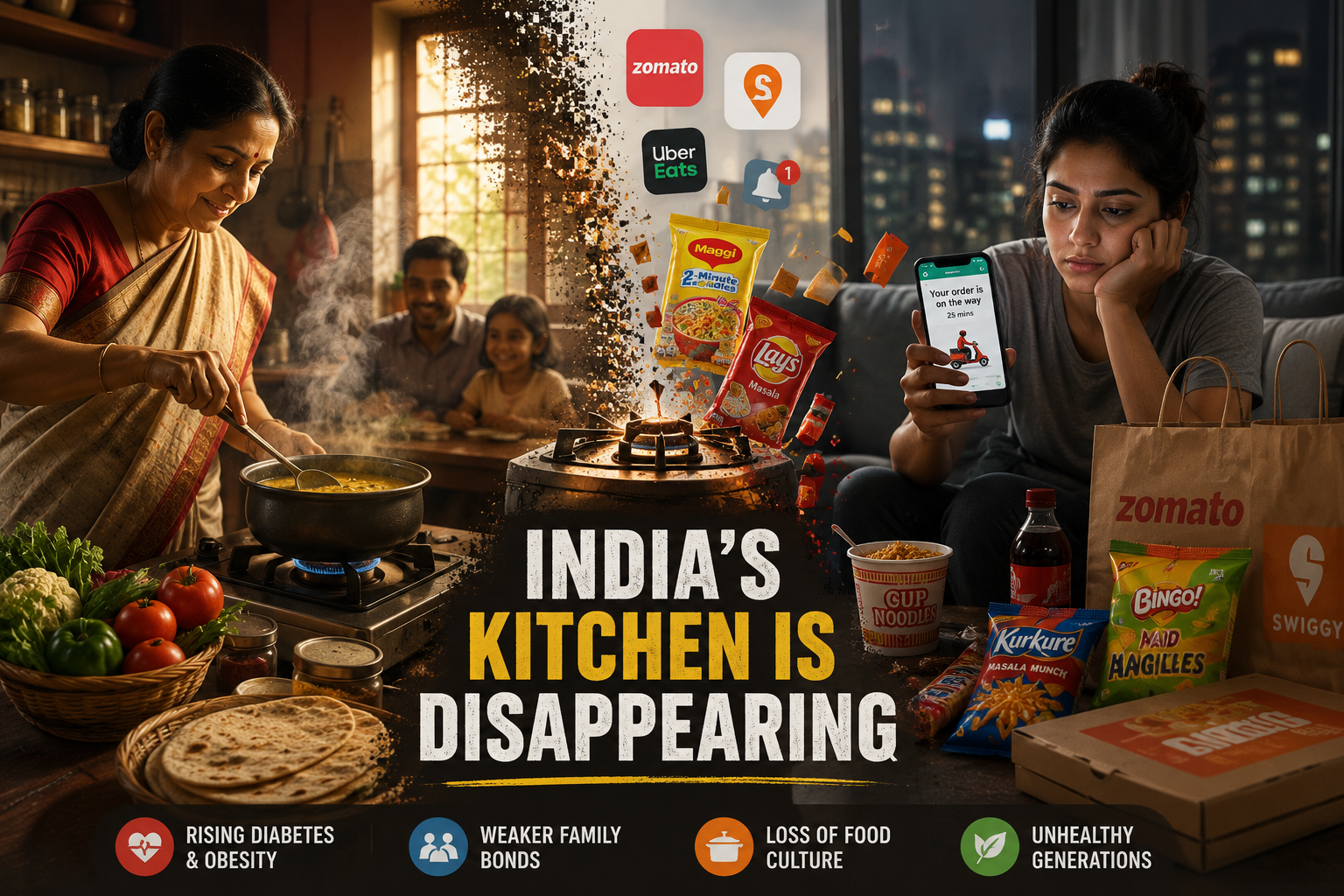
Ultra-processed food sales have exploded across Indian cities. Here is what that means for our health, our families, and the dal that is no longer simmering on the stove.
On a Tuesday evening in Bengaluru, Sneha Iyer gets home at 8:30 PM. She has back-to-back meetings behind her and a school lunch box to pack for tomorrow morning. Her mother used to have dinner on the table by 7. Sneha opens an app instead. Within 25 minutes, dinner arrives hot, decent, and entirely someone else’s problem.
“I feel guilty sometimes,” she admits. “But after a ten-hour day, the last thing I want to do is stand in the kitchen for an hour.”
Sneha is not an exception. She is a statistic. And the numbers tell a story that India’s food industry knows very well, even if the rest of us are only beginning to pay attention.
A forty-fold explosion
In 2006, India’s retail sales of ultra-processed foods, packaged snacks, instant noodles, sugary drinks, biscuits, ready-to-eat meals stood at just $0.9 billion. By 2019, that number had ballooned to nearly $38 billion. That is a forty-fold rise in just over a decade, the fastest growth in ultra-processed food (UPF) sales of any country in the world, according to a three-paper series published in The Lancet in November 2025.
Walk into any kirana store in Mumbai or any supermarket in Delhi today, and the shelves tell the same story. The namkeens, instant soups, chip packets, tetra-packed juices, there is more of it every year, it is cheaper than ever, and it is designed to be very, very difficult to stop eating.
India’s online food delivery sector is growing at nearly 28 per cent annually, according to market estimates, and Zomato and Swiggy alone control over 90 per cent of India’s organised food delivery market. What used to be an occasional treat has quietly become a daily habit for millions of urban households.
The kitchen is quietly dying
According to figures from the Ministry of Statistics and Programme Implementation (MoSPI) and an ICICI Securities report from 2024, urban elite households in India spent nearly 50 per cent of their monthly food budget on packaged food, dining out, and food delivery in FY23. A decade ago, that share was 41.2 per cent.
For middle-income urban households, the shift is even sharper. Their spending on processed food and beverages as a share of total food expenditure jumped from 16 per cent to nearly 25 per cent over the same ten years. In absolute terms, spending on processed food rose by 330 per cent for middle-income households in a decade.
The ICICI Securities report described it plainly: for the top five per cent of India’s urban households, there has been a reduction in absolute spending on staples. “The kitchen,” the report noted, “is slowly dying for elite urban households.”
Long working hours, smaller nuclear family units with no one to cook, and the explosion of quick commerce apps delivering groceries in ten minutes together, these forces are steadily pulling Indians away from the stove. The trend, MoSPI data shows, has been building for at least a decade, and it is not slowing down.
The health bill is already arriving
India currently has over 101 million people living with diabetes, according to the ICMR-INDIAB national study the largest diabetes population of any country in the world. A clinical trial by the ICMR and the Madras Diabetes Research Foundation, published in 2024, directly linked consumption of ultra-processed and fried foods to India’s escalating diabetes crisis. The study identified harmful compounds found in bakery products, packaged snacks, and processed meats as key contributors to inflammation and insulin resistance in the body.
The Lancet series drew the connection starkly. During the same years that UPF sales rose forty-fold in India, obesity rates doubled among men from 12 per cent to 23 per cent, and among women from nearly 15 per cent to 24 per cent. The ICMR’s own updated Dietary Guidelines for Indians, released in May 2024, specifically warned people to minimise high fat, high sugar, and ultra-processed foods.
Yet the warnings are competing against billion-dollar advertising budgets. UPF brands spend heavily on celebrity endorsements, social media influencers, and campaigns targeting children and teenagers precisely the demographic that Mintel’s 2025 India report identifies as driving the sharpest growth in instant noodle consumption. According to Mintel, instant noodles are now firmly mainstream among Gen Z consumers, consumed not just as a quick meal but as an all-day snack, for late-night eating, and on social occasions.
The ₹15 packet and the ₹500 grocery run
There is a reason packaged food is winning and it is not just convenience. It is economics.
A packet of instant noodles costs ₹15. A bag of chips, ₹20. A tetra pack of juice, ₹30. These are impulse-buy prices, engineered to feel harmless. Meanwhile, cooking a proper meal in an Indian city requires time which is expensive when both partners work and fresh produce that goes bad quickly in small urban apartments with limited storage.
Single-serve packets, designed for one person and one meal, led the Indian instant noodles market in 2024, contributing 62.82 per cent of total category value, according to data from Mordor Intelligence. These products are built for bachelors, students, and time-pressed working couples. They are not an occasional treat. For many, they are simply dinner.
The loss of the home kitchen is not only a health story. It is a cultural one. The act of cooking has always been central to how Indian families pass on identity regional recipes handed from grandmother to daughter, the particular way a Tamilian family makes rasam, the muscle memory of rolling rotis at 6 AM. These are not just meals. They are living documents of who people are and where they come from.
As packaged food replaces home cooking in city after city, those documents are getting harder to read. Children growing up in households where the stove rarely gets used are not learning to cook. The recipes are not being passed on. The smells are not becoming memories.
Prof. Srinath Reddy, Chancellor of the PHFI University of Public Health Sciences and co-author of the Lancet series, put the problem bluntly: “The traditional meals are being fast replaced by hyper-palatable industrial UPF products via aggressive marketing and advertisement campaigns.” He called for a ban on UPF advertising, at least between 5:30 AM and 9:00 PM, and mandatory front-of-pack warning labels that clearly communicate harmful levels of salt, sugar, and fat.
A shift that will not reverse itself
India is not the first country to go through this transition. Japan, South Korea, Brazil all watched their food cultures transform under the pressure of urbanisation, long working hours, and the convenience economy. In most cases, the shift only deepened over time.
What India has is the awareness of what is coming and the chance to act on it. The ICMR guidelines, the Lancet warnings, FSSAI’s ongoing push for front-of-pack labelling: these are signs that policymakers understand the problem. Whether they move fast enough is the real question.
For now, in millions of city apartments, the answer to “What’s for dinner?” is increasingly a tracking notification and a delivery partner’s knock on the door. The dal is not simmering. The stove, some nights, does not turn on at all.
Subscribe Deshwale on YouTube
