



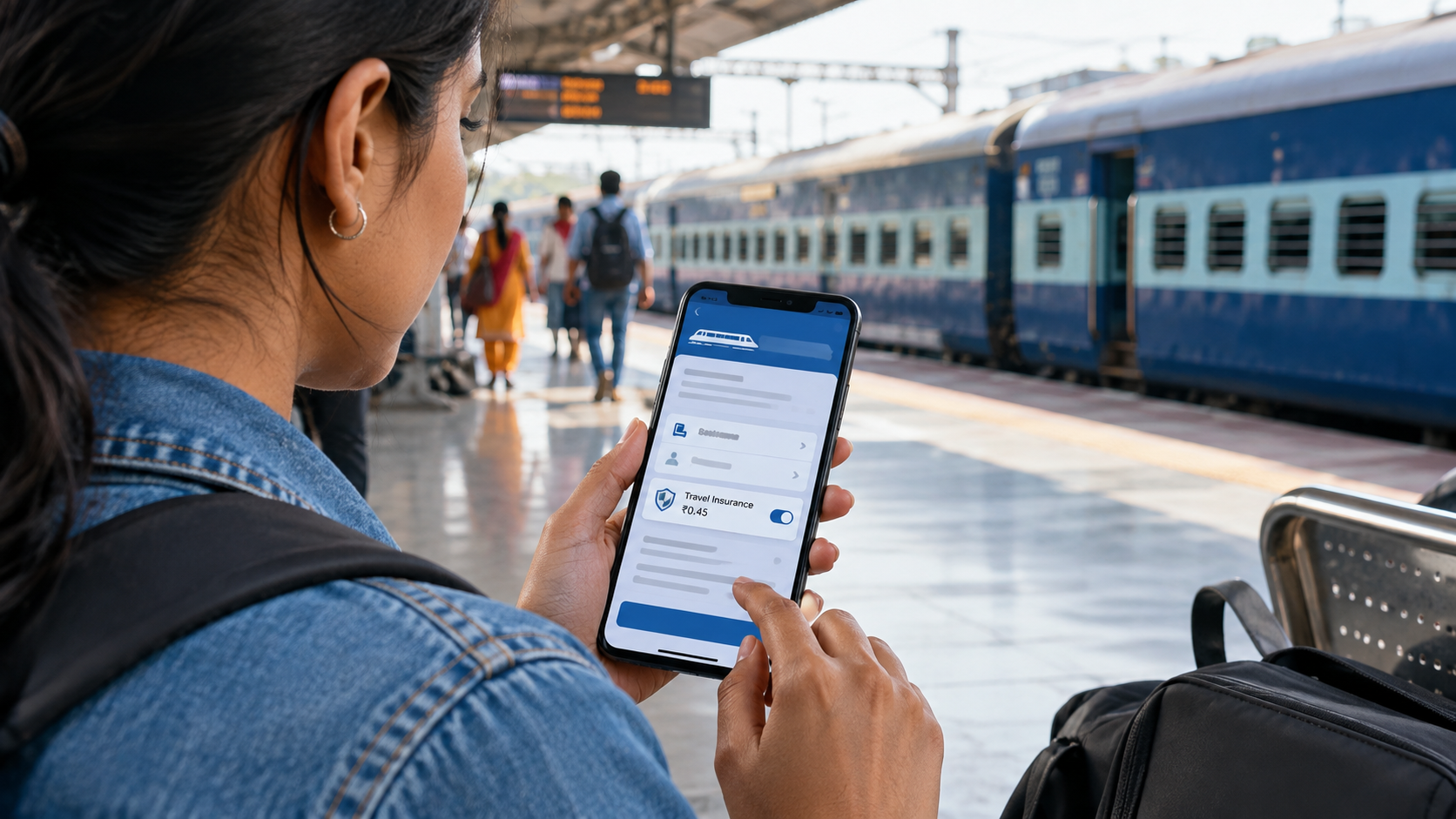
When you book a train ticket on IRCTC, a small box asks if you want travel insurance. At present, the price is 45 paise per passenger, taxes included. It is so small that most people either tick it without a thought or skip it without a thought.
For that amount, the scheme promises up to ₹10 lakh. So does it really pay? The honest answer is yes, but only in a narrow set of situations. Knowing those situations decides whether the 45 paise is a smart spend.
The product is called the Optional Travel Insurance Scheme, and Indian Railways offers it with partner insurance companies. It is available only on e-tickets booked through IRCTC, and only for confirmed, RAC and part-confirmed tickets, so a waitlisted passenger cannot buy it. Children below five are not covered, while children aged five to eleven are.
The payouts are fixed. The nominee gets ₹10 lakh in case of accidental death, and a passenger who suffers permanent total disability also gets ₹10 lakh. Permanent partial disability is covered up to ₹7.5 lakh, depending on the injury. Hospital expenses for injuries are covered up to ₹2 lakh, and this is paid in addition to the death or disability benefit. There is also ₹10,000 for carrying the mortal remains home.
How can a policy cost less than a rupee and still offer lakhs? The cover lasts only for one journey, not a full year. It is also spread across millions of passengers, and most of them reach their destination safely and never make a claim. Insurers price the cover on that probability, so it works like a group accident policy, not a personal one.
What exactly does it cover? The trigger is an accident linked to the train journey. This includes train accidents such as derailments and collisions, and the “untoward incidents” defined in the Railways Act, such as a terrorist attack, a violent attack, robbery, rioting or an accidental fall from a train. The policy wording also covers the process of boarding and getting off the train.
What it does not cover is just as important. This is not health insurance. If you get a fever, suffer a heart attack unrelated to an accident or die a natural death on the train, there is no claim, because the cover is only for accidents and untoward incidents. Suicide and self-inflicted injuries are excluded, and so are accidents under the influence of liquor or drugs or while breaking the law with criminal intent. Missing a train is not an insured event, and injuries before the journey begins or after it ends fall outside the cover.
Many passengers do not know that Railways pays compensation of its own. Under the Railways Act, a passenger injured or killed in a train accident or an untoward incident is entitled to statutory compensation, and the victim does not have to prove that the Railways was at fault. After a 2016 amendment, the amount for death is ₹8 lakh, and for injuries it varies with their seriousness. Claims go to the Railway Claims Tribunal. This law-based compensation is separate from the insurance, which is a private contract. After the 2017 Utkal Express derailment, a senior railway official said the Railways pays its own compensation and ex gratia apart from the insurance cover. So the insurance can be seen as an extra layer, though it is wise to ask the insurer how the two payments interact.
Claiming is where many people struggle. You do not claim from IRCTC. The passenger, nominee or legal heir must approach the insurance company’s nearest office within four months of the incident. The documents include a claim form, a report from the railway authority confirming the accident or untoward incident, photo ID and bank details. A death claim is paid only to the nominee named at the time of booking, and if no nominee was named, the legal heir has to prove their claim with legal papers. The policy says the insurer should pay within 15 days of receiving all documents. One insurance expert told India Today that claims are often rejected for a missing railway report, incomplete paperwork or a missed deadline.
That makes the nominee step important. Passengers should fill in nominee details when asked after booking. It is easy to ignore, but in a fatal accident it decides who receives the money.
Is it worth taking? Experts quoted by India Today are divided. Someone with a comprehensive personal accident policy may find it largely redundant. But because the price is so low, others see it as a useful extra safety net, especially for dependents.
So, does railway insurance under Re 1 really pay? Yes, if an insured passenger suffers a covered accident and the family files the right papers on time. It will not pay for illness, a missed train or an accident outside the journey. For 45 paise, it is a cheap safety net, not a complete shield.
Subscribe Deshwale on YouTube
