



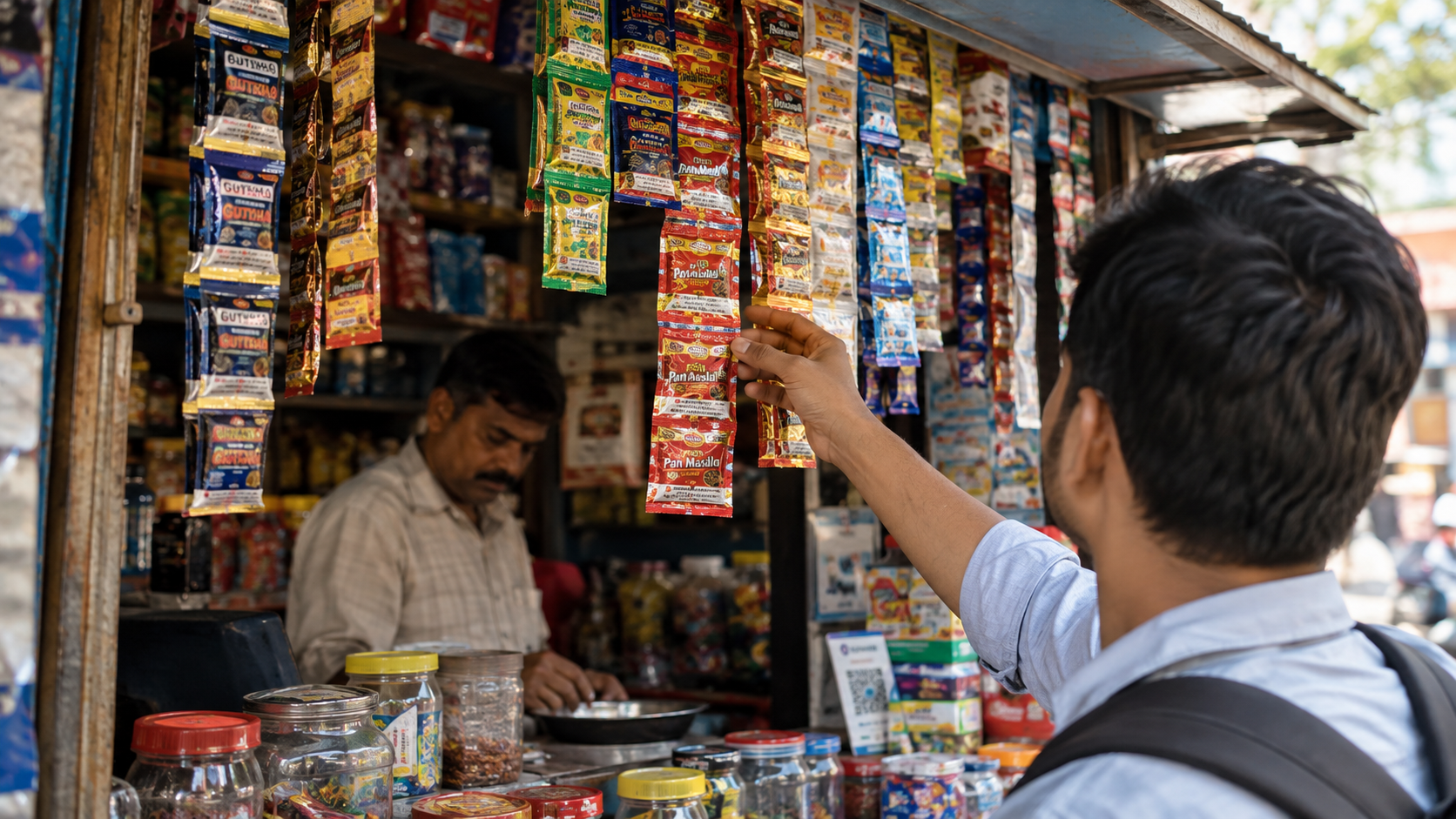
Walk past any paan shop in an Indian town and you will see small sachets hanging in bright strips. The shopkeeper rarely needs to ask what the customer wants. Both of them already know. This is odd, because gutkha has been banned in India for more than a decade.
A new study in The Lancet Global Health has brought the problem back into focus. It estimates that chewing tobacco contributed to about 251,000 deaths worldwide in 2023, with South Asia accounting for roughly 84 per cent of them. India is among the ten countries that carry more than 90 per cent of the global health burden. One caution: the study counts total deaths and disability, so a populous country can rank high even if its rate is not the highest, and it covers chewing tobacco in general, not gutkha alone. A ban meant to protect people has not removed the product from everyday life.
The ban began in 2011, when India’s food safety regulator ruled that tobacco and nicotine cannot be used as ingredients in any food product. Gutkha is sold as food, so this rule became the legal base for action. From 2012, states began issuing their own bans, and in time every state and Union Territory had one. On paper, it looked like the end of gutkha. In reality, it was the start of a long game of hide and seek.
Manufacturers adapted fast. Instead of one sachet with everything mixed together, they began selling two: pan masala without tobacco, and flavoured chewing tobacco. The two were often sold together by the same vendor, and the customer simply mixed them on the spot. The Supreme Court took note of this trick in 2016 and told the authorities to enforce the law. Many states have since written orders that also cover products sold separately but meant to be mixed. Even so, such sachets are still easy to find, which suggests the real trouble lies less in the wording of the law and more in how it is carried out.
Enforcement is the bigger problem. Bans are checked mostly by food safety officers and local police, who must cover thousands of small shops, kiosks and street vendors. Action does happen. Maharashtra says it seized banned items worth about ₹531 crore and registered nearly 10,000 FIRs between 2012 and 2026. But the sachets are small and cheap, demand is steady, and each state has its own order, which makes a national clampdown hard.
Laws can remove a product from a shelf, but they cannot easily remove a habit from a life. In many communities, chewing tobacco is part of the day. It is offered after meals, passed around at weddings and shared among friends and co-workers. The study’s authors say prevention must reflect the cultural and social factors that shape tobacco use, which is exactly what a simple ban overlooks. A person who wants to quit also needs counselling and medical support, which can be hard to find in small towns and villages, and a ban without a way out leaves people with the same craving.
Is the ban a complete failure? To be fair, no. India’s second Global Adult Tobacco Survey, held in 2016-17, found that about 21.4 per cent of adults, or roughly 199 million people, used smokeless tobacco. The first survey, in 2009-10, had put the figure at 25.9 per cent. So use has gone down. But the fall is slow, the number is still enormous, and that survey is now nearly a decade old. The global study points the same way: despite decades of tobacco control, worldwide use of chewing tobacco has barely changed.
Behind these numbers are real patients. The study found that stroke and cancers of the lip and oral cavity make up much of the health loss from chewing tobacco. Tobacco is a leading cause of these cancers, and India has the world’s highest numbers: about 144,000 new cases and nearly 80,000 deaths in 2022, according to GLOBOCAN. Treatment can mean surgery that changes how a person eats, speaks and looks. For poor families, the cost of care can be as heavy as the disease.
So what could work better? The first step is strict, uniform enforcement of the existing orders, including those that cover separately sold packs, so that the twin-sachet trick stops being profitable. Higher taxes would make chewing tobacco less cheap, and tougher penalties for manufacturers and distributors, not only small shopkeepers, would give enforcement real force. Affordable quit support through primary health centres, helplines and community workers matters just as much. Finally, awareness campaigns should speak to specific groups, such as young men, rural women and labourers, instead of sending one message to everyone.
India did the right thing by naming gutkha as a danger. But a ban is only the first step, and it works only when it is backed by strict enforcement, fair pricing and real help for people who want to quit. Until then, the sachet will keep hanging in the shop, and the cost will keep showing up in hospital wards.
Subscribe Deshwale on YouTube
