



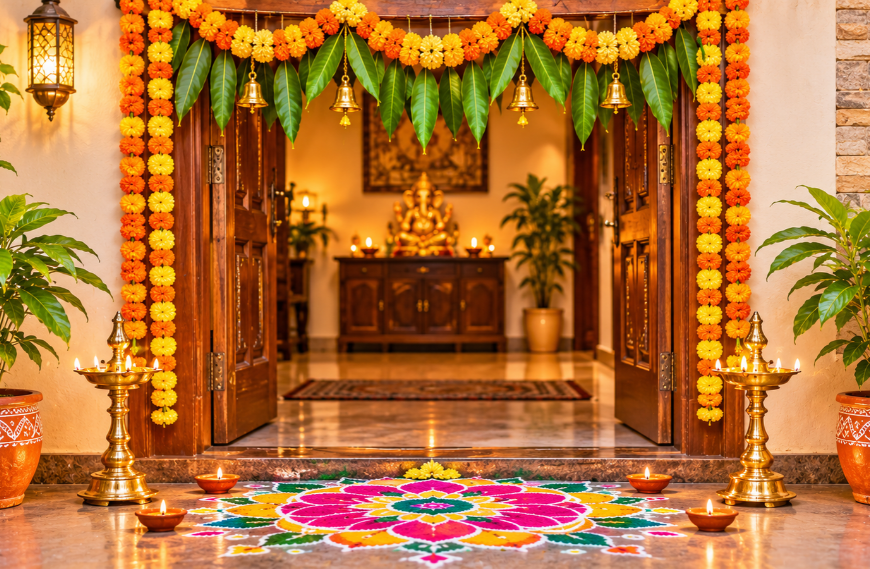
Before a festival begins, something interesting happens outside many Indian homes. Someone cleans the entrance, another person arranges fresh flowers, mango leaves are tied together, and colourful rangoli patterns appear on the floor. Sometimes, a small lamp is placed near the doorway.
These preparations may look simple, but they carry a meaning that goes beyond decoration. In Indian homes, the entrance is often treated as the first place where a celebration begins. It is where guests arrive, families welcome happiness and familiar traditions find their place in everyday life.
But have you ever wondered why decorating the doorway became such an important part of Indian celebrations?
The Doorway Is More Than Just an Entrance
In Indian traditions, the main entrance of a home holds a special place. It connects the outside world with the family’s private space. Therefore, preparing it for a festival or an important occasion is often seen as a way of welcoming something good into the home.
For many Hindu households, a decorated entrance is associated with auspiciousness, prosperity and positive beginnings. It is also connected with the traditional belief of welcoming Goddess Lakshmi, who is associated with wealth and prosperity.
This is one reason why people take special care to clean and decorate their entrances before Diwali, weddings, housewarming ceremonies and other celebrations.
Why Mango Leaves and Marigold Flowers?
One of the most familiar decorations is the toran, a decorative hanging placed above the main doorway. Traditionally, torans were made using fresh mango leaves, flowers and other natural materials.
Mango leaves hold an important place in several Indian religious and cultural ceremonies. They are often associated with auspicious beginnings, freshness and prosperity. Marigold flowers, with their bright yellow and orange colours, add a festive appearance and are widely used in religious decorations.
Over time, the traditional toran has also taken different forms. In Gujarat, embroidered torans made with colourful threads, mirrors and decorative patterns are a familiar part of home decoration. In other places, people use flowers, fabric, beads and other locally available materials.
The materials may change, but the purpose remains familiar: to make the entrance feel welcoming and ready for a special occasion.
Rangoli: A Welcome Drawn on the Ground
Look down at the entrance of many Indian homes during festivals, and you will often find another beautiful tradition: rangoli.
Made with coloured powders, rice flour, flower petals or other materials, rangoli turns an ordinary entrance into a small piece of art.
Interestingly, this tradition has different names across India. It is known as rangoli in Maharashtra and Gujarat, kolam in Tamil Nadu, alpana in Bengal, mandana in Rajasthan and muggu in Andhra Pradesh.
The designs and methods vary, but the underlying idea often connects with welcoming auspiciousness and inviting prosperity into the home. In some traditions, rice flour is also used as a way of offering food to small creatures such as ants and insects.
For the person making it, rangoli is not just about creating a colourful pattern. It is an expression of care, creativity and participation in the celebration.
Every Region Adds Its Own Touch
India does not have just one way of decorating a doorway. Every region brings its own materials, colours and artistic traditions.
In Maharashtra, families may decorate entrances with mango leaves, flowers and rangoli, especially during festivals such as Gudi Padwa and Ganesh Chaturthi.
In Gujarat, colourful embroidered torans, often decorated with mirrors and traditional patterns, bring a distinctive charm to the entrance. In South India, fresh mango-leaf decorations and kolam designs are common sights during festivals and special occasions.
During weddings, some communities also decorate entrances with flower arrangements and traditional symbols to welcome the bride, groom and guests.
These differences show how the same simple idea of welcoming a special occasion has developed into many beautiful regional expressions.
A Tradition That Begins with People
Perhaps the most beautiful part of this tradition is not the decoration itself, but the people behind it.
Think about a family preparing for Diwali. Someone is cleaning the main door, children are helping with rangoli, elders are arranging flowers, and someone is carefully hanging the toran. These small activities often become memories that stay with the family long after the festival ends.
Even today, when ready-made decorations are easily available, many families prefer making their own rangoli or hanging fresh flowers. Some traditions have changed with modern lifestyles, but the feeling behind them continues.
A decorated doorway does not necessarily require expensive materials or elaborate designs. Sometimes, a few flowers, fresh leaves and a simple rangoli are enough to make a home feel ready for a celebration.
And perhaps that is the real beauty of this Indian tradition. Before welcoming guests inside, families prepare their doorways to welcome the occasion itself. It is a small gesture that carries a much bigger message: every special beginning deserves a warm welcome.
Subscribe Deshwale on YouTube
