



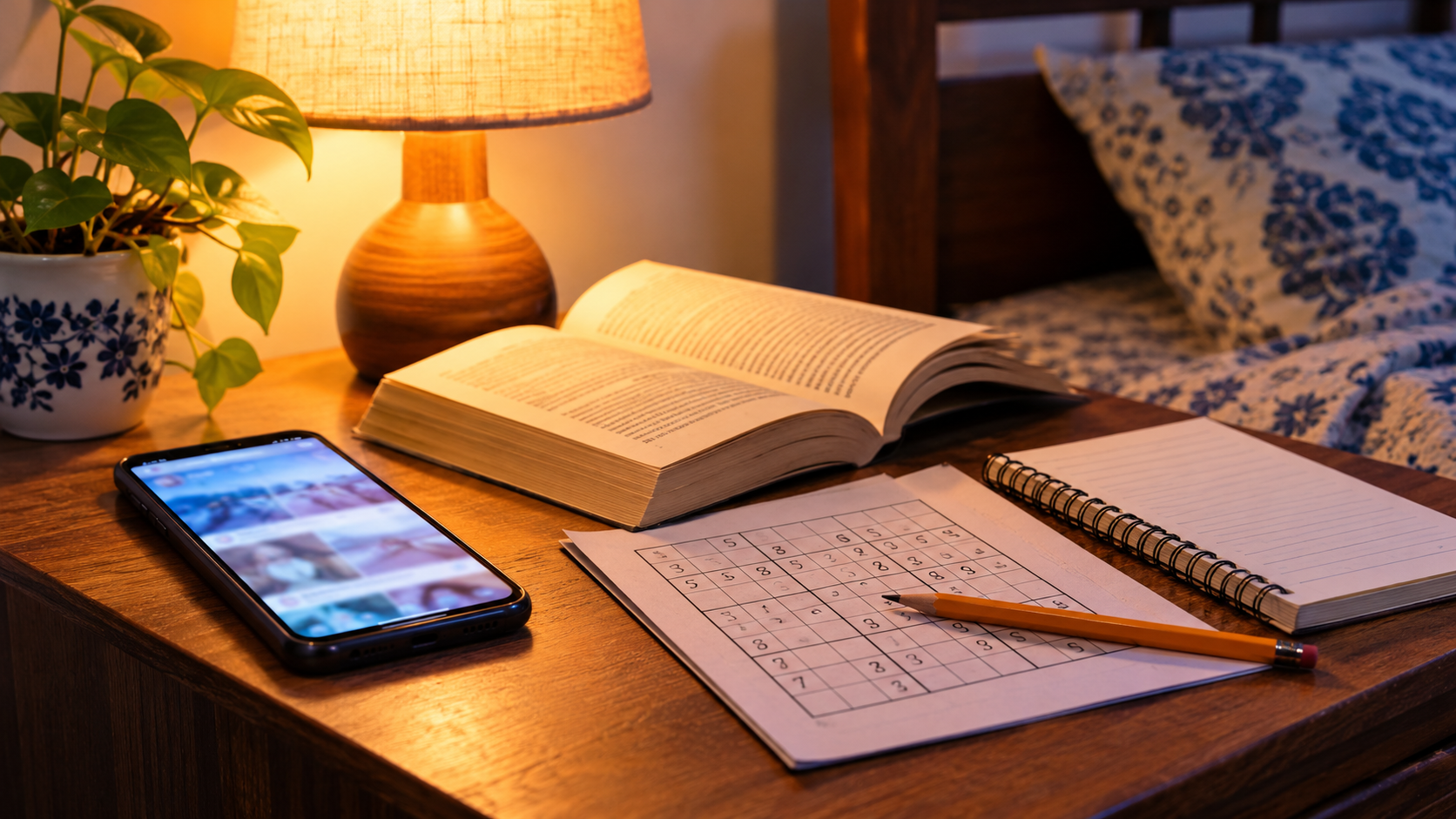
It is 11 pm. You promised yourself an early night. Instead, your thumb keeps moving, from a biryani recipe to a cricket clip to a stranger’s morning routine. Most of us know this feeling well. Now a TikTok trend claims there is a simple fix: brain stacking.
Brain stacking means keeping a small pile of offline activities within easy reach. It could be a novel, a journal, a Sudoku book or a crossword. When you feel the urge to open an app, you pick something from the pile instead.
The trend is credited to Mandy Rulez, a creator from Indiana in the United States. She films herself at the library, spending a fixed amount of time on each activity. Many others have since shared their own stacks, usually as part of morning or bedtime routines. It looks calm and pretty, which is a big reason it spread. In truth, the idea is not new. Many of us grew up around a version of it: the newspaper crossword, a Chandamama or Amar Chitra Katha comic, a Sunday game of chess.
But is the scrolling problem real? Yes, and the research is worth knowing. In 2025, a team from Griffith University in Australia published a large review in the journal Psychological Bulletin. It combined 71 studies covering 98,299 people. Heavier use of short videos, such as those on TikTok, was linked with weaker attention and weaker self-control. One detail stands out. Hours alone told a weaker story. Compulsive use, where a person finds it hard to stop, showed a stronger link with poorer thinking skills. So the real issue may be how we scroll, not only how long. There is a catch, though. Most of these studies show a link, not a cause, and many relied on people rating their own attention. Someone who already struggles to focus may simply scroll more. The arrow could point either way.
Now comes the bigger question: do puzzles really sharpen the mind? This is where the trend gets ahead of the science. A large study called PROTECT, run by the University of Exeter and King’s College London, looked at more than 19,000 adults aged 50 to 93. The more often people did crosswords or number puzzles like Sudoku, the better they scored on tests of attention, reasoning and memory. On some tests, regular puzzle-solvers performed like people eight to ten years younger. That sounds exciting, but read the fine print. It was a snapshot in time. The researchers said it could not prove that puzzles caused the better scores. Outside experts noted that people with sharp minds may simply enjoy puzzles more, while those whose memory slips may give them up. UK reviewers of the study also noted that evidence for crosswords, Sudoku and brain-training is still not strong. Also, those volunteers were all over 50. We cannot assume the same results for a 25-year-old with a Sudoku book.
Many people also hope puzzles can protect against dementia. The honest answer is that we do not know yet. In 2024, the Lancet Commission, a panel of leading experts, said that tackling 14 risk factors could, in theory, prevent or delay about 45 per cent of dementia cases. The list includes less education, hearing loss, physical inactivity and social isolation. Puzzles are not named on it, but the Commission does advise staying mentally active in midlife. Even so, brain health is also shaped by movement, good hearing and time with other people, not only by what is in your stack.
So, does it work? Here is a fair answer. Brain stacking will not turn you into a genius, and the evidence does not yet show that a pile of books and puzzles repairs attention. As far as we know, no study has tested brain stacking itself. But it may still help, for a simpler reason. It changes what your hand reaches for. Think of a water bottle on your desk. You do not drink more water because you studied hydration. You drink more because it is right there. A brain stack works the same way. Swapping a habit you cannot control for one that is calmer and slower is a reasonable bet, and it costs very little.
Some will roll their eyes and call it a show for the camera. Rulez herself has acknowledged that the trend can look performative. Yet she feels the benefits remain: less doomscrolling and more time with books, puzzles and the library.
If you want to try it without pressure, start with what you already own, such as a half-read book or an old notebook. Keep it where your phone usually sits, and keep the phone in another room if you can. Begin with ten minutes after dinner or with your evening tea. Pick activities you enjoy, because a stack you dislike will only gather dust. If some nights the phone wins, do not worry. The aim is not perfection. It is a little more control over your own time.
Brain stacking is not a miracle cure. It is a small, kind nudge away from the scroll. Sometimes, that is enough to begin.
Subscribe Deshwale on YouTube
