



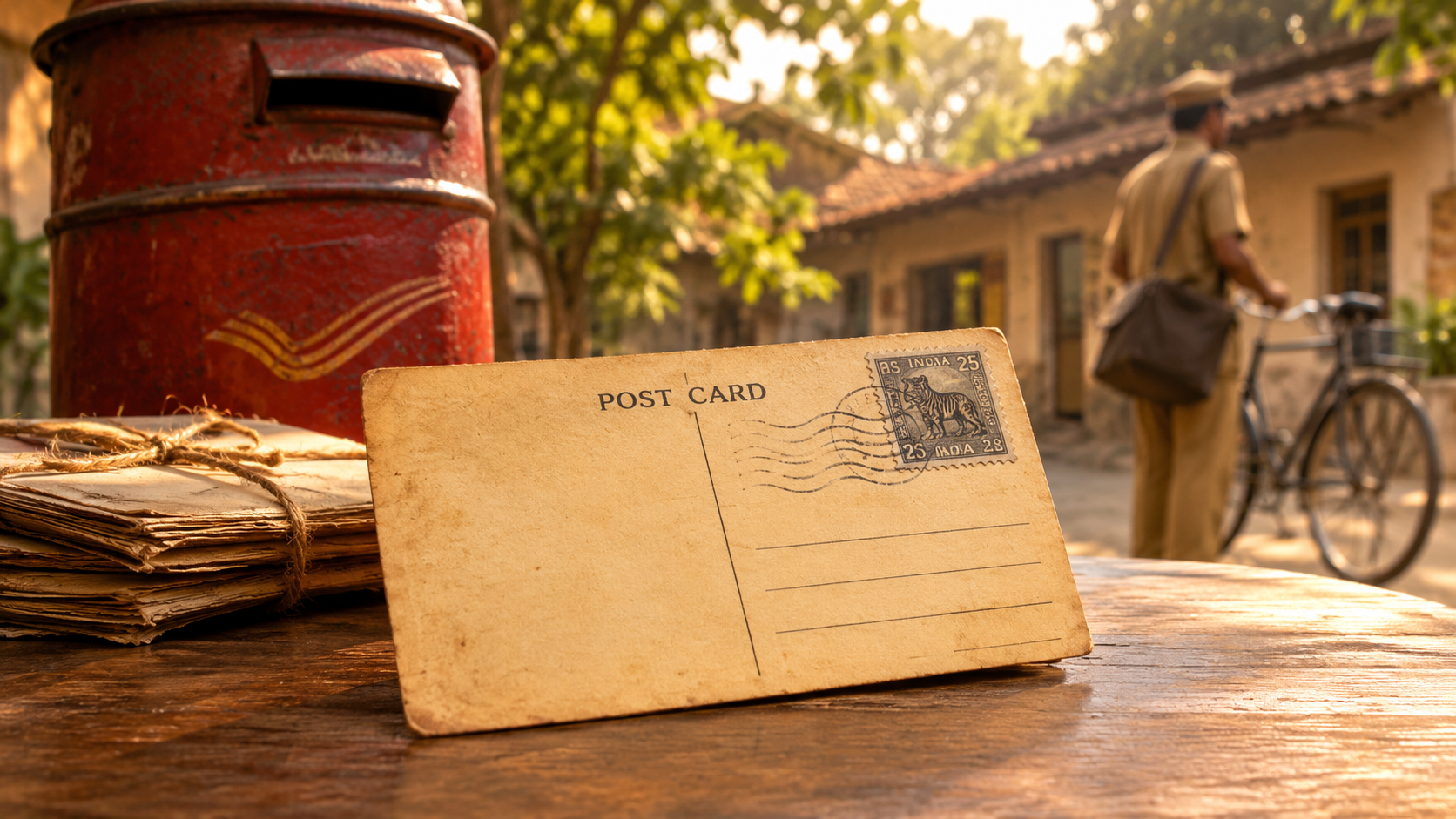
Imagine sending a message and then waiting days for a reply. No blue ticks, no “typing…”, no “last seen”. Just a postman, a cycle bell and a lot of hope. For generations of Indians, this was normal. And for millions, the humble postcard did the job that WhatsApp does today.
The postcard reached India on 1 July 1879, about ten years after the world’s first official postcard was issued in Austria-Hungary. It cost a quarter of an anna, which was only one-sixty-fourth of a rupee, and it could travel anywhere in British India. People loved it. By 1883, around 26 million postcards were being sold in the country every year. It was cheap, short and simple, which is exactly what everyday news needs.
Picture a postcard arriving at a family home. Someone reads it aloud, and everyone gathers around to listen. The reply is written together, with a line from each person. In many ways, it worked like a family group chat.
Behind the postcard stood a growing postal system. India’s modern postal service took shape with the Post Office Act of 1854. At the time of Independence, the country had 23,344 post offices. Today, India Post runs more than 1.6 lakh of them, which makes it the largest postal network in the world. In 1972, a six-digit PIN code arrived. It was introduced on 15 August by Shriram Bhikaji Velankar, a senior official in the Ministry of Communications, to speed up mail sorting.
A postcard had no envelope, so it was never truly private. The postman, a neighbour or a curious relative could read it. For personal matters, people used sealed letters and inland letter cards instead. Still, the postcard had its own charm. It carried news of exams, weddings, harvests and festivals in just a few lines. Then came the long wait for a reply, and that wait became part of the relationship. You thought about the other person while the letter travelled.
Nothing shows this feeling better than the song “Chitthi Aayi Hai” from the 1986 film Naam, sung by Pankaj Udhas. Director Mahesh Bhatt has said it became so popular because it spoke to the emotions of people living away from home. For them, a letter was not just paper. It was a piece of home arriving at the doorstep.
If the postcard carried everyday news, the telegram carried urgent news. India’s first experimental telegraph line was set up between Calcutta, now Kolkata, and Diamond Harbour in 1850. The East India Company began using it the following year, and the service was opened to the public a few years later. Over the years, the telegram became known as the messenger of both good and bad news. Telegrams were short by nature, so people used as few words as possible. So a telegram arriving at the door could make a whole family nervous.
The telegram’s end came quietly. On 14 July 2013, India sent its last telegram, closing a service that was 163 years old. By then, it was earning about Rs 75 lakh a year while costing more than Rs 100 crore to run, according to PTI. Even after the price was raised in 2011 to Rs 27 for 50 words, the first revision in around 60 years, there were too few takers. Reports at the time noted that it could take up to two days for a telegram to arrive, while an SMS cost as little as 10 paise and arrived almost instantly. Still, on the final day, many people rushed to telegraph offices to send one last message as a keepsake. Some even sent telegrams to the then telecom minister, Kapil Sibal, asking him to keep the service alive.
The postcard itself is still around. India Post’s tariff lists it at just 50 paise, though an RTI reply reported in 2014 showed that each postcard cost the department about Rs 7 to deliver in 2012-13. In other words, India Post lost money on every one.
So what did all this speed change in our relationships? A lot, and the change was not all good or all bad. Today, a mother can see her child’s face on a video call from another country. A friend can say sorry in seconds. But when replies come instantly, we also start expecting them instantly. A delayed answer can feel like silence, and a blue tick can feel like a verdict. The old system taught people patience. Many letters were written with care, because they could not be edited or deleted after posting. They could be kept in a trunk and read again after years. A message gets buried under the next one.
Of course, nobody wants to go back to waiting days to hear if someone reached home safely. But maybe we can borrow a little from the postcard era. Write a proper note to someone this week. A postcard is cheap, and it might stay in someone’s drawer for years.
Subscribe Deshwale on YouTube
