



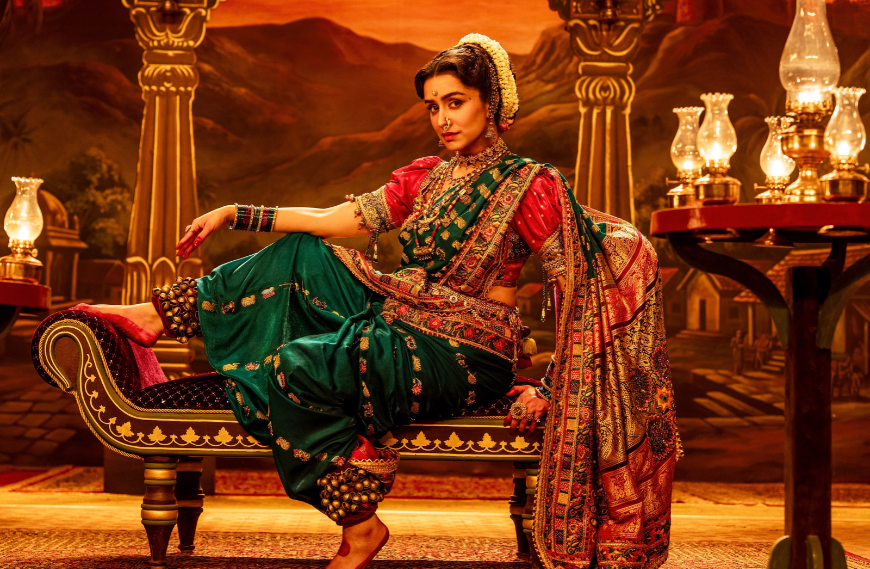
Bringing a traditional character to life on screen requires more than just acting. Costumes, jewellery, accessories and even the way an outfit is worn play an important role in making a character look authentic. For Shraddha Kapoor’s upcoming film Eetha, the costume department has paid special attention to these details, particularly the traditional Maharashtrian Nauvari saree.
Costume designer Sheetal Sharma has revealed that Shraddha wore traditionally draped nine-yard Nauvari sarees even during dance rehearsals. The team deliberately avoided pre-draped sarees to maintain the traditional appearance and natural movement of the outfit. The decision reflects the effort taken by the filmmakers to present the world of Tamasha performers with greater attention to detail.
Why Traditional Nauvari Draping Matters
The Nauvari saree is an important part of Maharashtra’s traditional clothing heritage. Its nine-yard length and distinctive draping style allow greater freedom of movement, making it suitable for activities such as dancing and performing.
According to Sheetal Sharma, the team wanted Shraddha’s costumes to look natural rather than overly arranged. She explained that pre-draped sarees often fall differently around the hips and sides, creating an appearance that may not reflect traditional draping.
Sharma shared that Shraddha, director Laxman Utekar and choreographer Vaibhavi Merchant agreed that there would be no pre-draped sarees in the film. The actress was dressed in a properly draped Nauvari saree every time she attended rehearsals.
This approach also helped Shraddha become familiar with the outfit before performing the dance sequences. Wearing the saree regularly allowed her to understand how it moved and how it felt while dancing.
Traditional Fabrics from Different Regions
The costume department’s research went beyond the usual Maharashtrian textiles. Since Shraddha plays a Tamasha artiste, the team wanted her wardrobe to reflect the character’s position in the performing arts.
Along with traditional Paithani sarees, the team sourced fabrics from Karnataka, Madhya Pradesh and Kanchipuram. These different regional textiles were adapted into nine-yard sarees to create a distinctive wardrobe for the character.
Paithani sarees are particularly associated with Maharashtra’s rich weaving heritage. Their traditional designs and detailed craftsmanship make them an important part of the state’s cultural identity.
By bringing together textiles from different regions, the costume team aimed to create a wardrobe that reflected the visual richness of the character and the performance culture associated with Tamasha.
Six-Kilo Ghungroos Add to the Authenticity
The attention to traditional details also extended to the jewellery and performance accessories used in the film.
For the dance sequences, director Laxman Utekar chose traditional ghungroos attached to metallic chains. Each pair reportedly weighs approximately six kilograms. This decision came after discussions with dancers and researchers who helped the team understand the accessories traditionally worn by performers.
Ghungroos are an important part of several Indian dance traditions. Their rhythmic sounds add to the musical experience and help connect dance movements with the accompanying music.
For a film centred on a Tamasha artiste, these details become particularly important. The accessories are not simply decorative elements; they also contribute to the overall presentation of the performer and the traditional art form.
Research in Kolhapur and Pune
To understand Tamasha beyond its visual appearance, the team travelled to Kolhapur and Pune. During these visits, they interacted with senior Tamasha performers and musicians to learn about the history of the art form and its stage culture.
These conversations helped the team understand the scale and energy associated with traditional Tamasha performances. Sharma recalled hearing stories about shows that attracted as many as 14,000 people, with very little space left for the audience.
The team wanted to bring some of that excitement and grandeur back to the screen. Their research helped them look beyond costumes and understand the atmosphere, performance style and cultural significance of Tamasha.
Tamasha has a long association with Maharashtra’s folk entertainment traditions. Music, dance, storytelling and theatrical performances come together to create an energetic stage experience. The performers, musicians and supporting artists all contribute to its distinctive character.
Presenting such a tradition in cinema requires an understanding of both its artistic elements and its cultural background. The research undertaken for Eetha reflects the effort to bring these aspects into the film.
‘Eetha’ Brings Maharashtra’s Tamasha Culture to Cinema
Directed by Laxman Utekar, Eetha features Shraddha Kapoor as a Tamasha artiste. The film’s costume and performance details suggest a strong focus on presenting the traditional art form through its visual and cultural elements.
The project is produced by Dinesh Vijan, Laxman Utekar and Karishma Sharma. It is scheduled to release in cinemas on December 4, 2026.
From traditionally draped Nauvari sarees to regional textiles and performance accessories, the costume department has worked to create a look that connects the character with Maharashtra’s cultural heritage.
Shraddha’s preparation for the role also highlights how costumes can become an important part of an actor’s performance. In Eetha, the Nauvari saree is not just an outfit but an essential element of the character’s identity as a Tamasha performer.
As the film prepares for its theatrical release, the attention given to traditional clothing, jewellery and folk performance culture makes it an interesting project for audiences who enjoy stories rooted in India’s regional arts and traditions.
Subscribe Deshwale on YouTube
