 Deshwale
After Nitish: The Power Equation That Will Decide Bihar’s First BJP Chief Minister
In brief · AI summary Nitish Kumar's move to the Rajya Sabha opens the way for the Bharatiya Janata Party to install its own Chief Minister in Bihar for the first time, after it won 89 of the 243 seats in the November 2025 Assembly election. The article gives Samrat Choudhary the highest chance of being chosen, at 60 to 65%, followed by Nityanand Rai at 20 to 25% and Prem Kumar or Vijay Kumar Sinha at a combined 10 to 15%. It frames the succession as tied to the 2029 general election and Bihar's 40 Lok Sabha seats.
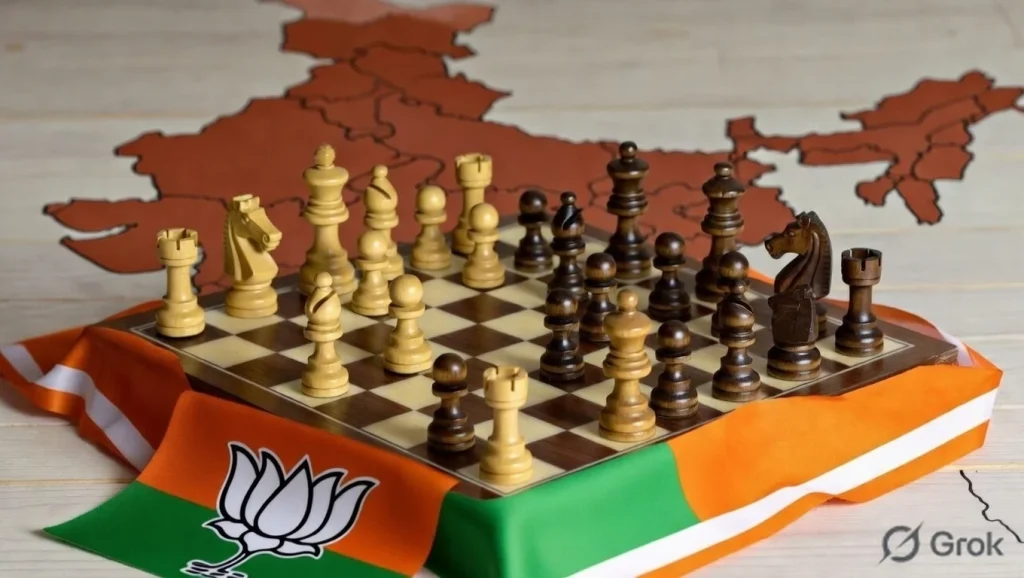
Delhi will choose carefully, because this decision is about 2029, not 2026
Political Forecast | Bihar | Strategic Affairs
Nitish Kumar’s move to the Rajya Sabha does not merely close a personal political chapter. It triggers the most consequential power transfer in Bihar since 2005.
For the first time in three decades of alliance politics, the Bharatiya Janata Party is positioned to install its own Chief Minister in Patna. In the November 2025 Assembly election, the BJP emerged as the single largest party with 89 seats in the 243-member House, comfortably ahead of the Janata Dal (United). The arithmetic shifted then. The authority shifts now.
But this succession is not about filling a vacancy. It is about engineering Bihar’s political future before the 2029 general election.
The central question is simple: who best converts state control into durable parliamentary dominance?
Why this transition is structurally different
Under Nitish Kumar, Bihar’s governance operated on calibrated caste balancing and incremental reform. The BJP was a powerful partner but not the final authority.
That equilibrium has ended.
The decision now rests squarely with Prime Minister Narendra Modi and Union Home Minister Amit Shah, whose leadership selections in other politically sensitive states show a consistent pattern: expand the social coalition first, stabilise the alliance second.
Bihar’s caste demography makes that logic decisive. OBCs account for roughly 27% of the population. Extremely Backward Castes represent approximately 36%. Yadavs constitute about 14%, and upper castes around 15%.
The BJP’s 2025 victory rested on consolidating non-Yadav OBCs, EBCs and upper castes while limiting the Rashtriya Janata Dal’s Yadav core.
The next Chief Minister must protect that coalition and widen it.
The clear frontrunner: Samrat Choudhary
On balance, Samrat Choudhary remains the most strategically coherent choice.
As a Kushwaha (Koeri) leader, he represents a large agrarian OBC bloc critical to BJP expansion. His elevation would signal that non-Yadav backward castes now form the ruling spine of Bihar politics. Holding the Home portfolio provides executive credibility, and law and order remains a central electoral concern in Bihar. Choudhary is viewed as organisationally aligned with Amit Shah’s political calculus, a factor that cannot be overstated in leadership decisions of this scale. Appointing him preserves the BJP’s non-Yadav consolidation without unsettling upper-caste voters who remain institutionally loyal to the party.
His history of party shifts may raise questions about ideological rootedness. However, the BJP has increasingly prioritised electoral architecture over ideological pedigree in state leadership selections.
Probability estimate: 60 to 65%.
The strategic gambit: Nityanand Rai
The second serious possibility is Nityanand Rai.
Elevating a Yadav leader from within the BJP would represent a bold attempt to puncture the Rashtriya Janata Dal’s traditional monopoly over that community. The strategic upside is considerable: a direct assault on the RJD’s social base, national stature from his Union ministerial role, and symbolic proof that the BJP can produce backward caste leadership beyond tokenism.
The strategic risk is equally real. Non-Yadav OBCs, who fuelled the BJP’s growth, may perceive dilution, and the party’s carefully engineered 2025 coalition could fragment.
Delhi typically avoids high-risk social experiments immediately after electoral consolidation. For that reason, Rai may be seen as a medium-term option rather than the immediate successor.
Probability estimate: 20 to 25%.
The stability option: Prem Kumar or Vijay Kumar Sinha
Names such as Prem Kumar and Vijay Kumar Sinha represent different stabilising pathways. Prem Kumar offers an EBC face with long legislative continuity. Sinha brings ideological reliability and upper-caste reassurance.
However, neither dramatically expands the BJP’s coalition. They preserve; they do not transform.
Combined probability: 10 to 15%.
The JD(U) variable
Nitish Kumar’s party remains institutionally relevant, even if numerically diminished. Reports suggest JD(U) could retain deputy chief ministerial posts to soften the transition.
The BJP’s calculation is delicate: assert primacy, avoid triggering JD(U) insecurity, and prevent opposition mobilisation framed as betrayal. However, with the BJP now legislatively dominant within the alliance, JD(U)’s leverage is constrained. Any instability would likely hurt JD(U) more than its larger partner.
Governance reset: what changes
A BJP-led chief ministership would likely produce stronger central alignment with faster integration into Delhi’s development pipeline. A quiet review of prohibition policy to address fiscal strain is probable. Infrastructure timelines on transport and urban projects would accelerate. A sharper policing posture is expected, particularly if the Home portfolio remains influential.
The stylistic shift will be noticeable. Nitish governed through administrative caution. The BJP will govern through political assertion.
The 2029 lens
Ultimately, this choice is less about Bihar’s Secretariat and more about Parliament.
Bihar’s 40 Lok Sabha seats are structurally vital to the BJP’s national majority calculus. Installing a leader who can deepen OBC consolidation, contain RJD revival, maintain upper-caste stability, and prevent JD(U) erosion is the real objective.
Choudhary aligns most closely with that design.
Forecast
Barring an unforeseen recalibration by the high command, Bihar is likely to see Samrat Choudhary sworn in as its first BJP Chief Minister within weeks of Nitish Kumar’s formal transition to the Rajya Sabha.
This would mark not merely a change in office but the formal end of coalition-era asymmetry in Bihar politics.
The BJP would move from junior partner to principal architect, and from tactical participant to structural hegemon.
Whether that dominance endures will depend on one enduring truth of Bihar politics: caste equations can be engineered, but they must constantly be maintained.
Delhi understands this.
That is why this decision is being made not for today’s headlines, but for 2029’s arithmetic.
Subscribe Deshwale on YouTube