 Deshwale
Your Next Coworker Might Be an AI Agent Here’s What That Actually Means
In brief · AI summary AI agents are systems that can observe their environment, make decisions, and take actions with little step-by-step human guidance, unlike simple chatbots. The article reports that 51% of enterprises already run AI agents in production as of 2026, and it cites companies such as Telus, Danfoss, and Suzano as examples of large-scale use. It also notes that, according to SHRM, AI is 5.7 times more likely to shift job responsibilities than to eliminate jobs outright.
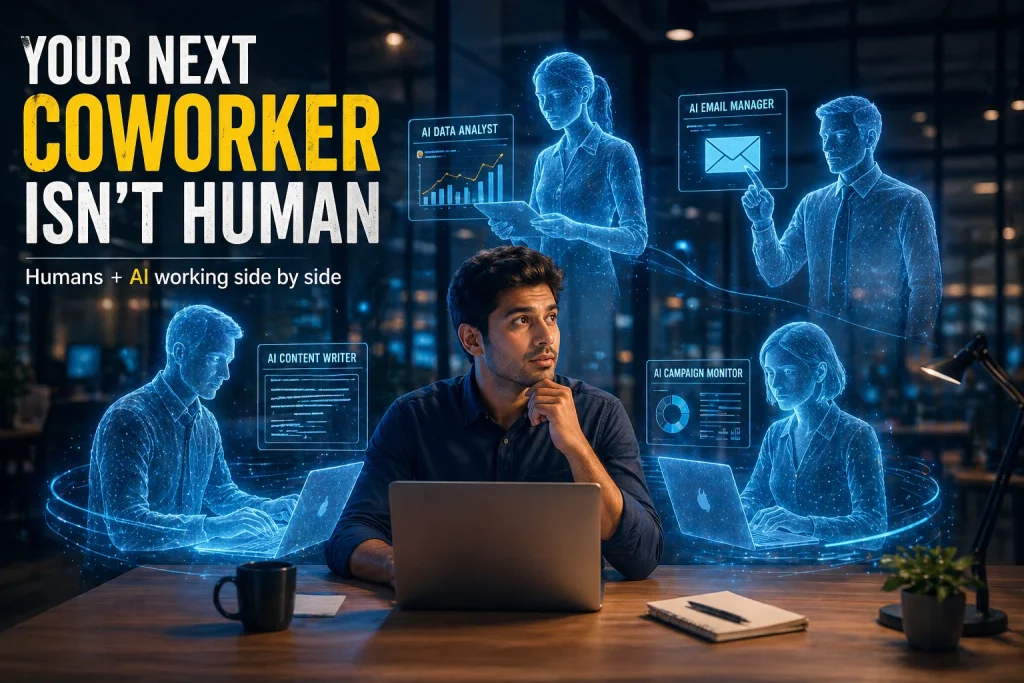
Picture this: It’s Monday morning. You send a message to your team saying you want to launch a new marketing campaign by Friday. Within seconds, one team member drafts the content, another builds the customer list, a third schedules the emails, and a fourth monitors performance in real time all before you’ve finished your second cup of coffee.
Now here’s the twist: three of those four “team members” are not human.
Welcome to the new workplace where AI agents are no longer a futuristic promise but an increasingly ordinary presence in offices around the world.
So, what exactly is an AI agent?
Before we go any further, let’s clear up the confusion because “AI agent” is a term that gets thrown around a lot, and not always accurately.
An AI agent is not just a chatbot that answers your questions. It is a system that can observe its environment, make decisions, and take actions often without needing a human to guide it step by step. Think of it less like a calculator and more like a capable intern who can independently research, write, send emails, schedule meetings, and report back with results.
The key word here is autonomous. Where older AI tools needed you to hold their hand through every task, agents can handle a workflow from start to finish on their own.
From experiment to everyday reality
Just eighteen months ago, AI agents were largely confined to research labs and tech demos. Today, they are clocking in alongside human employees at companies across the world.
The numbers tell a striking story. According to research aggregated from G2 and OneReach.ai, 51% of enterprises already have AI agents running in production as of 2026, with another 23% actively scaling them. A separate survey by PwC found that 88% of senior executives plan to increase their AI-related budgets this year specifically because of agentic AI with more than a quarter planning increases of 26% or more.
And the market itself is booming. The global AI agents market is valued at $10.91 billion in 2026, up from $7.63 billion just a year ago, and is projected to hit $50 billion by 2030, according to market research data.
In short: this is not a trend on the horizon. It is already underway.
Real companies, real results
The most convincing evidence is not in the projections, it is in what companies have already done.
Take Telus, the Canadian telecommunications giant. More than 57,000 of its employees are now regularly working with AI, saving an average of 40 minutes per AI interaction, according to Google Cloud’s 2026 AI Agent Trends Report.
Or consider Danfoss, a global manufacturing company, which deployed AI agents to automate email-based order processing. The result? Roughly 80% of transactional decisions are now automated, and the average customer response time dropped from 42 hours to near real time.
Then there is Suzano, the world’s largest pulp manufacturer, which built an AI agent using Google’s Gemini Pro that translates plain-language questions into database queries. The outcome was a 95% reduction in query time across a workforce of 50,000 employees.
These are not small pilot projects tucked away in a corner of the IT department. These are large-scale deployments that have changed how work actually gets done.
The “digital coworker” what it looks like in practice
For most people, the day-to-day reality of working alongside AI agents is less dramatic than the headlines suggest. It does not feel like science fiction. It feels like delegation.
A lawyer at a mid-sized firm might ask an AI agent to review 200 contracts overnight and flag any unusual clauses by morning. A human resources manager might rely on an AI agent to screen hundreds of job applications and surface the top candidates before a hiring panel convenes. A small-business owner might hand off customer support emails to an agent that resolves roughly 30% of cases without any human involvement, according to industry data freeing the owner to focus on strategy and growth.
According to Microsoft’s Chief Product Officer for AI Experiences, Aparna Chennapragada, this is precisely the shift that defines 2026. She describes AI agents as tools that allow a three-person team to do what once required ten handling data crunching, content generation, and personalization while humans steer the creative and strategic direction.
PwC’s research backs this up more bluntly: 75% of executives agree that AI agents will reshape the workplace more than the internet did. That is a remarkable statement, and it deserves to be taken seriously.
The jobs question let’s be honest about it
No article about AI agents is complete without addressing the question that most people are actually thinking: Is my job at risk?
The honest answer is: it depends on what your job involves and how quickly you adapt.
The Society for Human Resource Management (SHRM) published findings in 2026 showing that AI’s impact on the workplace is 5.7 times more likely to shift job responsibilities than to eliminate jobs outright, and three times more likely to create new roles than to displace them. A new category of job, the “AI Workforce Manager” is already emerging, with responsibilities that include assigning tasks between human employees and AI agents, ensuring agents operate within ethical guidelines, and monitoring performance.
Gartner projects that by 2029, at least 50% of knowledge workers will need to develop new skills to work with, govern, or create AI agents. That is not a comfortable number if you are planning to stand still but it is not a death sentence either.
The workers most at risk are those whose roles consist almost entirely of repetitive, rule-based tasks: processing forms, sorting data, answering routine queries. The workers best positioned are those who can define a problem clearly, evaluate an output critically, and make judgment calls that require human context and accountability.
The trust problem and why it matters
Here is the complication that the technology industry does not always advertise loudly enough: AI agents make mistakes, and sometimes those mistakes are serious.
Research from Anthropic and Carnegie Mellon University found that current AI agents make too many errors to be relied upon for high-stakes business processes without meaningful human oversight. Prompt injection where a malicious actor manipulates an agent’s instructions is a known cybersecurity vulnerability. And there are growing concerns about agents becoming subtly misaligned with the intentions of the people they serve.
Vasu Jakkal, Microsoft’s Corporate Vice President of Security, has argued that every AI agent should have security protections equivalent to those of a human employee — a clear identity, limited access to sensitive systems, and protection against manipulation. “Security,” she has said, “will become ambient, autonomous, and built-in, not something added on later.”
Consumer trust is also lagging behind adoption. Despite the rapid deployment of AI agents in customer service, 79% of consumers still prefer speaking with a human when problems arise, according to industry surveys.
Trust, in other words, is not a given. It has to be earned through transparency, reliability, and a clear understanding of where AI ends and human judgment must begin.
What this means for you the non-technical reader
You do not need to be an engineer or a data scientist to prepare for this shift. But you do need to pay attention.
A few things are worth keeping in mind.
AI agents are tools, not replacements for thinking. The organizations getting the most value from them are not those that have simply automated their old processes. They are those that have reimagined their workflows from scratch.
Fluency matters more than expertise. You do not need to know how to build an AI agent. But you do need to know how to work alongside one, how to give it clear instructions, how to evaluate its output, and when to escalate a decision to a human.
The shift is happening faster than most people realize. Gartner estimates that by the end of 2026, 40% of enterprise applications will include task-specific AI agents up from less than 5% in 2025. That is a staggering pace of change.
The arrival of AI agents in the workplace is not a distant possibility. It is a present reality, already reshaping how companies hire, operate, and compete. The most important question is not whether this transformation will affect you it almost certainly wil but how you choose to engage with it.
The workers and organizations that will fare best are not those who resist the change, nor those who blindly hand everything over to a machine. They are those who figure out, clearly and honestly, what humans do best and let AI handle the rest.
That, in the end, is what a good coworker does.
Subscribe Deshwale on YouTube