 Deshwale
The Internet Was Never Built for a World Where Machines Ask the Questions
In brief · AI summary The article argues that the internet was built on the assumption that a human starts every data transaction, but AI traffic is different: it is irregular, can spike unpredictably, and increasingly comes from machines talking to each other. Researchers at Nokia estimate that by 2034, more than a third of all AI-generated network traffic will be machine-to-machine. The author concludes that network infrastructure must evolve to offer the deterministic, guaranteed performance that real-time AI applications require.
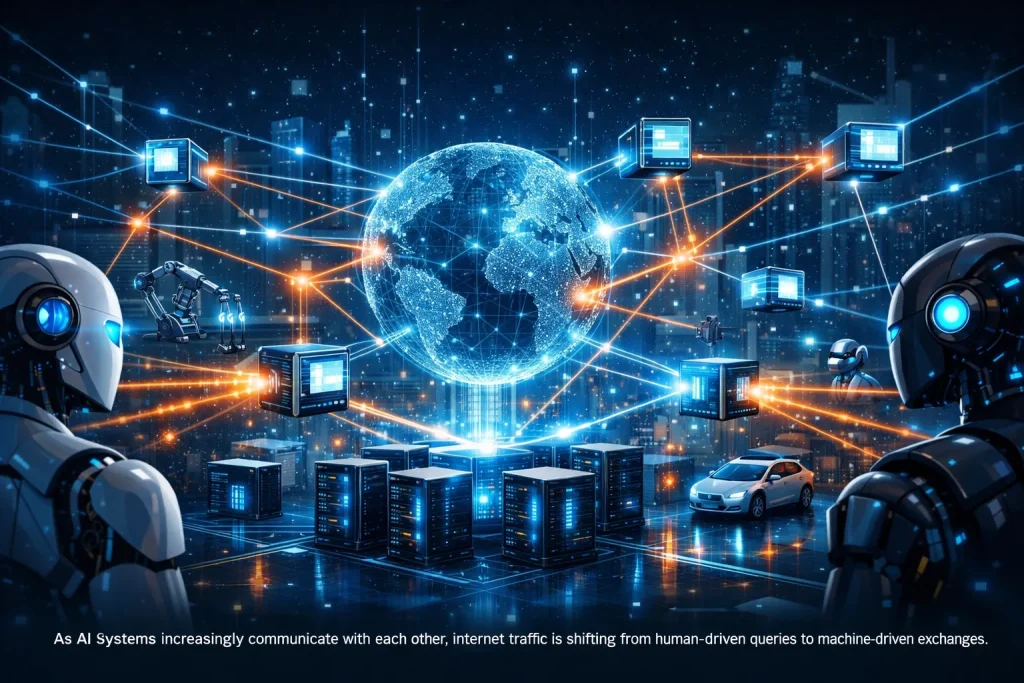
There’s a quiet assumption baked into every piece of internet infrastructure ever built. It goes something like this: somewhere at the start of every data transaction, there is a human being. A person clicked something. A person typed something. A person pressed play.
That assumption is about to become obsolete and most people haven’t noticed yet.
We tend to think of the internet as a highway. Traffic goes out, content comes back. Someone searches for a recipe, a video loads, an email lands. The direction of information has always been pretty lopsided: a lot flowing toward you, a little trickling from you. That’s why for decades, your home broadband has given you much faster download speeds than upload speeds. The system was built around the idea that you’re mostly consuming, not creating.
AI doesn’t consume. It exchanges.
When you type a prompt into an AI assistant, you’re not just downloading a result. You’re initiating a chain reaction. Your query hits a model somewhere. That model might call another model to double-check something. It might retrieve documents from a database, run a safety check, pull in context from your previous conversations, confirm something against a live source. Multiple data centers might be involved before a single word appears on your screen. And if you’re using a voice assistant, or smart glasses, or an AI system wired into a factory floor the same thing is happening, except continuously, in real time, whether you’re paying attention or not.
That’s a fundamentally different kind of traffic. Not a river flowing in one direction. More like a conversation happening inside the walls.
Here’s what makes this shift genuinely interesting rather than just technically inconvenient: it’s not about the size of the problem. It’s about the shape of it.
Every previous wave of internet growth was enormous, but it was legible. The rise of video streaming was a clear upgrade, requesting more bandwidth, please, and making it fast. The mobile internet was an expansion request to take everything we already built and shrink it to fit a pocket-sized screen. Engineers knew what they were dealing with. They could model it, plan for it, scale infrastructure accordingly.
AI traffic doesn’t behave like that. It’s irregular. It spikes unpredictably. A single user interaction can trigger ten separate behind-the-scenes network calls, or it might trigger a hundred, depending on how the underlying system is architected. And increasingly, a lot of this traffic won’t be triggered by users at all; it’ll be AI systems running their own processes, checking in with each other, updating models, coordinating actions across environments that span from a server farm in Virginia to a robot arm in a warehouse in Shenzhen.
Researchers at Nokia estimate that by 2034, more than a third of all AI-generated network traffic will be machine-to-machine. Not human-initiated. Not human-supervised. Just machines, talking.
That’s not a catastrophe. But it does mean the internet needs to grow up.
There’s an analogy worth sitting with here. When cities first started building electrical grids, they were designed around the predictable rhythms of human life. Lights went on at dusk, factories ran during the day, demand dipped overnight. Grid managers could more or less anticipate the load.
Then air conditioning happened. Then computers. Then data centers that never sleep. The grid had to evolve not just in capacity, but in intelligence learning to balance dynamic, unpredictable demand in real time rather than following a schedule.
We’re at a similar inflection point with networks. The old model big fat pipes optimized for one-way content delivery was built for a world where humans sat at the center of every transaction. What comes next needs to be built for a world where intelligence is distributed, agents are autonomous, and the most important conversations happening on the network aren’t ones you’re having. They’re ones your tools are having on your behalf.
The uncomfortable truth is that the infrastructure question doesn’t get nearly as much attention as the AI application question. Everyone wants to talk about what AI can do. Fewer people want to talk about whether the pipes it runs through are actually up to the job.
And to be fair, for most consumer use cases right now, they roughly are. You can use a chatbot. You can generate an image. Things work. But “things work” is different from “things are ready for what comes next.” Real-time AI in industrial settings, autonomous agents that make decisions in milliseconds, physical AI systems like robots and vehicles that require continuous low-latency communication don’t just need more bandwidth. They need something closer to guaranteed performance. Networks that can promise a level of consistency and timing that today’s infrastructure simply wasn’t designed to provide.
The industry term for this is “deterministic” performance. The idea that you can count on the network to deliver exactly what’s needed, when it’s needed, with predictable precision not as a best-case scenario, but as a baseline. That’s a harder engineering problem than it sounds. And it matters enormously when the thing waiting on the other end of the connection isn’t a patient human watching a loading bar, but an AI system that needs to react to something happening right now.
None of this means the internet is broken or that AI is going to grind everything to a halt. The people building network infrastructure are paying attention. They can see the projections. They’re investing.
But infrastructure doesn’t happen overnight. It’s built in cycles. Fibre gets laid. Towers get upgraded. Standards get negotiated. Software gets rewritten. And the decisions being made right now about how to prioritize investment, how to design new network architectures, how to think about the edge versus the core will shape what’s possible for the next decade of AI development.
The AI era isn’t going to run smoothly on an internet designed for streaming Netflix. That’s not a criticism of Netflix. It’s just that the requirements have changed, fundamentally and quickly, in a way that very few people were fully prepared for.
What the internet was designed for is humans. What it needs to become is something built for a world where intelligence doesn’t sit at a single address, doesn’t wait for you to click something, and doesn’t stop working when you close the tab.
That’s a bigger rebuild than it might look like from the outside. And the clock, as they say, is already running.
Subscribe Deshwale on YouTube