




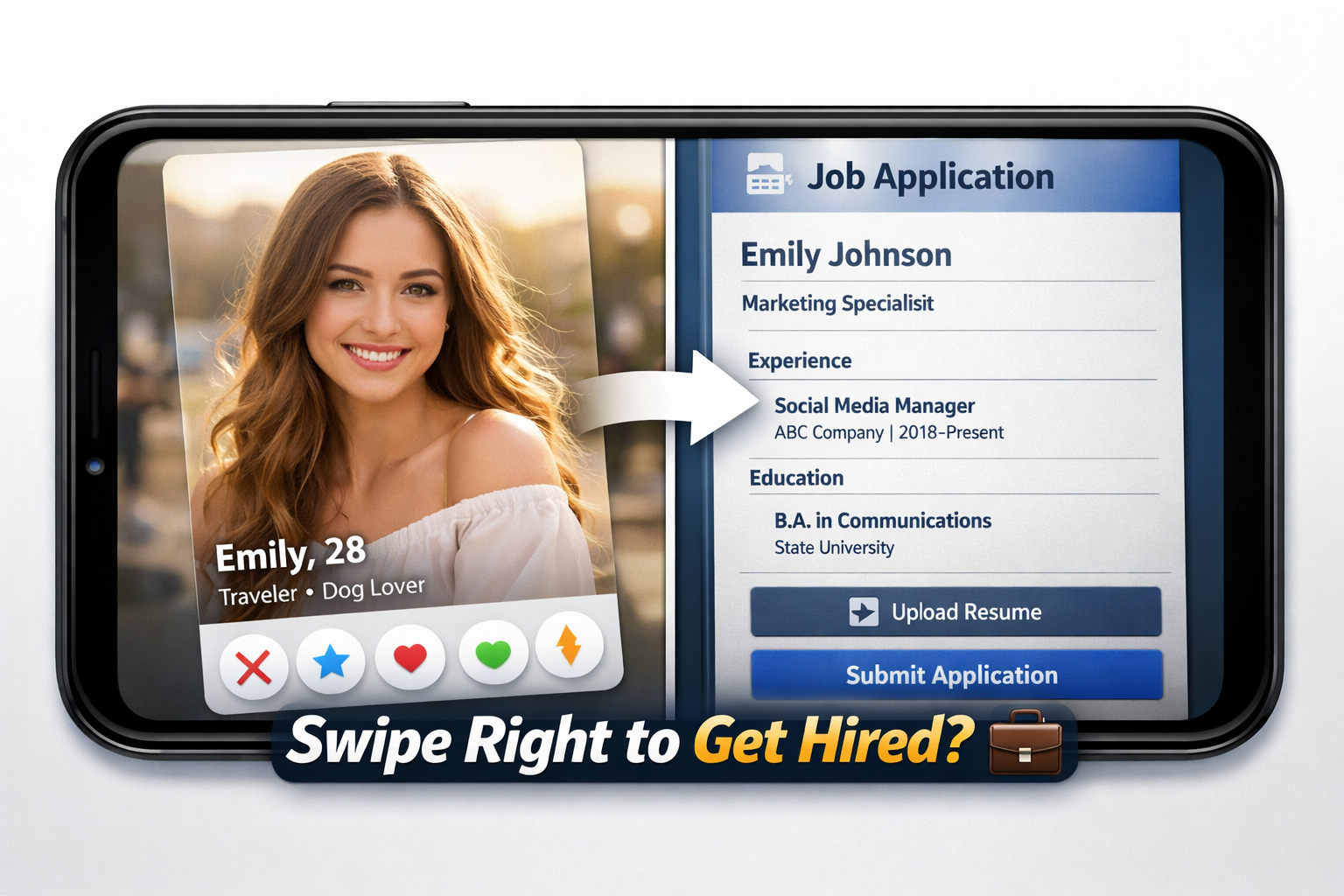
Everyone is calling it a clever hack. Nobody is asking who gets left out.
There is a story going viral right now, and it has a feel-good frame. Young people, frustrated by ghost applications and AI rejection emails, have discovered a loophole. Instead of submitting resumes into the void, they are going to Hinge and Bumble, matching with people who work at companies they want to join, and somewhere between discussing weekend plans, they ask: “Hey, are there any openings at your company?”
The coverage has been largely warm. Words like “creative,” “resourceful,” and “innovative” keep showing up. It is being told as a Gen Z underdog moment young people finding a human route through a dehumanised hiring process.
It is a good story. It just happens to be incomplete.
Because hidden inside this celebrated “hack” is a question nobody is asking: What if you are not conventionally attractive? What if your profile does not get swiped right in the first place?
If your path to a job referral now runs through a dating app match, then access to opportunity has been quietly tied to physical appearance. That is not a hack. That is a tax, an attractiveness tax being levied silently on millions of people who cannot afford to pay it.
The research has been telling us this for decades
Attractive people earn more. Not a little more. Meaningfully more.
Economist Daniel Hamermesh found that attractive workers earn roughly 5% more than average-looking peers, while less attractive workers face a plainness penalty of up to 9% in hourly earnings amounting to around $230,000 in lost lifetime wages. A 2025 study published in Information Systems Research, tracking over 43,000 MBA graduates across 15 years, found that attractive professionals were 52.4% more likely to hold prestigious positions and earned an annual salary premium of up to $5,528. This advantage did not shrink as people proved their abilities over time. It kept growing.
A separate survey of over 200 HR professionals found that hiring managers rank physical appearance as the third most important factor in hiring decisions above formal education.
None of this is because attractive people are more talented. It is because of a well-documented cognitive shortcut called the “what is beautiful is good” heuristic when we find someone attractive, we instinctively attribute intelligence, competence, and reliability to them, regardless of evidence.
Hiring has always had an attractiveness problem. The dating-app networking trend did not create it. But it has given it a far more powerful delivery mechanism.
When the first filter is a profile photo
In a traditional job application, your appearance is at least delayed. Your qualifications are read, your experience is weighed, before anyone sees your face.
In the dating-app networking model, the face comes first. It is the only thing that comes first.
Before you can mention your skills, your portfolio, or your interest in the company someone has to swipe right on your photo. The referral only exists if the match exists. The match only exists if the swipe exists. And the swipe is, almost entirely, an aesthetic judgment.
This means the shortcut is structurally available only to people who perform well on dating apps. Which is a very specific and much smaller group than the pool of talented, capable candidates who deserve a fair shot.
Who gets left out
Think about who this model excludes, and the list grows uncomfortable quickly.
People who are not conventionally attractive face an immediate invisible barrier. The same bias that already costs them wages now also costs them access to informal referral networks before they ever get to speak.
People who do not photograph well are disadvantaged even if they are attractive in person. The warmth visible in a room, the confidence that fills a conversation none of it survives a static profile image.
Introverts heavily represented in technical, analytical, and creative fields find the casual, flirtatious energy of a dating app conversation deeply unnatural. They are being asked to perform in a medium built for extroverts, just to access a professional opportunity.
Older workers are largely absent from dating apps altogether. The experienced 40-year-old making a mid-career switch has been quietly written out of this conversation before it started.
And then there is class. A dating-app profile is not just a photograph. The travel photos, the gym membership, the aesthetic of the image itself these signal social capital loudly and immediately. People whose profiles do not reflect the “right” background are filtered out not just by looks, but by a visual display of economic standing. Like most hacks, this one works best for people who already have advantages.
The meritocracy myth, with a new storyline
The referral, the warm introduction, the “let me put in a word for you” is arguably the most powerful card in modern hiring. Referred candidates are hired faster, at higher rates, and retained longer than those who apply cold.
If access to that referral pool is now partly gatekept by a dating app swipe, then the attractiveness premium which already shapes wages and promotions now also determines who gets through the front door in the first place.
This is not a quirky side-effect of a creative trend. It is a meaningful regression in hiring equity, dressed up as a plucky workaround.
The real problem behind the hack
To be clear: people using dating apps to find jobs are not the villains here. When algorithms screen resumes before human eyes see them and applications vanish into portals without acknowledgment, the impulse to find a real person and talk to them is entirely rational.
The problem is that the bypass route is not neutral. It reintroduces a form of bias at a stage where it is even harder to detect or challenge than before. A rejected job application can at least be questioned. A swipe left on a dating app cannot be appealed.
The celebration of this trend has largely skipped a basic question: innovation for whom?
If the answer is “for people who are conventionally attractive, socially confident, and whose profile signals the right social background” then it is not an innovation in access. It is a new filter that replicates old exclusions in a shinier medium.
The attractiveness tax has always been buried in the hiring system. Right now, everyone is swiping right on it without noticing.
Subscribe Deshwale on YouTube
