









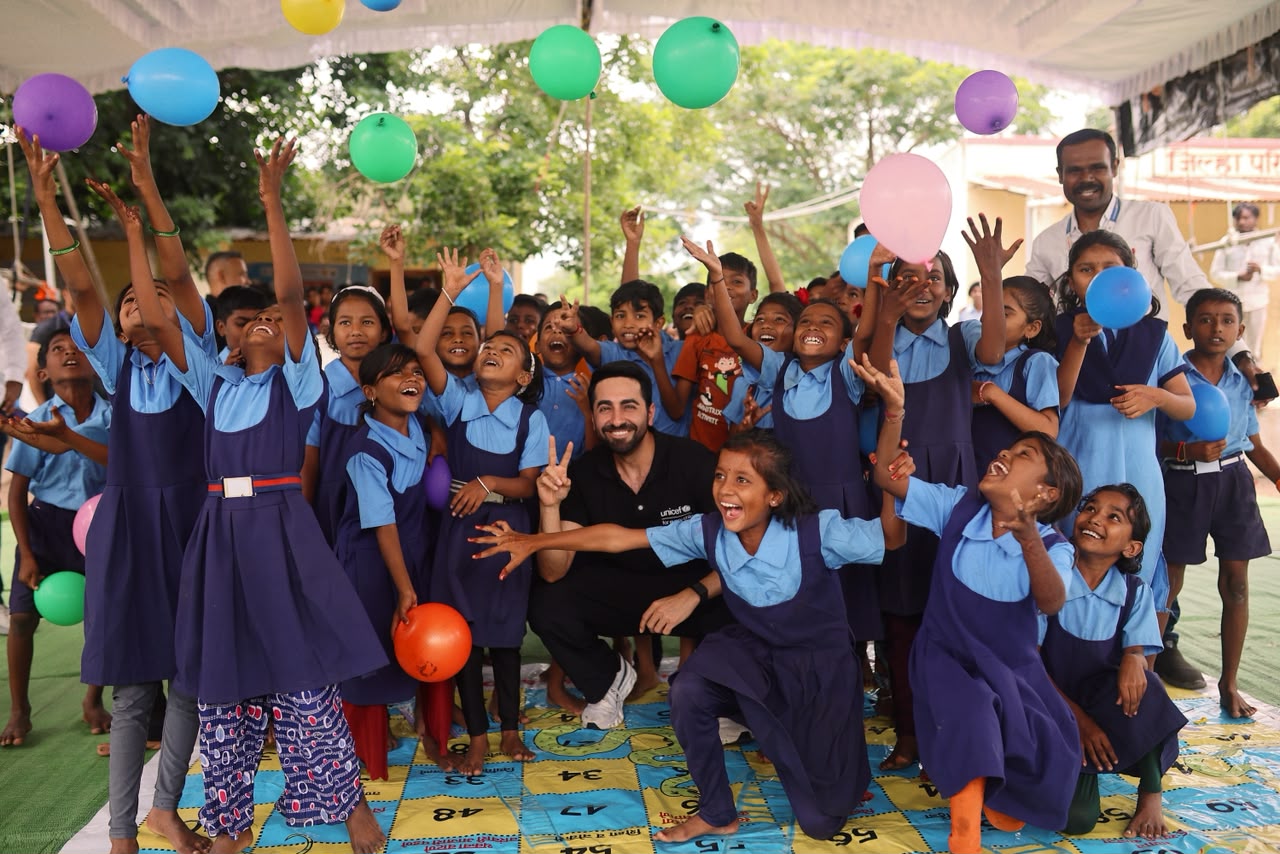
Actor and UNICEF India National Ambassador Ayushmann Khurrana visited Jalna district in Maharashtra to highlight the importance of protecting children affected by seasonal migration. During his visit, Khurrana interacted with children, families and community members as part of a UNICEF-supported Kinship and Community Care programme aimed at ensuring safer childhoods.
The programme focuses on children from families who migrate seasonally due to financial difficulties. For many such children, migration can lead to challenges including disrupted education, child labour, child marriage, neglect and limited access to healthcare and support services.
The UNICEF-supported initiative in Jalna works with the district administration and local communities to ensure that children remain connected to education, healthcare, nutrition and emotional support systems while their parents migrate for work.
Khurrana was accompanied by a UNICEF India team, including Deputy Representative Programmes Jesper Moller, along with government and NGO representatives. The visit focused on understanding how community-based care models are helping vulnerable children continue their education and grow in safe environments.
Speaking after meeting children and community members, Khurrana said seasonal migration is a difficult reality for many families and children should not lose their childhood because of circumstances beyond their control.
“Seasonal distress-driven migration is not a choice. It is the stark reality for many families. No child should have to lose their childhood because of circumstances beyond their control,” he said.
He added that the Kinship and Community Care programme helps children stay connected with family, support systems and opportunities. According to him, such care not only provides safety but also helps restore confidence and hope among children.
During the visit, Khurrana met young community leaders, including Shankar Asaram, whose work as a youth volunteer gained the trust of villagers and led to his election as village Sarpanch. He also met Pratiksha, a Class 12 student and Balmitra, who works towards supporting children’s rights and creating awareness about challenges faced by adolescent girls.
Balmitras are youth volunteers who act as role models in their communities. They help children stay in school, prevent child labour and child marriage, and connect families with essential services.
Khurrana also spoke about the importance of strengthening child protection systems in India. “India has strong laws to protect children, including the Juvenile Justice Act, which completes 10 years this year. What matters now is to make sure that these protective measures are felt by every child and family,” he said.
The programme brings together Gram Panchayats, frontline workers and local communities to create a safety network for children. It helps families access education, healthcare, nutrition and psychosocial support.
During his interaction with adolescent girls, Khurrana met Shilpa, an 18-year-old who earlier migrated with her family but later completed her education and joined a vocational course. He highlighted her journey as an example of how education and support can help children overcome challenges.
According to UNICEF, more than 5,800 children in Jalna stayed in kinship care during 2024–25 while their parents migrated for seasonal work. The initiative has helped reduce school dropouts, improve access to healthcare and nutrition services, and create safer environments for children.
UNICEF India Representative a.i. Jesper Moller appreciated the efforts of the Jalna District Administration and said protecting children from violence, exploitation and neglect requires strong community-level systems.
Through his visit, Ayushmann Khurrana called for collective efforts to ensure every child grows up in a safe, caring and supportive environment.
Subscribe Deshwale on YouTube


