










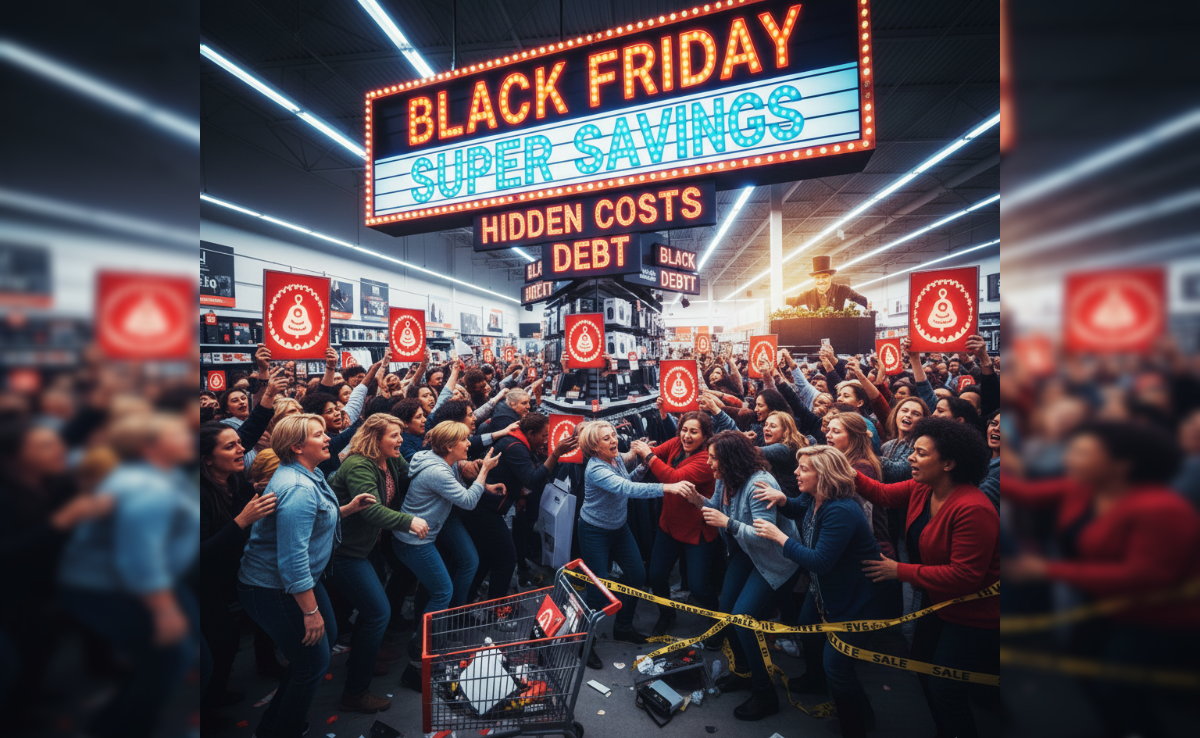
Black Friday is a global shopping event that takes place the day after Thanksgiving in the United States. The term originated in the 1950s and 1960s in Philadelphia, where police used it to describe the chaotic holiday crowds, traffic jams and store rush. Retailers later repackaged the day as a massive discount festival, and today it has become the biggest shopping event worldwide.
From the outside, Black Friday looks tempting. Huge banners, loud promotions and crowds rushing in give the illusion that you are about to save a lot of money. But the reality is simple. Black Friday is engineered to make you buy more, not save more. It is a psychological trigger dressed as a sale.
Around sixty to seventy percent of Black Friday discounts are not real discounts at all. Brands mark up prices weeks in advance and then present fake reductions so customers feel they are winning. It is a basic psychological trick. Increase the anchor price, flash a heavy discount, add a countdown timer and convince people they are losing out if they do not act immediately. The script repeats every year, and most people fall for it again and again.
The original purpose of Black Friday was never customer benefit. It was always about clearing old stock before Christmas. Retailers use the hype to push outdated electronics, last season’s clothing and slow moving inventory. In countries like India, the day has turned into emotional importing. People buy things without any real need simply because the word sale is plastered everywhere.
The entire system runs on pressure and manipulation. First, brands flood you with ads on every platform. Instagram shows you tempting reels, YouTube plays targeted ads, your email fills up with “exclusive offers” and apps send hourly notifications until you open them. Then they add a ticking clock so you panic that the deal might disappear any minute. If you have ever bought something just because you feared missing out, that is exactly how the marketing machinery is designed to work.
Electronics are the biggest trap of Black Friday. People jump at TVs, phones and laptops because the price drop looks massive. But once you dig deeper, you notice the reality. A lot of those models are older versions, discontinued lines or special Black Friday editions with cheaper internal components. In short, you think you are getting a premium product for less, but you are actually buying a lower quality product disguised as a deal.
Black Friday survives on one thing. Impulse. The day is structured to make you act before thinking. The noise, the urgency, the fake scarcity and the shiny graphics are all tools to make you emotionally reactive. A calm and logical buyer is a terrible customer for Black Friday. That is why the entire ecosystem is built to stop you from thinking clearly.
If you strip away the noise, the conclusion is straightforward. Black Friday is not a money saving event. It is a profit maximizing strategy for brands. It works only because people do not question the illusion of discounts. The smartest shoppers avoid the hype and buy only what they actually need, not what looks exciting for fifteen seconds.
If you want real savings, Black Friday is rarely the place to find them. It is the place where people convince themselves they are saving while doing the exact opposite.
Subscribe Deshwale on YouTube


