









A US President repeating a story does not make it true. What the record shows – and what it costs India every time the claim goes unchallenged.
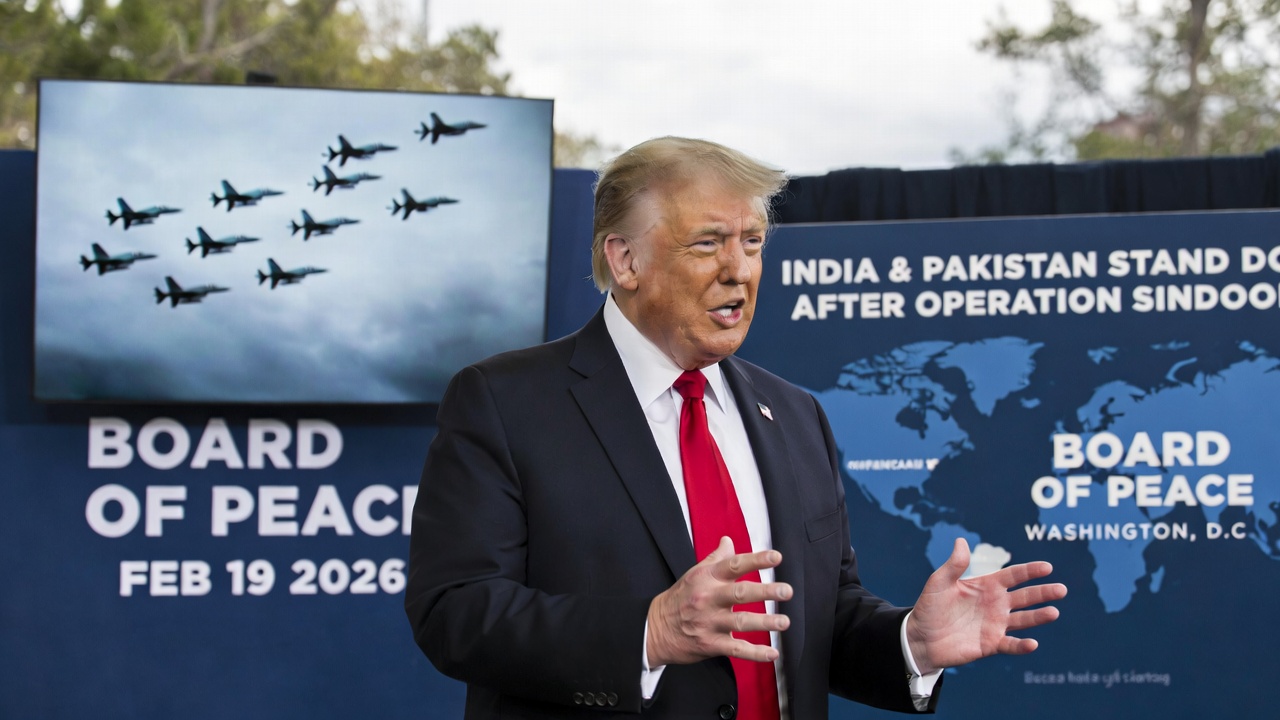
Donald Trump has now told the same story at least a dozen times since May 2025. Each retelling adds something new. Speaking at the Board of Peace event in Washington on February 19, 2026, he repeated his claim that a threat of 200 per cent tariffs forced both India and Pakistan to stand down after Operation Sindoor. This time he added that eleven jets were shot down during the conflict. Previously, he had said seven. Then eight. Then ten. The number keeps rising with each telling.
The story is not getting more credible with repetition. It is getting less so.
What the Official Record Shows
The sequence of events on May 10, 2025 is documented and unambiguous. Pakistan’s Director General of Military Operations initiated a hotline call to his Indian counterpart at 3:35 PM. Both sides agreed to halt all military operations – on land, in the air, and at sea – with effect from 5:00 PM IST that day. Foreign Secretary Vikram Misri confirmed this at a press briefing the same evening. Instructions were issued on both sides immediately.
There was no tariff ultimatum in that conversation. There was no American official on that call. The MEA spokesperson was precise about the sequence when the question arose: “From the time Operation Sindoor commenced on May 7, the issue of trade or tariffs did not come up in any of our discussions with the United States. The plea for ceasefire came from Islamabad. It was Pakistan’s DGMO who contacted his Indian counterpart. There was no American mediation.”
That statement has never been walked back. It has been repeated at subsequent briefings and confirmed by Foreign Secretary Misri before a parliamentary committee. Prime Minister Modi conveyed the same position directly to Trump during a bilateral call in June 2025: there was no discussion of trade or US mediation at any stage of the conflict.
Pakistan’s Own Admission Tells the Same Story
The most significant corroboration of India’s account comes from an unlikely source. Pakistan’s Deputy Prime Minister and Foreign Minister Ishaq Dar, speaking to Al Jazeera in September 2025, confirmed that when Pakistan raised the question of third-party mediation with US Secretary of State Marco Rubio, Rubio’s response was candid: India does not support any outside involvement. The issue is strictly bilateral.
When the other party to the conflict – the one that has every interest in keeping the US mediation narrative alive, because it serves Pakistan’s longstanding goal of internationalising the Kashmir question – confirms that India rejected third-party involvement, the factual basis of Trump’s claim becomes very thin indeed. Notably, the US State Department has not publicly confirmed Trump’s account of a tariff ultimatum at any stage. That silence from Foggy Bottom is itself telling.
Battlefield Claims Without a Verified Source
Trump’s aircraft tallies deserve separate scrutiny. He began in July 2025 with five jets shot down. He then said seven. Then eight. Then ten. At the Board of Peace event he said eleven – “very expensive jets.” Neither India nor Pakistan has confirmed these figures officially. According to Indian Air Force briefings in the days following the operation, over 114 aircraft were involved in what became one of the largest beyond-visual-range air engagements seen on the subcontinent. But no official from either country has confirmed Trump’s rolling tally of downed jets.
A US President citing unverified battlefield statistics as credentials for a diplomatic achievement is not an evidentiary standard that serious analysis can accept. The numbers are changing because they are not grounded in verified intelligence. They are performance.
Why Pakistan Plays Along
Pakistani Prime Minister Shehbaz Sharif attended the same Board of Peace event and called Trump a “man of peace” who saved 25 million lives. This is not a disinterested endorsement. Islamabad has specific reasons to keep the mediation narrative alive. A US-brokered ceasefire implicitly internationalises the India-Pakistan dispute. It positions Washington as a necessary participant in any future South Asian security architecture. It gives Pakistan diplomatic cover and, potentially, leverage it would not otherwise have. Sharif’s effusive praise serves Islamabad’s strategic interests. It does not serve the factual record.
What This Means for India’s Strategic Position
This is not merely a question of historical accuracy. Every time Trump’s account goes unchallenged in a major international forum, it chips away at something India has defended for decades: the principle that its disputes with Pakistan are bilateral and do not require external mediation. That principle is not sentimental. It is the cornerstone of India’s negotiating posture on Kashmir and on every India-Pakistan engagement that follows.
India has responded correctly. South Block has not escalated rhetorically. It has not picked a public fight with Washington at a moment when India-US trade negotiations are at a sensitive stage. It has maintained its position through official channels, parliamentary briefings, and the foreign secretary’s public statements – calmly, consistently, and on the record.
That composure is the right call. But composure is not acquiescence. The factual record must be restated every time the claim surfaces, at every forum where it is repeated, for as long as it takes.
The ceasefire on May 10, 2025 was initiated by Pakistan and concluded bilaterally between two militaries through their designated channels. No tariff ultimatum was issued. No American official mediated the outcome. Eleven jets may or may not have been shot down – the number appears to be growing in proportion to the audience Trump is addressing.
These are the facts. They do not require embellishment or repetition beyond what the record already shows. They simply need to remain on the record.


