









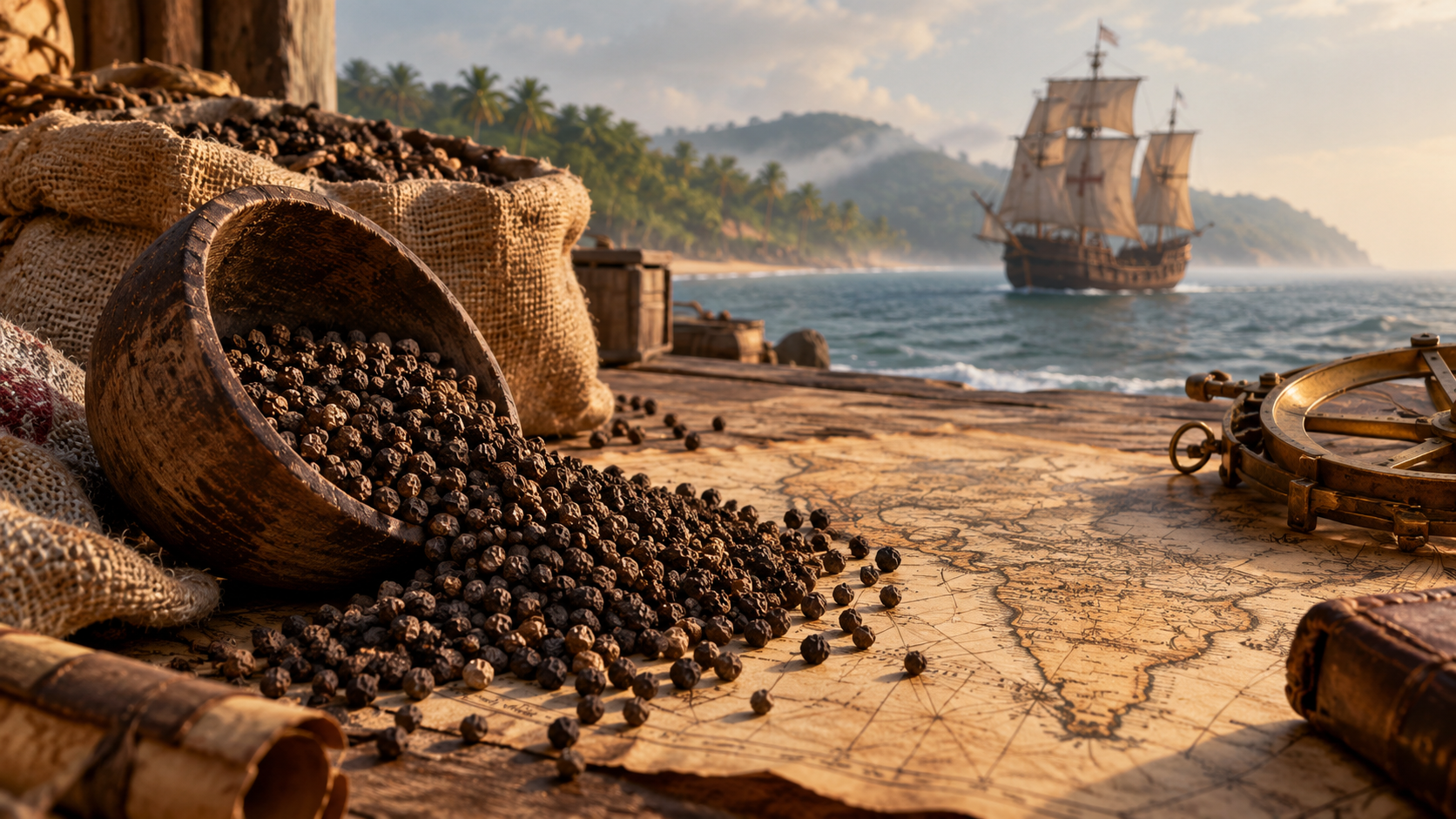
Today, black pepper sits on almost every dining table in the world, right next to the salt. It is so common that we hardly notice it. Yet for more than two thousand years, this small dried fruit was one of the most valuable goods in world trade. The hunger for it sent ships across unknown oceans, made cities rich, and helped bring European trading companies to Asia.
Born on India’s Malabar Coast
Black pepper (Piper nigrum) is native to the Western Ghats of southern India, and the Malabar Coast, in today’s Kerala, was its heartland. It grows as a climbing vine in warm, wet forests, and Indians have used it for thousands of years. The English word “pepper” comes from the Sanskrit word pippali, which originally meant long pepper, a related spice. Black pepper later took over the name.
Pepper travelled far even in ancient times. Peppercorns were reported in the nose of the Egyptian pharaoh Ramesses II, who died in 1213 BCE, which suggests that pepper, most likely from India, reached Egypt very early. Old Sanskrit texts also use the name yavanapriya for pepper, meaning “beloved of the Greeks.”
Rome’s Costly Taste
The trade became huge under the Roman Empire. Sailors learned to use the monsoon winds to cross the Arabian Sea directly to India’s coast. Muziris, a port in Kerala, became a busy market where Roman coins were exchanged for pepper and other goods. A damaged papyrus from the 2nd century CE, known as the Muziris papyrus, describes the valuable cargo of the ship Hermapollon, which carried Indian goods such as spikenard, ivory and textiles to Egypt.
The Roman writer Pliny the Elder complained that Rome was losing huge amounts of money to India, China and Arabia for luxuries like pepper. Pepper was so prized that when Alaric the Visigoth besieged Rome in 408 CE, he demanded 3,000 pounds of it as part of the ransom.
A Myth About Pepper
Many people believe that medieval Europeans used pepper to hide the taste of rotten meat. Historians consider this very unlikely. Pepper was expensive, and people who could afford it could also afford fresh meat. It was a luxury, a sign of wealth and good taste. In medieval Europe, it was sometimes even used to pay rent, and the phrase “peppercorn rent” still exists today. It is also often said that pepper was “worth its weight in gold,” but this is an exaggeration. It was costly, though never as costly as gold. Still, its price was high enough to make traders rich.
Middlemen and High Prices
In the Middle Ages, pepper reached Europe through a long chain of traders. Indian and Arab merchants carried it to the ports of the Red Sea and Egypt. From there, Italian cities, above all Venice, sold it across Europe. Every middleman added his profit, so by the time pepper reached a European kitchen, it cost far more than in Kerala. European rulers and merchants dreamed of reaching the source directly.
Vasco da Gama Finds the Way
Portugal led the search for a sea route. In 1488, Bartolomeu Dias had already rounded the southern tip of Africa, showing that an eastern sea route was possible. In July 1497, Vasco da Gama sailed from Lisbon with four ships, went around Africa, and reached Calicut on the Malabar Coast in May 1498. Calicut was then one of the main spice ports of the coast, and this was the first direct sea voyage from Europe to India. The ruler of Calicut, the Zamorin, received him, although relations soon became tense. Da Gama returned home with spices that brought Portugal a large profit. The new route had been opened.
Pepper also inspired another famous voyage. In 1492, Christopher Columbus sailed west for Spain, hoping to reach Asia and its rich spice markets. He instead reached the Americas. There he found chili peppers, which Europeans called “peppers” because of their burning taste. Columbus believed he had reached the Indies, which is why the Caribbean islands are still called the West Indies.
From Trade to Empire
Portugal soon tried to control the trade by force. It built a fort at Cochin in 1503 and captured Goa in 1510 under Afonso de Albuquerque, making it the centre of Portuguese power in Asia. But the monopoly did not last. The English East India Company was founded in 1600, and the Dutch East India Company followed in 1602. English merchants were partly pushed to organise after Dutch traders sharply raised pepper prices. These companies became powerful organisations with their own ships, soldiers and forts. In time, the English company grew from a trader into the ruler of large parts of India. A kitchen spice had helped change the political map of Asia.
Over time, pepper was also planted in other warm regions, including Indonesia, Brazil and Vietnam. Vietnam is now the world’s largest producer. As supply grew, prices fell, and a spice once fought over became an everyday item. Kerala still grows pepper and remains famous for it. Yet the next time you shake pepper over your food, remember its journey. It crossed deserts and oceans, enriched empires, and helped open the modern world.
Subscribe Deshwale on YouTube


