



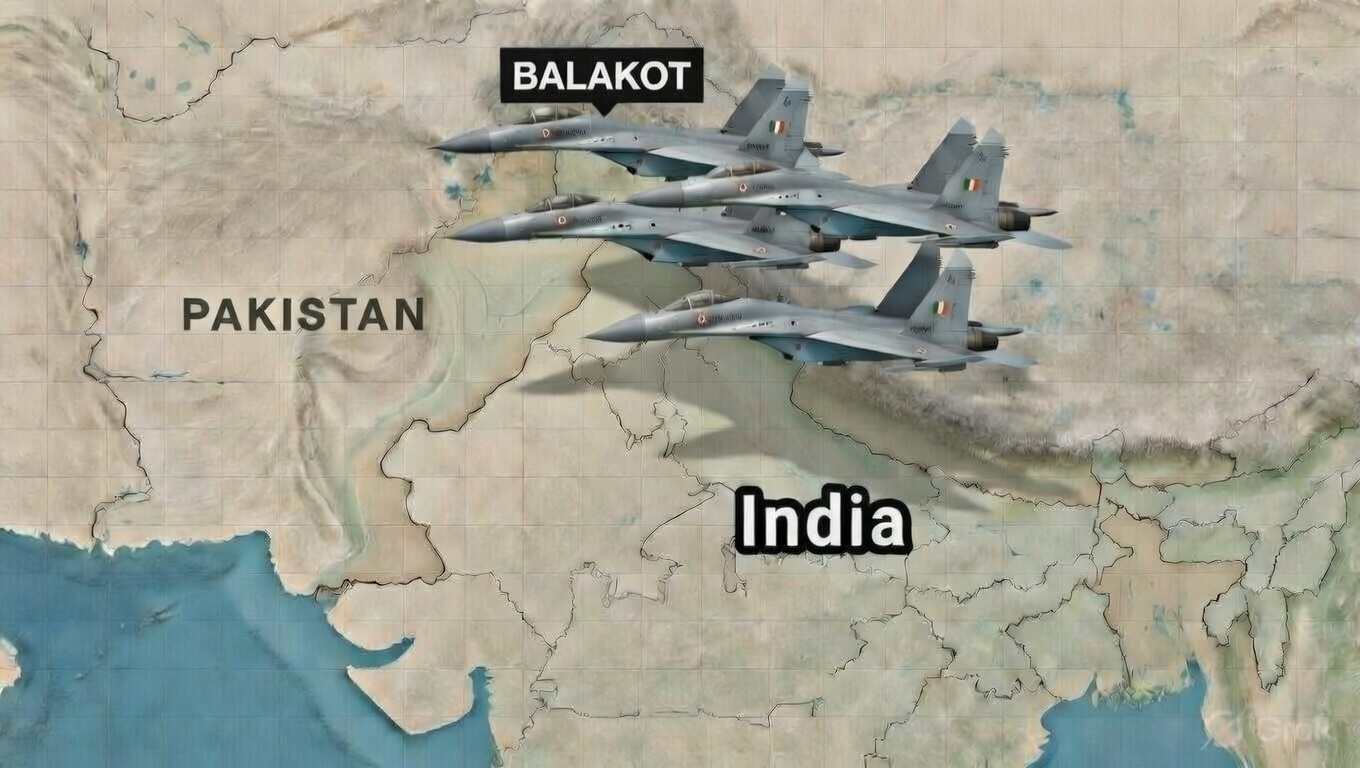
Seven years after India’s deepest military strike into Pakistan since 1971, and months after Operation Sindoor raised the stakes further still, the fog over what was actually achieved has not lifted. What has become unmistakably clear is the direction of India’s military doctrine, the political uses to which conflict is routinely put, and the question that no government in South Asia has yet found the courage to answer.
What Actually Happened That Night
The Indian government’s position was specific: a large number of terrorists killed, a significant camp dismantled, a pre-emptive strike to prevent an imminent attack on Indian soil. At a press briefing on 26 February 2019, Foreign Secretary Vijay Gokhale stated, in remarks made publicly and on record, that the strike had eliminated “a very large number of JeM terrorists, trainers, senior commanders and jihadis” at the Balakot facility. That was the most specific claim the Indian government made. Everything after it, in the studios, on WhatsApp, across social media, was elaboration without evidence.
Pakistan’s response was equally managed. The army’s Inter-Services Public Relations released photographs of a largely intact treeline. Independent satellite imagery analysis, reviewed by several international researchers, suggested that buildings at the targeted site showed minimal structural damage. No independent journalist was allowed close access to the site for weeks.
The honest conclusion, seven years on, is this: the exact number of casualties remains unknown. Credible estimates range from zero to a few dozen. India has never officially released a casualty figure. That silence is telling, but it is not proof of failure. It may simply reflect the operational reality that such claims are nearly impossible to verify after a night strike on a remote compound. What is certain is that the Indian Air Force conducted the deepest strike into Pakistani territory since the 1971 war. Everything else remains contested.
The Nuclear Dimension
What is far less ambiguous is what Balakot meant strategically. For the first time since both countries tested nuclear weapons in 1998, India conducted an airstrike inside undisputed Pakistani territory. Not Pakistani-administered Kashmir. Pakistan proper. Balakot sits in the Mansehra district of Khyber Pakhtunkhwa, hundreds of kilometres from the Line of Control.
India framed the operation deliberately as a “non-military pre-emptive action” targeting a non-state actor. That framing was designed to give Pakistan a way out, a ladder to climb down without treating the strike as an act of war. It worked, narrowly. Pakistan retaliated the next morning with its own air incursion, and the two air forces exchanged fire over the skies of Kashmir. An Indian MiG-21 was shot down. Its pilot, Wing Commander Abhinandan Varthaman, ejected into Pakistani territory, was captured, and was returned 60 hours later in what was widely read as a deliberate signal of de-escalation.
Both nuclear-armed states pulled back from the brink, not because of some noble strategic wisdom, but because both sides understood, with great clarity, where uncontrolled escalation leads. Pakistan’s then Foreign Minister Shah Mahmood Qureshi, speaking publicly in Islamabad on 27 February 2019, warned that his country would respond “at a time and place of our choosing.” He did not specify. The ambiguity was the point. It was a statement designed to satisfy a domestic audience without committing Islamabad to a course of action it did not want to take.
The doctrinal underpinning of India’s willingness to operate in this space had been articulated, with notable precision, three years before Balakot. In his 2016 book Choices: Inside the Making of Indian Foreign Policy, published by Brookings Institution Press, former National Security Adviser Shivshankar Menon wrote that India might find it useful to strike first if it were certain that an adversary’s launch was imminent, and that flexibility is baked into India’s existing nuclear doctrine. Menon was writing about doctrine in the abstract, not about any specific operation. But the thinking he described, that India reserved the right to act within the space below the nuclear threshold when conditions demanded it, was precisely the framework that Balakot operationalised in 2019, and that Sindoor extended further in 2025.
The Man in the Middle
Wing Commander Abhinandan Varthaman became, in those 60 hours, the most watched Indian in the world. The video of his captivity, recorded by Pakistani personnel, showed him composed, measured, declining to answer operational questions, and remarking, with a calm that struck many viewers as almost surreal, that a cup of tea he had been given was “fantastic.” It was a small, strange, deeply human detail in the middle of what could have become a catastrophe. His wife, Tanvi Marwaha, a decorated Indian Air Force pilot herself, waited quietly for news while the television channels ran their loops of speculation. When he crossed back into India at the Wagah border on the evening of 1 March 2019, the relief was not merely nationalist. It was the relief of a subcontinent that had held its breath.
The less comfortable detail, which got absorbed quickly into the celebration, is that a MiG-21, a Soviet-era aircraft designed in the 1950s and operated by virtually no modern air force, had gone up against Pakistani platforms operating more current technology. That the aircraft was lost should have been a serious conversation about procurement failures. It became, instead, almost entirely a story of personal bravery. Which it was. But it was considerably more than that.
The Electoral Timing Question
The Pulwama attack, which killed 40 CRPF personnel on 14 February 2019, took place roughly ten weeks before India’s general election. The Balakot strike followed within twelve days. The Bharatiya Janata Party went on to win 303 seats and a thumping majority. Post-election surveys showed the Pulwama-Balakot sequence registered strongly with voters as evidence of a decisive government. The BJP’s campaign leaned into it without subtlety. At a rally in Rajasthan in March 2019, Prime Minister Modi told an assembled crowd that the nation’s armed forces had made every Indian “proud,” a formulation that drew the strike directly into the campaign’s emotional vocabulary.
The question is not whether the strike was militarily justified. Most serious Indian strategic analysts believe it was a proportionate response to state-harboured terrorism. The question is whether the speed, framing, and television-ready narrative around it were shaped, at least partly, by electoral calculation. That question deserves to be asked plainly. Democracies are not immune to the temptation of convenient timing. And India is no exception.
The Media Problem
Indian television journalism, during the 72 hours after Balakot, did not merely exaggerate. It industrialised exaggeration. The problem was not a few anchors getting facts wrong in the fog of a fast-moving story. The problem was structural. Television ratings in India rise sharply during nationalist crises. The incentive for a channel to be the loudest, the most certain, and the most dramatic is financial, not editorial. One prominent anchor claimed, without any source, that 250 terrorists had been killed. The number was repeated across platforms within minutes. On WhatsApp, it became 300, then 350. By the time a correction might have been warranted, the correction had no audience. Pakistan’s media performed its mirror image of the same dynamic, treating ISPR briefings as settled fact and every Indian government statement as propaganda. Both governments understood that the information vacuum of a cross-border strike rewards the boldest narrative, not the most accurate one. Both played that game with practised competence. Neither paid a meaningful price for it.
China’s Role, Which Almost Nobody Wrote About
It is worth pausing here on something that received almost no sustained attention in either Indian or Pakistani media at the time, and has received very little since. China’s role in shaping the environment around both Balakot and, later, Operation Sindoor is a thread that serious analysts have noted but that rarely surfaces in mainstream coverage, perhaps because it complicates the cleaner nationalist narratives that both countries prefer. Beijing is Pakistan’s primary strategic guarantor, its largest arms supplier, and the one permanent member of the UN Security Council that blocked Masood Azhar’s global terrorist designation for nearly a decade before finally relenting in May 2019. During both crises, China’s quiet signalling to Islamabad, and its parallel communications urging restraint in New Delhi, shaped the diplomatic environment in ways that made de-escalation not just possible but available to both sides as a face-saving option when they needed it most. That China ultimately preferred managed de-escalation over open conflict in 2019 and again in 2025 is not altruism. It is strategy, and it deserves more examination than it has received.
Operation Sindoor: The Doctrine Matures
If Balakot was the first test of a new Indian posture, Operation Sindoor in May 2025 was its consolidation. After 26 civilians were killed in a targeted attack on tourists in Pahalgam on 22 April 2025, the pattern that began in 2019 reached a significantly more serious point.
On the night of 6-7 May 2025, India launched missile strikes on nine sites it described as terrorist infrastructure in Pakistan and Pakistan-administered Kashmir. The operation lasted roughly 23 minutes. The targets were far more expansive than Balakot. For the first time since 1971, India struck across the international boundary, the settled and accepted border between India and Pakistan proper. That included sites in Punjab province, the first time India had hit Pakistan’s most populous state in over five decades. Targets included infrastructure associated with Jaish-e-Mohammed in Bahawalpur and Lashkar-e-Taiba networks near Lahore.
The weapons used told their own story. India carried out the strikes using domestically developed or assembled systems, including BrahMos missiles and loitering munitions, without relying on foreign logistics. The MiG-21 era, exposed so painfully in 2019, was over. The Rafales procured partly in the political aftermath of Balakot were now operational assets, not campaign props.
Pakistan hit back. Islamabad launched retaliatory strikes targeting several Indian military installations. The conflict marked the first significant drone exchange between the two nuclear-armed nations. A ceasefire was agreed on 10 May 2025, after Pakistan’s Director General of Military Operations made contact with his Indian counterpart. The echoes of 2019 were unmistakable. Pakistan again chose de-escalation over sustained confrontation. But the scale of what had just happened was of a different order entirely.
Did Sindoor Actually Solve Anything?
Nine targets struck in under half an hour. A level of precision and reach that Balakot could only hint at. Jaish-e-Mohammed’s headquarters in Bahawalpur and Lashkar-e-Taiba’s infrastructure near Lahore sustained documented damage. That is not nothing.
But nipping the Pakistan problem in the bud? That is a considerably larger claim, and the evidence does not support it. Pakistan’s military establishment, the institution that has historically controlled the country’s India policy and its relationship with non-state militant groups, emerged from Sindoor with its political dominance internally intact. Its nuclear arsenal was unaffected. Its relationship with groups like Jaish-e-Mohammed and Lashkar-e-Taiba, cultivated across four decades as instruments of strategic depth, was not structurally severed by a 23-minute strike package. Organisations of this kind have been bombed before, by the Americans in Afghanistan and by Pakistan’s own air force in the tribal belt, and have reconstituted themselves within months. There is, so far, no serious analytical reason to believe Sindoor produced a structurally different outcome, even if the psychological shift it achieved was real and significant and will matter in the next crisis, whenever that arrives.
What Sindoor did accomplish is a genuine shift in the strategic balance. Pakistan’s military now knows that India will strike Punjab, not just Khyber Pakhtunkhwa. It knows India can do so without putting pilots at serious risk. That knowledge may produce a degree of restraint. But restraint is not resolution. Deterrence is not peace. And the history of this particular conflict suggests that each new escalation threshold, once crossed, simply raises the stakes for the next crisis rather than eliminating the conditions that produce crises in the first place.
The Psy-Op Question, Still Valid
The Pulwama-Balakot sequence in 2019 preceded a landslide election victory. The Pahalgam-Sindoor sequence in 2025 played out against a backdrop of domestic political pressure and a government seeking to demonstrate continued decisiveness. The pattern of major Pakistan-linked crises coinciding with politically sensitive periods in India is long enough now to demand something more than coincidence as an explanation.
These are serious allegations and they require serious evidence, which has not publicly emerged. But the question itself is legitimate. Was the intelligence failure at Pahalgam, in one of the world’s most heavily surveilled conflict zones, as total as it appeared? How does a tourist valley in Indian-administered Kashmir become the site of a mass killing without any prior intercept or warning? The implications of that question, whether it points to a catastrophic institutional failure or something more deliberate, have not been seriously examined in the Indian public domain. A democracy that cannot conduct that examination is not fully functioning.
The Pakistan Question, Still Unanswered
India has spent 75 years using Pakistan as both a threat and an explanation. After two cross-border military operations in six years, the question worth asking is this: what would Indian domestic politics look like if the Pakistan problem were actually solved? Which political constituency in New Delhi would lose more from permanent peace than from permanent hostility?
South Asia remains the least economically integrated region in the world. SAARC has been effectively paralysed for nearly a decade. India and Pakistan do not maintain a functional trading relationship. The human cost of sustained hostility is diffuse and largely invisible, which makes it politically costless to maintain. Operation Sindoor demonstrated India’s military reach with unmistakable clarity. It did not, and cannot, substitute for a political framework. Missiles can destroy infrastructure. They have never, anywhere in the world, built peace.
Balakot widened the escalation corridor. Sindoor widened it further. At some point, a corridor that keeps widening stops being a managed space and starts being a road toward a destination neither side has chosen and neither side can afford. The direction of Indian military policy is now clear. The political will to match that military ambition with an equally serious attempt at resolution is not. And until it is, the next crisis is not a possibility. It is a calendar entry waiting for a date.
Subscribe Deshwale on YouTube
