 Deshwale
Robots Run, Humans Win: Beijing’s Bizarre Half Marathon
In brief · AI summary Twenty-one humanoid robots ran alongside thousands of human runners in the 21-kilometre Yizhuang Half Marathon in Beijing in 2025, with results that were mixed, as one robot shut down a few metres in and another crashed into a barricade. Tiangong Ultra finished the full course in about 2 hours and 40 minutes. The event was presented as a real-world test of what robots can do, and the teams behind them plan to develop uses such as factory work and household chores.
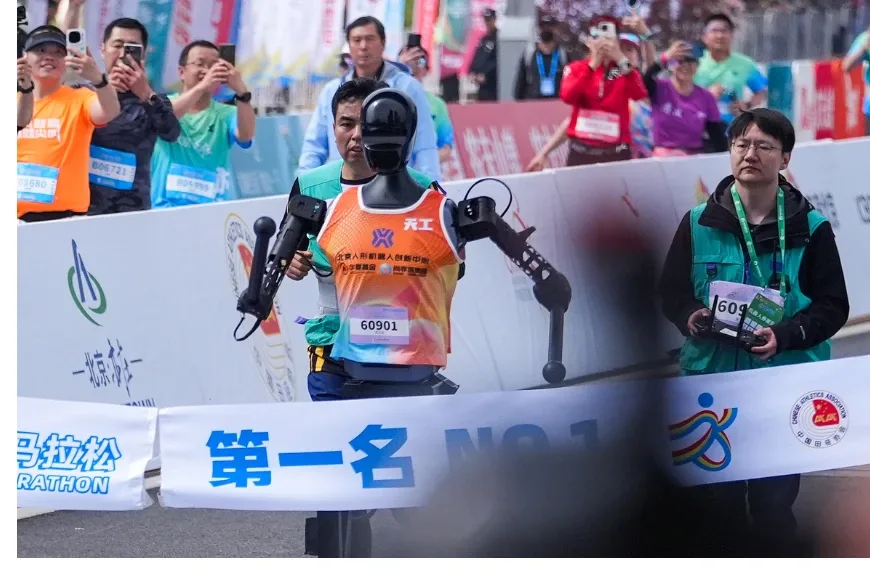
Imagine turning up at a half marathon and instead of just runners stretching at the start line, you see robots doing warm-ups. Yep, actual robots. That’s exactly what went down at Beijing’s Yizhuang Half Marathon in 2025. A race that turned into part tech demo, part public spectacle — and it had everyone talking.
So what really happened?
Twenty-one humanoid robots joined thousands of human runners to take on the 21-kilometre course. Not just toy-sized things either — some of these bots stood nearly 6 feet tall. They blinked, moved, and some even had friendly faces that looked like they might start chatting.
Each robot came with its own team — engineers and handlers in tow, making sure nothing short-circuited mid-run. This wasn’t just a gimmick. The goal was clear: test how well these bots could move like us, in real-time, on real streets.
Did the robots run well?
Umm… mixed results.
Some of them managed to jog a fair bit. Others — let’s just say they struggled. One robot conked out barely a few metres in. Another ran into a barricade and dropped its handler like a sack of potatoes.
But hey, a few stood out. One named Tiangong Ultra powered through and actually finished the entire 21K — took about 2 hours and 40 minutes. Not bad for a machine that doesn’t get tired or need water breaks, right?
What’s the big idea?
This whole thing was less about winning and more about showing what robots can do in the real world. The district where the race was held is a tech hub, full of AI and robotics companies. And this race? It was a live trial, a rolling lab on legs — or circuits, in this case.
More than performance, it was about pushing boundaries. These robots weren’t just following a line on the floor. They were reacting to road conditions, balancing on uneven paths, and dealing with the crowd.
One spectator summed it up perfectly — “I feel like I’m watching the future take its baby steps.”
What’s next?
The teams behind these bots aren’t stopping here. They’ve already got their eyes on real-world jobs for these mechanical mates. From helping in factories to handling daily chores at home, they’re working on making these bots useful beyond races and exhibitions.
Of course, we’re still a long way from robots running marathons without tripping or crashing into barriers. But this race was proof — they’re learning, adapting, and getting better.
The takeaway?
Humans may have outrun robots this time, but the bots weren’t there to beat us. They were there to show they’re coming — slowly, steadily, step by mechanical step.
Let me know if you’d like this article localised or translated into any Indian language, or formatted into WordPress HTML directly — happy to help!