 Deshwale
Beyond Religion and Rituals: The Timeless Message of Guru Nanak Dev Ji
In brief · AI summary Guru Nanak Dev Ji challenged social divisions, questioned empty rituals, and taught that true faith is shown in how people treat others, especially those less fortunate. His teachings stressed honesty, compassion, and equality, and the three principles of Naam Japo, Kirat Karo, and Vand Chhako offer a practical way of living. The article argues that his message remains relevant today, when problems such as discrimination, dishonesty, and inequality continue to affect people.
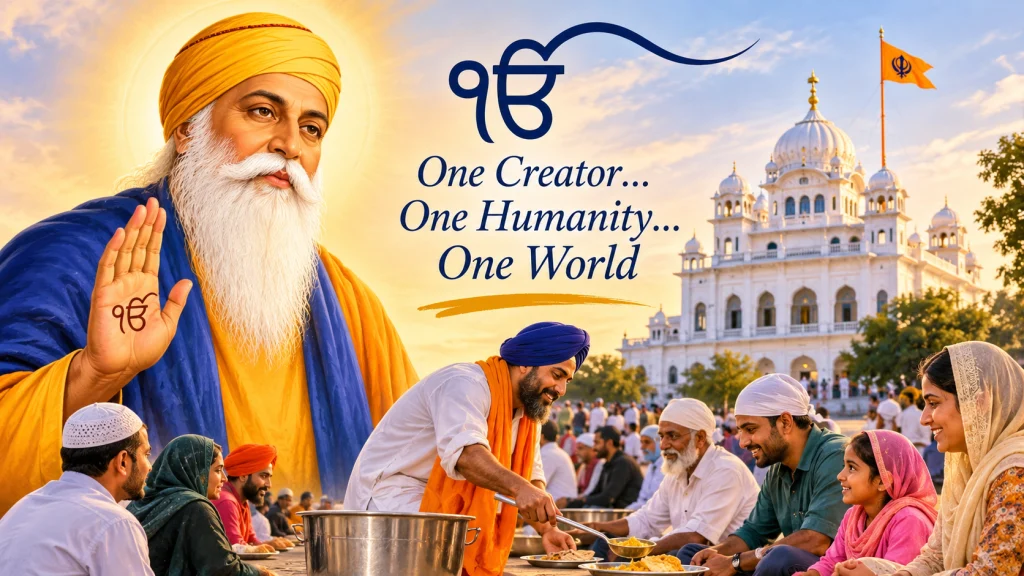
He challenged social divisions, questioned empty rituals and taught the world that the true measure of faith lies in how we treat other human beings.
What makes a person religious? Is it the number of times they visit a place of worship, the rituals they perform or the prayers they offer? Or is it the way they treat people, especially those who are less fortunate than themselves?
More than five centuries ago, Guru Nanak Dev Ji offered an answer that remains relevant even today. He believed that remembering God was important, but living with honesty, compassion and respect for every human being was equally essential.
Every year, millions of people celebrate Guru Nanak Jayanti, also known as Gurpurab or Prakash Parv, to mark the birth anniversary of Guru Nanak Dev Ji, the founder of Sikhism and the first of the ten Sikh Gurus. He was born in 1469 at Talwandi, now known as Nankana Sahib in present-day Pakistan. His birth anniversary is traditionally observed on Kartik Purnima, although historical accounts differ about the exact date of his birth.
But beyond the celebrations, his life offers a lesson that goes far beyond any one religion.
A voice against discrimination
Guru Nanak Dev Ji lived in a society where caste, religious identity and social status often determined how people were treated. He challenged these divisions and questioned practices that made one person appear superior to another.
His message was built around a simple belief: there is one Creator, and all human beings are equal before the divine.
The expression Ik Onkar, one of the central concepts in Sikhism, reflects this belief in one supreme reality. It also reminds us that differences in religion, language, caste or wealth should never become reasons to hate or discriminate against others.
He questioned the idea that religious identity alone made someone a better human being. His teachings placed greater importance on truthfulness, humility and compassion than on outward displays of religious devotion.
He also challenged the social attitudes that treated women as inferior. One of his well-known teachings asks, in essence, why should women be considered inferior when they give birth to kings and other great people? It was a powerful message for a society in which women often faced restrictions and discrimination.
Three principles for a meaningful life
Guru Nanak Dev Ji’s teachings are often explained through three foundational principles that continue to guide Sikh life.
Naam Japo: Remember God and maintain a spiritual connection through prayer and meditation.
Kirat Karo: Earn your livelihood honestly through sincere work. Success should never come through cheating, exploitation or unfair practices.
Vand Chhako: Share what you have with others, particularly those who need help.
These principles are not complicated religious instructions. They offer a practical way of living. A person can follow them while managing a business, working in an office, raising a family or fulfilling everyday responsibilities.
Langar: Where equality is served on a plate
One of the most beautiful expressions of Guru Nanak Dev Ji’s teachings is the tradition of Langar, the community kitchen associated with Sikh gurudwaras.
People from different religions, castes and economic backgrounds sit together and share a meal. There is no special seating for the wealthy, no separate arrangement for people of higher social status and no discrimination based on background.
The food is prepared and served by volunteers, many of whom consider this service an important part of their devotion.
Think about the message behind this simple practice. In a world where people often measure one another by wealth, position and social standing, Langar brings everyone to the same level.
It is not merely about feeding hungry people. It is about making equality a lived experience rather than just an idea.
A spiritual message beyond boundaries
Guru Nanak Dev Ji travelled extensively to share his teachings. These journeys, traditionally known as Udasis, brought him into contact with people of different faiths and backgrounds.
Through conversations and hymns, he encouraged people to look beyond religious differences and focus on truth, compassion and devotion to the Creator.
He eventually established a community at Kartarpur, in present-day Pakistan, where people gathered to pray, work honestly and share their lives. This became an important centre for practising the values he taught.
His approach was not to encourage hatred towards another faith but to question hypocrisy, discrimination and behaviour that contradicted the very values religion was supposed to promote.
Why his message matters today
Centuries have passed, but many of the problems Guru Nanak Dev Ji spoke against remain part of our society. Religious intolerance, caste discrimination, dishonesty, inequality and divisions based on identity continue to affect people across the world.
This is what makes his teachings so relevant.
Guru Nanak Jayanti should not be remembered only as the birthday of a great spiritual leader. It should also be an occasion to ask ourselves some uncomfortable questions. Do we treat everyone equally? Do we earn honestly? Are we willing to share what we have? Can we respect people whose beliefs are different from ours?
The real tribute to Guru Nanak Dev Ji is not limited to visiting a gurudwara, listening to devotional hymns or participating in celebrations. It lies in bringing his teachings into our homes, workplaces and everyday relationships.
After all, lighting a lamp in a place of worship is an act of devotion. Bringing light into another person’s life is an act of humanity.
And perhaps that is the most meaningful way to celebrate Guru Nanak Jayanti.
Subscribe Deshwale on YouTube