



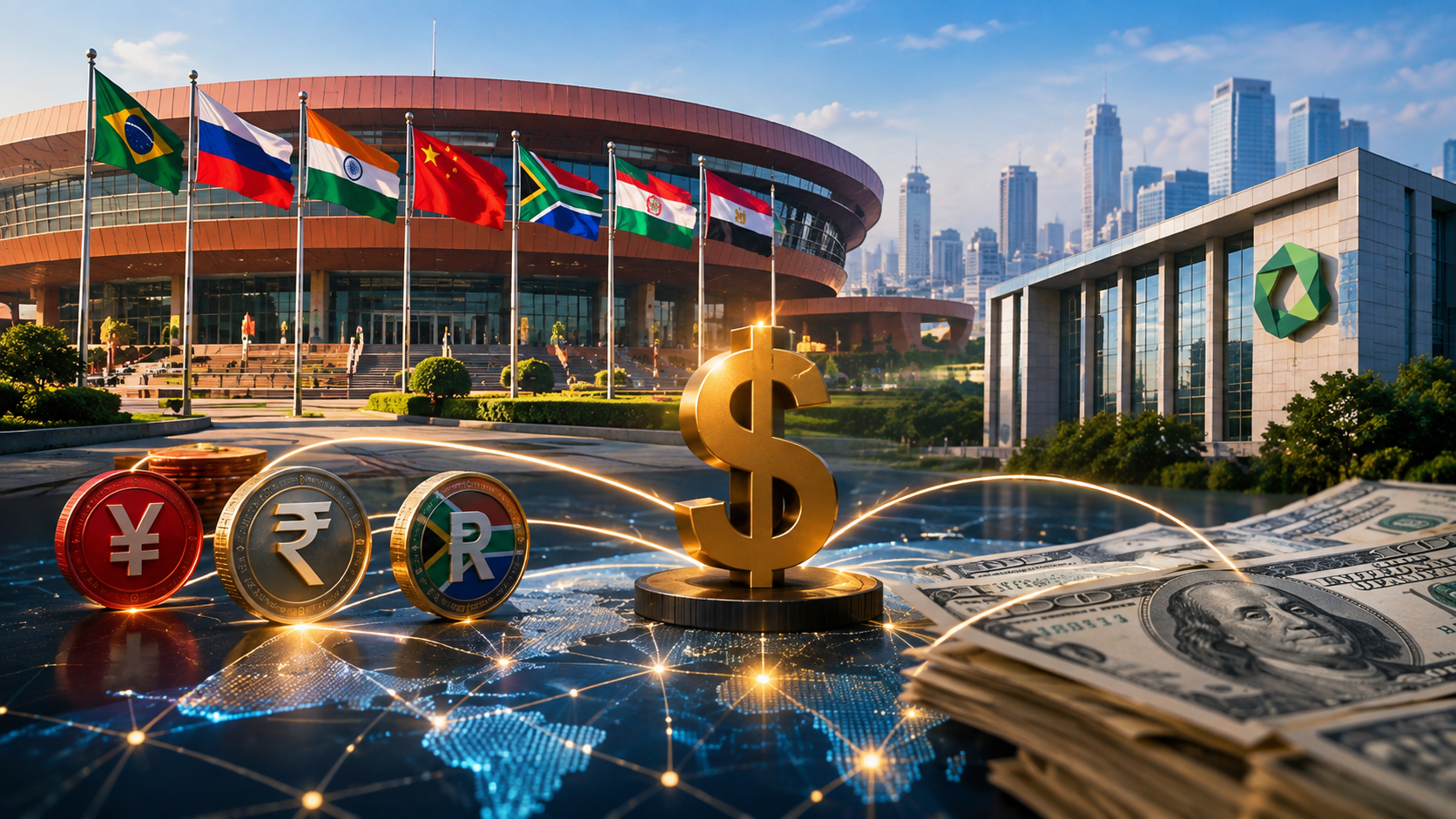
This week, the world’s attention is on New Delhi. The 18th BRICS Summit is being held at Bharat Mandapam on September 12 and 13, with India hosting as this year’s chair. Leaders and officials from across the bloc, now eleven countries strong, have gathered for a summit built around a familiar promise: reducing the world’s dependence on the US dollar.
But a few days before the summit even began, one of BRICS’s own institutions quietly did something that tells a more complicated story.
On September 8, the New Development Bank, the bank BRICS created to fund infrastructure across its member countries, priced a 7 billion renminbi Panda Bond in China’s domestic bond market. It was framed as proof that the bank is serious about local-currency financing. And it is, on paper, a genuine step away from the dollar.
Except the same bank still relies on something very dollar-shaped to make deals like this work in the first place: its international credit rating.
The New Development Bank currently holds an AA+ rating from S&P, AA from Fitch, and AAA from the Japan Credit Rating Agency. These ratings are what let it borrow cheaply and confidently on global markets, including the very market it just tapped in China. And those ratings, in turn, are built on the bank’s access to hard, globally trusted currencies and its standing within a financial system that the US dollar still anchors.
So here is the contradiction sitting quietly underneath this week’s summit. BRICS wants a financial world that depends less on the dollar. Its flagship bank, at the same time, needs the credibility that the dollar-centred system provides in order to keep raising money at all.
This isn’t a small detail buried in a policy paper. It is happening in real time, right alongside the summit itself. Just two days before the summit opened, on September 10, the bank launched the BRICS-NDB Knowledge Portal at a finance ministers’ meeting in Mumbai, meant to bring the bloc’s financial institutions closer together. In the space of a single week, the bank held a governance meeting in Mumbai, priced a bond in China’s currency, and is now in the spotlight of a summit built around moving away from the dollar. The direction is clear: BRICS wants this bank to become the financial engine room for its de-dollarisation ambitions.
But an engine room still needs fuel, and right now, a lot of that fuel is dollar-adjacent.
Consider the numbers. The bank has set a target of providing 30 percent of its financing in the national currencies of its member countries. That means, even as an aspiration, 70 percent of its lending is expected to continue in other currencies, largely the dollar. The bank raised funds in the South African rand in 2023 and 2024, and is now planning a similar issue in India. These are real steps. But they are incremental ones, not a break from the dollar system.
There’s also a membership puzzle that complicates the “united BRICS financial front” story. Bangladesh, Algeria, and Uzbekistan joined the New Development Bank but never went on to join BRICS itself. The UAE and Egypt followed a similar path at first, joining the bank, before eventually joining BRICS as well. The bank’s rules also protect the five founding members, who must together hold at least 55 percent of voting power, no matter how many new members sign up. In effect, BRICS is expanding faster than its own bank’s ownership structure allows it to.
This gap between political ambition and institutional capacity shows up elsewhere too. Alongside the bank, BRICS has been building parallel financial mechanisms of its own, including a Cross-Border Payments Initiative and a Multilateral Guarantees pilot the bank agreed to host under its 2025 Leaders’ Declaration commitments. Each is meant to cut reliance on Western-controlled payment systems. But if they develop separately instead of feeding into the bank’s own framework, BRICS risks ending up with overlapping tools rather than one coherent alternative to the dollar system it wants to move away from.
Why does this matter to India specifically? India has consistently kept the New Development Bank distinct from more China-weighted institutions like the Asian Infrastructure Investment Bank. A bank dominated by one country’s financial gravity, even if that currency isn’t the dollar, would not serve India’s interest in strategic autonomy. That is part of why India, including during its current presidency, has pushed for credible multilateral governance rather than louder anti-West rhetoric.
None of this means the New Development Bank is failing. It has real infrastructure projects, real credit ratings, and now a real Panda Bond behind it. But the summit happening in Delhi this week is a reminder that de-dollarisation, as a slogan, is easy to declare. Building an institution that can actually operate without leaning on the dollar-based system is a much slower, messier process, one that even BRICS’s own bank hasn’t finished yet.
The bloc can keep expanding its membership and its ambitions. Whether its bank can keep pace, without secretly needing the very system it claims to be moving away from, is the real story to watch once the summit’s photographs and declarations fade.
Still need to pick a final title from the earlier list, or want to go with this working one? And let me know if you want the SEO pack and hashtag set next.
Subscribe Deshwale on YouTube
