 Deshwale
A Cosmic Clash of Titans: Two Massive Black Holes Rewrite the Rules
In brief · AI summary On November 23, 2023, the LIGO-Virgo-KAGRA team detected GW231123, the largest black hole merger ever recorded, in which black holes of about 103 and 137 times the Sun's mass merged into one of about 225 solar masses. The collision happened about 10 billion light-years away and was caused by two rapidly spinning black holes. Its intermediate-mass black holes may challenge current models of how black holes form and grow.
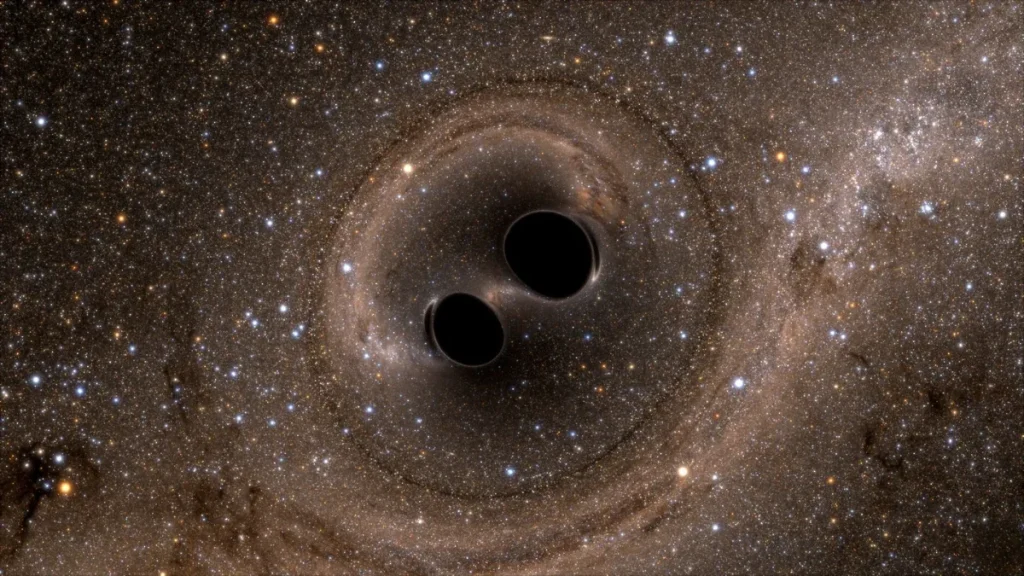
Imagine two cosmic heavyweights, black holes so colossal they make our Sun look like a speck, spiraling toward each other in a dance that shakes the universe. On November 23, 2023, scientists caught the echoes of this epic collision, named GW231123, through tiny ripples in space-time called gravitational waves. Detected by the LIGO-Virgo-KAGRA team, this is not just any black hole merger, it is the biggest ever recorded, and it is turning our understanding of the cosmos upside down.
These were not ordinary black holes. One weighed about 103 times the mass of our Sun, the other around 137. Spinning at mind-boggling speeds, nearly the maximum allowed by Einstein’s physics, they slammed together to form a single monster black hole, roughly 225 times the Sun’s mass. This clash, which happened about 10 billion light-years away, sent out a burst of gravitational waves that lasted just a tenth of a second but carried enough energy to outshine every star in the universe for that fleeting moment.
Why is this a big deal? For starters, these black holes are what scientists call intermediate-mass black holes, a rare breed bridging the gap between smaller stellar-mass black holes and the supermassive giants at galaxy centers. Even more intriguing, their masses, especially the 103-solar-mass one, fall in or near a mysterious zone called the pair-instability mass gap, where stars should not be able to form black holes at all. The 137-solar-mass black hole sits just above this gap, hinting that both likely grew through a cosmic game of mergers, where smaller black holes combine in dense star clusters over billions of years.
The signal from GW231123 was so extreme, thanks to those furiously spinning black holes, that it pushed the limits of our detectors and challenged the models we use to understand these cosmic beasts. Scientists are buzzing with excitement and shared their findings at the GR24 and Edoardo Amaldi conferences in Glasgow, Scotland, from July 14 to 18, 2025, with more discoveries likely to follow as they dig into this complex signal.
What’s a Black Hole, Anyway?
Picture a spot in space where gravity is so intense it swallows everything, even light. That’s a black hole. They form when massive stars burn out and collapse, squeezing their cores into a point of infinite density called a singularity, surrounded by an invisible boundary called the event horizon. Cross that line, and there is no turning back, it is like diving into a cosmic whirlpool.
The Black Hole Family
Black holes come in different flavors:
- Stellar-mass black holes: Weighing 5 to 100 times the Sun’s mass, these form from dying stars.
- Intermediate-mass black holes: Ranging from hundreds to thousands of solar masses, like the ones in GW231123.
- Supermassive black holes: Monsters millions to billions of times the Sun’s mass, like Sagittarius A* at the Milky Way’s core.
The Science of Their Pull
Albert Einstein’s theory of General Relativity, dreamed up in 1915, tells us that massive objects like black holes warp space and time like a heavy ball on a rubber sheet. Near a black hole, that warp is so extreme that light itself cannot escape, and time slows to a crawl. If you watched a friend approach a black hole, they would seem to freeze at the event horizon, stuck in a moment that stretches forever.
How Do We Spot Them?
Black holes do not glow, so spotting them is like finding a shadow in the dark. In 2019, the Event Horizon Telescope gave us a stunning first: a photo of a black hole’s shadow in the galaxy M87, a glowing ring of gas circling a dark void. It was proof of what Einstein predicted a century ago.
Then there is the LIGO-Virgo-KAGRA network, which hears gravitational waves, ripples in space-time caused by cosmic collisions like GW231123. These detectors, based in the U.S., Italy, and Japan, pick up signals so faint they are like whispers from across the universe. This latest merger, with its rapid spins and massive scale, is pushing our technology and our theories to the edge.
The Mystery of Lost Information
Here is where things get weird. Quantum mechanics says information, like the details of what falls into a black hole, cannot be destroyed. But black holes seem to swallow it whole, creating the black hole information paradox. Physicist Stephen Hawking suggested a clue: black holes might slowly leak energy through something called Hawking radiation, eventually evaporating. But whether this saves the lost information? That is still one of physics’ biggest head-scratchers.
Could Black Holes Birth New Universes?
Now for the wild stuff. Some scientists wonder if black holes could be gateways to new universes. Instead of collapsing into a singularity, the stuff inside might bounce and spark a new cosmos. It is a far-out idea tied to multiverse theories, and while it is not proven, it makes you wonder what secrets black holes are hiding. As astrophysicist Dr. Janna Levin might say, in the spirit of her work, “Black holes are where our understanding of reality gets stretched to the breaking point.”
What’s Next?
Since LIGO’s first gravitational wave detection in 2015, scientists have confirmed nearly 100 black hole mergers, with over 300 candidate events, including recent ones like GW231123 from the fourth observing run. Future observatories like LISA, a space-based detector set for the 2030s, and LIGO-India, expected by 2027, will catch even more cosmic crashes, letting us peek deeper into the universe’s past.
GW231123 is a game-changer. It confirms intermediate-mass black holes exist and might be more common than we thought. It also shows that the universe loves to keep us guessing, with black holes spinning and merging in ways we are just beginning to understand. So next time you gaze at the stars, imagine these invisible giants, twirling and colliding in the dark, rewriting the story of the cosmos with every earth-shaking crash.