




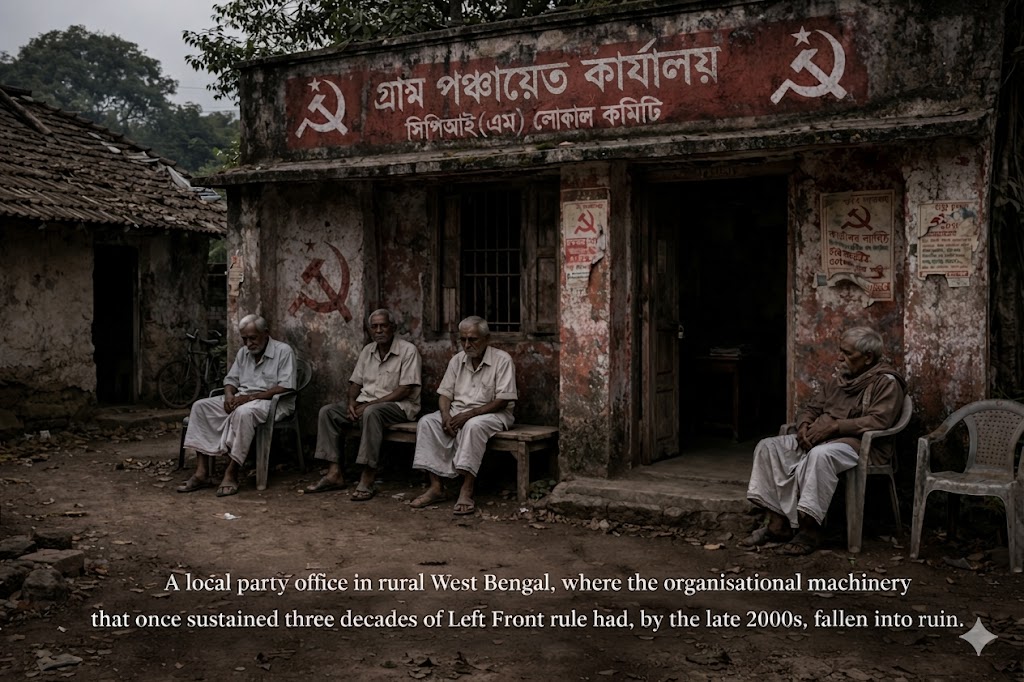
The Slow Unravelling of the Left: How the CPI(M)’s Political Machinery Collapsed in West Bengal
When the Left Front lost power in 2011, the defeat was widely interpreted as the triumph of a determined challenger. Yet the fall of the communist establishment in West Bengal cannot be explained solely through the rise of Mamata Banerjee. The deeper story lies in the gradual weakening of the political system that had sustained the dominance of the Communist Party of India (Marxist) for more than three decades.
For much of its history, the CPI(M)’s authority in Bengal rested not only on electoral success but on an elaborate network of organisational control. Over time, however, this very structure began to suffer from stagnation, ideological contradictions, and a growing disconnect between party leadership and the electorate.
The Architecture of Communist Power
The strength of the Left Front lay in what political scientists often described as a “party society”. The Communist Party of India (Marxist) developed a dense network of cadres embedded in trade unions, agricultural cooperatives, student organisations, and local governing bodies.
Through the three-tier panchayati raj system, the party exerted considerable influence over rural governance. Village councils became not merely administrative units but also instruments of political mobilisation. This system enabled the Left to maintain a durable presence across the countryside and convert organisational strength into electoral victories.
For decades, the arrangement proved extraordinarily resilient. Rural voters, particularly small farmers and agricultural labourers, remained firmly aligned with the Left Front, which had delivered tangible benefits through land reforms and decentralised governance.
Yet the very success of this system eventually created the conditions for its decline.
From Cadre Discipline to Bureaucratic Rigidity
Long periods in power often transform revolutionary organisations into administrative establishments. By the late 1990s and early 2000s, many observers noted that the once-dynamic cadre culture of the CPI(M) had begun to exhibit signs of institutional fatigue.
The party apparatus increasingly resembled a bureaucratic hierarchy rather than a political movement. Local leaders who had once mobilised grassroots support were now perceived by many voters as gatekeepers controlling access to government resources and welfare schemes.
This transformation weakened the ideological appeal that had once distinguished the communist movement in Bengal. The party remained organisationally powerful, but its connection with everyday public sentiment was gradually eroding.
The Leadership Transition
Another factor contributing to the weakening of the Left was the transition in leadership after the long tenure of Jyoti Basu. His successor, Buddhadeb Bhattacharjee, was widely respected for his intellectual outlook and administrative competence. However, the political environment he inherited was markedly different.
By the early 2000s, the economic landscape of India had begun to change rapidly. Liberalisation and industrial expansion in other states highlighted Bengal’s relative economic stagnation. Seeking to revitalise the state’s economy, Bhattacharjee pursued policies designed to attract private investment and promote industrial development.
While economically rational, this policy shift produced a profound political dilemma for the Left.
The Contradiction of Industrialisation
The CPI(M) had built its legitimacy upon defending the interests of peasants and rural labourers. Yet industrialisation required land acquisition, often involving fertile agricultural land.
The most prominent controversy emerged in Singur, where land was acquired for a proposed automobile factory by Tata Motors. Resistance soon spread to Nandigram, where villagers protested against plans for a chemical industrial zone.
These conflicts exposed a striking ideological contradiction. A government historically associated with agrarian reform was now perceived as facilitating the displacement of farmers. The political damage was severe.
The protests provided an opportunity for opposition forces, particularly the movement led by Mamata Banerjee, to challenge the moral authority of the Left Front.
Erosion of Rural Loyalty
For decades, rural Bengal had formed the electoral backbone of the Left. However, the controversies surrounding Singur and Nandigram weakened this bond. Farmers who had once benefited from land reforms now feared losing their land to industrial projects.
At the same time, generational changes were reshaping rural society. Younger voters were less influenced by the historical memory of land reforms and more concerned with employment opportunities and economic mobility.
This shift gradually diluted the emotional attachment that earlier generations had felt toward the communist movement.
Urban Discontent and Economic Frustration
Urban voters also began to question the Left’s governance model. Despite its strong ideological orientation, the government struggled to generate the kind of economic growth seen in states such as Gujarat and Maharashtra.
Kolkata’s once-formidable industrial base had declined significantly over previous decades, and many younger residents perceived limited prospects for economic advancement within the state.
This environment created fertile ground for alternative political narratives promising change and renewal.
The Collapse of an Electoral Fortress
By the end of the 2000s, these various pressures had converged: organisational fatigue, ideological contradictions, rural unrest, and urban dissatisfaction. The political system that once appeared invincible was steadily losing its capacity to mobilise voters.
In the 2011 state elections, the Communist Party of India (Marxist) and its Left Front allies were decisively defeated by the All India Trinamool Congress led by Mamata Banerjee.
The result marked the end of thirty-four uninterrupted years of communist rule in West Bengal, one of the longest continuous tenures of an elected communist government anywhere in the world.
A Political System That Outlived Its Moment
The fall of the Left in Bengal illustrates a broader political lesson. Dominant political systems often collapse not suddenly but through a gradual process of institutional erosion. Organisational strength can sustain electoral success for decades, but it cannot indefinitely compensate for declining legitimacy and changing social expectations.
By the time the electorate delivered its verdict in 2011, the communist establishment had already lost much of the vitality that had once made it formidable.
Part III of this series examines how the Bharatiya Janata Party, once a marginal force in West Bengal, emerged as the principal challenger to the dominance of Mamata Banerjee and her All India Trinamool Congress.
