




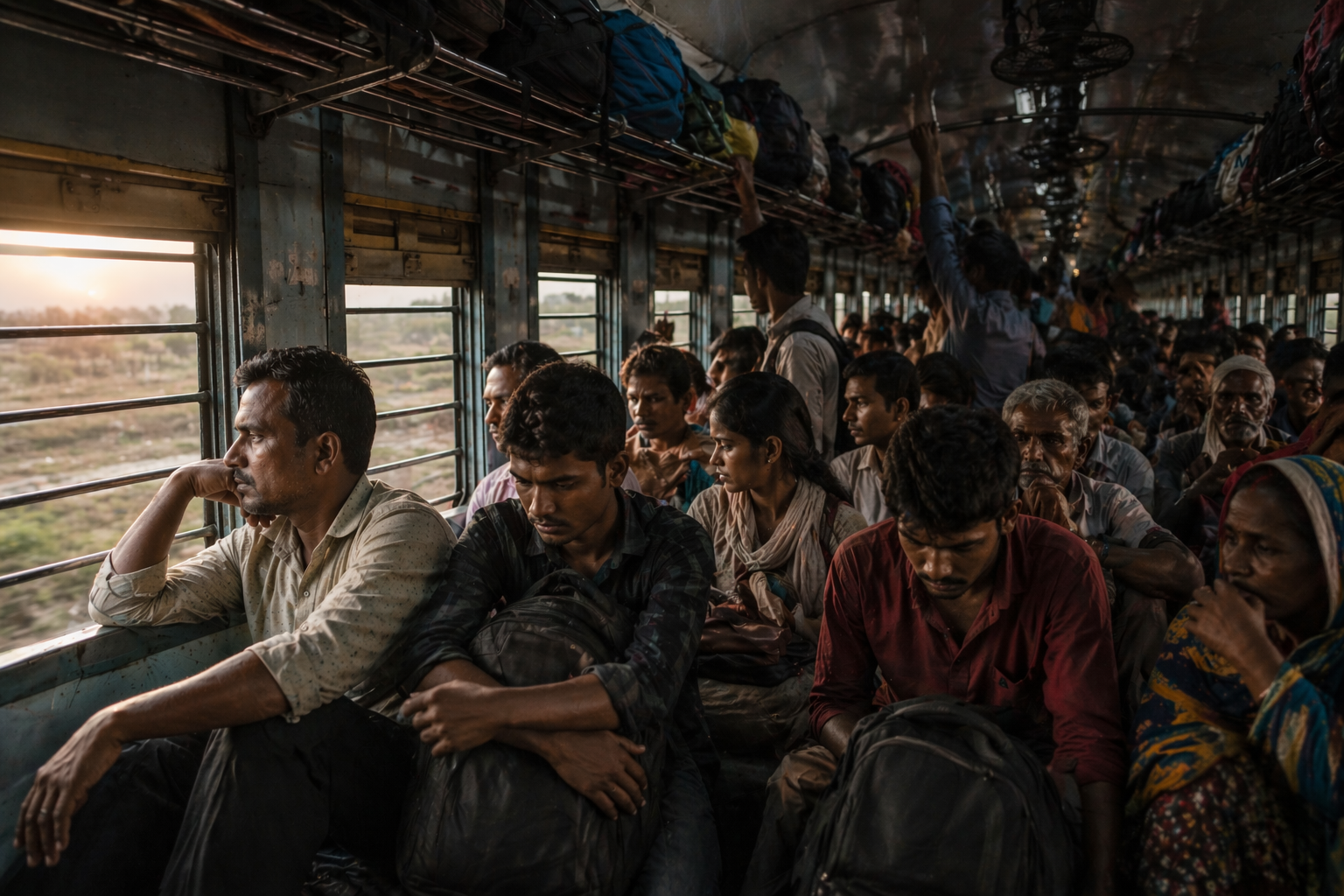
The train from Surat to Howrah takes roughly 36 hours. It passes through Vadodara, Ratlam, Itarsi, Nagpur, and then begins the long eastward crawl into Bengal. On the nights of April 20 and 21, those trains were packed.
Not with tourists. Not with pilgrims heading to a festival. They were packed with men and women who work in textile units, construction sites, and domestic households hundreds of kilometres from home, people who had not seen their villages in months, sometimes years. They had taken emergency leave, forfeited a week’s wages, and bought last-minute tickets in the general compartment because they had heard something back home that unsettled them deeply.
They had heard their names might not be on the voter list anymore.
On April 23, West Bengal voted in the first phase of its Assembly election, covering 152 constituencies. By 7 PM, the state had recorded a turnout of over 91 percent, a number that made headlines across the country as a triumph of democratic participation.
It is a remarkable number. It is also a number that deserves to be read carefully, and with some patience, because the story behind it is not simply one of enthusiastic voters. It is a story about what fear does to people, and what people do when they are afraid of disappearing.
A list that changed everything
In October 2025, the Election Commission of India announced a Special Intensive Revision SIR of electoral rolls in five states heading to polls: West Bengal, Assam, Tamil Nadu, Kerala, and Puducherry. The stated purpose was legitimate and straightforward: clean up the rolls of deceased voters, absentee names, duplicate entries, and those who had moved away permanently. Intensive revisions of this kind have been conducted thirteen times since Independence, the last being in 2004.
But the scale of what happened in West Bengal was unlike anything the state had seen before.
By the time the revision concluded in early April 2026, approximately 91 lakh names had been removed from the electoral rolls of West Bengal. The state’s registered voter count shrank from roughly 7.6 crore to approximately 6.8 crore, a reduction of nearly 12 percent of the entire electorate in one exercise.
Of the 91 lakh removed, around 60 lakh were categorised as absentee, deceased, or having moved. Another 27 to 30 lakh names remained disputed, their cases referred to special electoral tribunals that, given the sheer volume, had little realistic chance of hearing all cases before polling day. The Supreme Court, when approached, held that those with pending tribunal cases could not be permitted to vote in April.
In practical terms, this meant that millions of people who had voted in 2021 could not vote in 2026.
The districts where it hurt most
The deletions were not evenly distributed. Murshidabad district, in the western part of the state bordering Jharkhand, saw around 4.6 lakh names removed. North 24 Parganas, just north of Kolkata, lost approximately 3.3 lakh voters. Malda, in the north, saw around 2.4 lakh deletions. Even Kolkata, the state capital, had nearly 7 lakh names removed from its rolls.
These are not abstract numbers. Each number is a person who walked to a booth in 2021, cast a ballot, went home, and in 2026 discovered that the system no longer recognised them as a voter.
Nabijan Bibi, a widow in her sixties from North 24 Parganas, was one such person. Her voter card listed her as “Nabijan.” Her Aadhaar card said “Nabirul.” Nobody in her family had ever considered this a problem; these were different renderings of the same name, a common occurrence in rural Bengal where nicknames travel easily between official documents. Her husband was on the list. Her sons were on the list. She was not.
Stories like hers multiplied in the weeks before the election. A retired schoolteacher in Malda who found his wife’s name missing despite having the same address for 40 years. A farmer in Murshidabad who discovered his mother, 78 years old, who had never missed an election had been classified as “absentee.” A young man in Burdwan who had moved temporarily to Delhi for work and returned to find himself categorised as having “shifted permanently.”
The migrant who came back
Here is something that did not make it into most of the headline coverage: for every person who lost their vote, there were many more who were terrified they might lose it and who resolved, quietly and urgently, to do something about it.
Across the industrial belts of Gujarat, Maharashtra, and Karnataka, Bengal’s migrant workers estimated to number in the millions across India began receiving calls from home. Brothers calling brothers. Mothers calling sons. The message, in various forms, was the same: Come back. Vote. Make sure your name is still there.
Ranjit Mondal, a welder from Birbhum who had been working in Surat’s textile industry for two years, described it simply: “My mother called me and said, ‘Your name is there, but come back and vote or they might do something.’ I didn’t want to argue. I took leave and came.”
He is not alone. Railway data for the Howrah-bound superfast trains in the week before April 23 showed unusually high occupancy in the general and sleeper compartments, with a surge in bookings from Gujarat, Maharashtra, and Karnataka three of the biggest destinations for Bengali migrant workers. The pattern repeated in local reports from Murshidabad, Malda, and Cooch Behar districts that send large numbers of workers out of state.
They came back. They stood in queues in the April heat. They cast their votes. And then many of them boarded trains back to their jobs.
When the ballot becomes identity
There is something profound, and something quietly troubling, in this image.
Democratic theory tells us that voting is the mechanism through which citizens express their preference for governance. You vote for the candidate or the party you believe will best serve your interests and your community. The ballot is an instrument of choice.
But what happens when the act of voting stops being primarily about choice and becomes primarily about proof? When standing in a queue is not just civic participation but a declaration I am here, I exist, I belong?
Dr. Prasanta Biswas, a sociologist at Presidency University in Kolkata who has studied electoral behaviour in Bengal for over two decades, puts it this way: “What we witnessed this election was not simply enthusiasm. It was anxiety expressing itself through democratic participation. People came out to vote not because they felt empowered, but because they felt threatened. There is an important difference, and we must be honest about it.”
The distinction matters because it changes how we read the headline number. A 91 or 92 percent turnout in normal circumstances tells you that people feel the election matters and that their voice counts. In the context of this election, it tells you something more complicated: that millions of people felt that not voting carried a cost that exceeded the ordinary cost of political disengagement.
In other words, they felt they could not afford to stay home.
The women who almost didn’t count
One dimension of this story that has received less attention than it deserves involves women particularly women in rural areas who changed their surnames after marriage, or who are known by nicknames that do not match their official documents precisely.
India’s patrilocal system means that women, when they marry, often shift households and sometimes villages. Their voter registrations follow them, but the bureaucratic trail can be imperfect. A woman registered in her maiden name in one village, who then appears in a different village under her married name, can end up on neither list or on one list with a slightly different spelling than her other documents.
Swati Narayan, a legal scholar who has studied electoral enrolment and marginalisation, noted in her research that women and those living in poverty face disproportionate risk in any intensive voter roll revision, precisely because they are more likely to lack the clean, consistent paper trail that makes identity verification straightforward. “In case of women,” she observed, “they shift homes, especially after marriage. There can also be errors in translating names into English. What we saw was large-scale panic among residents.”
Some of the most poignant accounts from Bengal in the weeks before the election involved elderly women, some illiterate, some widowed, some who had never owned a document in their own name suddenly confronted with the requirement to prove not just who they were but that they had always been who they claimed to be.
The math behind the miracle turnout
There is also a statistical dimension to the 92 percent figure that deserves honest acknowledgment.
Turnout is calculated as a fraction: votes cast divided by total registered voters. When the denominator of the registered voter base is reduced by 91 lakh, the fraction increases, even if the number of people actually voting remains roughly the same.
Consider it this way: if in 2021 a constituency had 1,00,000 registered voters and 75,000 voted, the turnout was 75 percent. If in 2026 the same constituency had 88,000 registered voters (due to deletions) and 78,000 voted, the turnout would be recorded as 88.6 percent even though only 3,000 more people actually went to the booth.
Analysts who have worked through district-level data suggest that a meaningful portion of the headline turnout increase is attributable to the shrinkage of the denominator, not solely to an increase in the numerator. This is not to say that actual participation did not increase the returning migrants and the fear-driven mobilisation is real. But the full picture of what produced that 92 percent is more complex than any single headline can hold.
What democracy owes its most anxious citizens
On the morning of April 23, in a village in Murshidabad, a 70-year-old man named Habibur Rahman walked 3 kilometres to his polling booth. He had voted in every election since 1977. His name was on the list. He voted.
He told a local reporter afterward: “I came because I needed to show that I am here. I have always been here.”
That sentence I needed to show that I am here is not the language of a citizen exercising a routine democratic right. It is the language of someone who feels that their presence in their own country has become conditional, subject to verification, open to challenge.
There is no political blame to assign for this feeling, and this article does not attempt to assign any. The SIR was a lawful exercise conducted by a constitutionally mandated body. Courts reviewed it and largely allowed it to proceed. The political debate around it fierce on all sides reflects genuine and legitimate disagreements about immigration, identity, documentation, and the boundaries of citizenship in a complex, densely populated state.
But the feeling itself, the anxiety, the fear, the sense that the ballot was the last line of defence against erasure is a fact. It was felt by real people, in real places, and it shaped one of the largest electoral turnouts this country has ever seen in a state election.
After the booth
The trains going back to Surat and Mumbai and Delhi began filling up on the evening of April 23 itself. Some of the returning migrants had managed a day or two at home. Others had come solely for the vote and left almost immediately after.
Ranjit Mondal, the welder from Birbhum, was on one of those trains. He had voted. His name had been on the list. He felt, he said, “lighter” than when he had arrived.
But he also said something that stayed with the people who spoke to him: “Until next time,” he said, “I don’t know if it will be okay.”
He was not speaking about the election result. He was speaking about the list.
That worry, quiet, personal, not easily resolved by any political party’s victory or defeat — is perhaps the most important thing that the 92 percent turnout number carries within it. Not a story of triumph, but a story of resilience under pressure. Not a demonstration of confidence in democracy, but a determination to hold on to it.
In a country as large and as complicated as India, those two things can look identical from the outside. It is only when you ride the train, and listen to the people on it, that you begin to understand the difference.
Subscribe Deshwale on YouTube
