






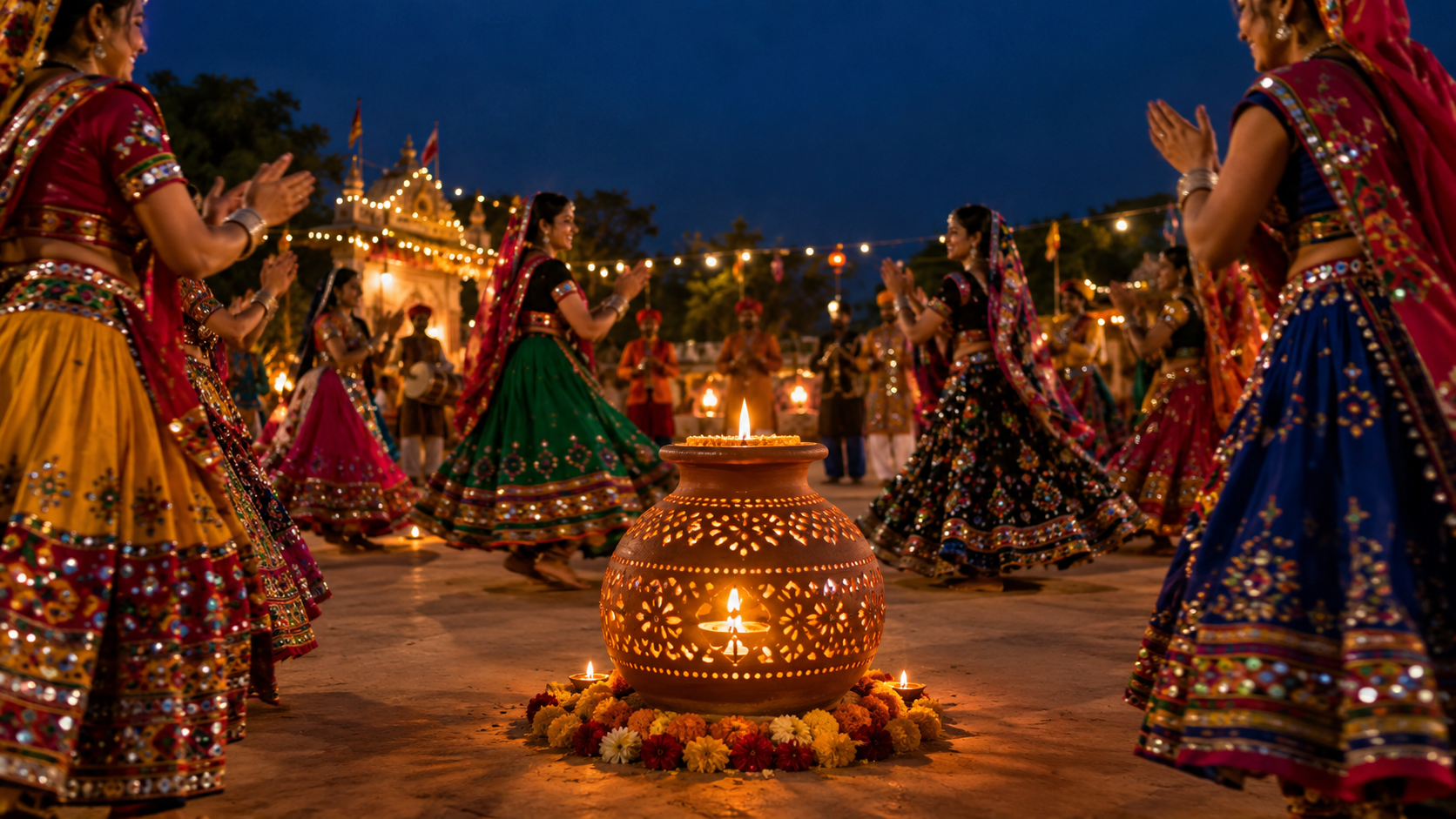
Walk into any Garba ground this Navratri, in Ahmedabad, Mumbai or New Jersey, and the picture looks the same. Loud music, bright chaniya cholis, thousands of people moving in rings. Very few of them look at what sits at the centre: a small clay pot with a lamp inside. That pot is the reason Garba exists.
The word Garba comes from the Sanskrit word garbha, which means womb. The lamp inside the pot is called the garbha deep, or the womb lamp, and it is usually read as a symbol of the body that holds the divine energy of the Goddess. UNESCO describes Garba as a ritualistic and devotional dance performed during Navratri, a festival dedicated to the worship of feminine energy, or Shakti. The dancers move around a perforated earthen pot lit with an oil lamp, or around an image of the mother goddess Amba. Today many places keep an image of Durga at the centre instead of the pot, but the idea does not change: the dance is built around something sacred, and everyone else moves around it.
The shape of the dance carries the same idea. According to UNESCO, the dancers move counter-clockwise, using simple steps while they sing and clap in unison. The dance starts with slow circular movements, and the tempo gradually builds up to a frenzied whirl. When the crowd is large, people form many rings, one inside the other. Seen from above, the centre stays still while everything around it keeps moving, faster and faster. Writers on Garba often say this shows the Goddess staying constant while the world changes around her. It is a belief, not a rule, but it explains why the lamp, and not the dancer, is the main character.
Garba is also, at its heart, a women’s celebration. Britannica notes that it celebrates fertility, honours womanhood and pays respect to the mother goddesses. In Gujarat, it also customarily marks a girl’s first menstrual cycle and, later, her coming marriage. Women are the typical performers, although men may take part on some occasions. That detail is easy to miss today. In many homes, periods and marriage preparations are still spoken about quietly, yet Garba took exactly these life moments and placed them inside a community celebration, with songs, lights and the whole neighbourhood watching.
Most people say “Garba and Dandiya” in one breath, but they are two different dances. Garba is danced with hand and foot movements and claps, while Dandiya Raas is danced with a pair of decorated sticks. Tradition gives the sticks two stories. In one, they stand for the swords of Goddess Durga, and the dance stages her mock fight with the demon king Mahishasura. In the other, Raas comes from the raas leela of Krishna and Radha. Both stories are told with equal confidence, so it is safest to call them traditional beliefs, not settled history.
The most surprising line in UNESCO’s description is not about the Goddess at all. It says Garba fosters social equality by diluting socio-economic, gender and religious structures. The people who keep it alive are described as broad and inclusive: dancers, musicians, social groups, craftspeople and religious figures. And it is passed on the old way, through practice, imitation and observation, in both villages and cities. That fits how Garba grew. It began in the villages of Gujarat, in open spaces at the heart of the community, where the whole village could join. In the circle, no one is in the front row.
In December 2023, at its 18th session in Kasane, Botswana, UNESCO added “Garba of Gujarat” to its Representative List of the Intangible Cultural Heritage of Humanity. It was India’s 15th element on the list, and the nomination was prepared by the Maharaja Sayajirao University of Baroda, the Sangeet Natak Akademi and the Ministry of Culture. But the Garba most people experience today looks different from the village square. In 2025, a report from DeshGujarat said that season passes at some of the top events in Ahmedabad had crossed ₹10,000. In Vadodara, the season pass for women at the LVP Heritage Garba rose from ₹1,300 in 2024 to ₹2,100 in 2025, while the pass for men cost ₹5,500. The hikes drew backlash online, with many people calling it the commercialisation of a grassroots tradition.
Then there is the question of who gets in. Ahead of Navratri 2026, the Vishwa Hindu Parishad issued guidelines for organisers in Maharashtra that included Aadhaar verification and a tilak to confirm Hindu identity. The organisation says Garba is a form of worship and its religious character should be protected. Critics and civil liberties activists question whether such checks are legal and what they mean for privacy. In Bhopal, organisers were divided: some events stayed open to people of all faiths, while others planned ID checks. This is a live debate, and there are serious arguments on both sides. What can be said plainly is that UNESCO’s text describes an inclusive tradition, and the way organisers, communities and courts settle these questions will decide how much of that description is still true.
We play Garba to honour the Goddess, to celebrate life and womanhood, and to dance together as equals. The glitter, the passes and the reels are the newest layers. The lamp is the oldest one. So this Navratri, before you step into the ring, take one moment to look at the centre. It is a small thing, but it will tell you what the circle was built for.
Subscribe Deshwale on YouTube


