




In 2025, millions of degree-holders worldwide, including in India, face a stark reality: their qualifications do not guarantee employability. Despite holding diplomas, over 30% of global graduates remain unemployed or underemployed within a year of graduation (ILO, 2024). In India, this figure is higher, with 40% of graduates deemed unemployable due to skill gaps (NASSCOM, 2025). The culprits, poor quality education, a cultural fixation on rapid career progression, and misaligned job approaches, are not isolated issues but symptoms of a deeper systemic failure. This article proposes a transformative solution: lifelong learning ecosystems, blending AI-driven upskilling, micro-credentials, and community mentorship to bridge the employability gap from global and Indian perspectives.
The Employability Crisis: A Global and Indian Snapshot
Globally, the employability crisis stems from a disconnect between education systems and labour markets. The World Economic Forum (2025) notes that 50% of current job skills will be obsolete by 2030 due to automation and AI. Yet, universities often teach outdated curricula, with 60% of global institutions failing to integrate emerging fields like data science or green technology (UNESCO, 2024).
In India, the challenge is amplified by scale and socio-cultural factors. With 35 million students enrolled in higher education annually (AISHE, 2024), the system prioritizes rote learning over critical thinking. A 2025 Aspiring Minds report found that 80% of Indian engineering graduates lack basic coding skills, despite India’s IT sector employing 5 million people. Cultural pressures, such as parental expectations for prestigious degrees (e.g., engineering or medicine), and a “get-rich-quick” mindset drive graduates toward mismatched careers, further exacerbating unemployability.
Root Causes: Beyond Poor Education
Outdated Curricula: Globally, 70% of degree programs lag behind industry needs by at least five years (McKinsey, 2025). In India, only 10% of colleges offer industry-aligned courses like AI or cybersecurity.
Misaligned Aspirations: The pursuit of quick success fuels job-hopping; 45% of Indian graduates switch jobs within a year, seeking higher pay over skill-building (LinkedIn, 2025).
Lack of Soft Skills: Employers worldwide prioritize communication, problem-solving, and adaptability, yet 65% of Indian graduates lack these skills (SHRM, 2024).
Socio-Economic Barriers: In India, rural graduates (60% of the student population) face limited access to quality education and digital infrastructure, widening the employability gap.
A Super Thought-Provoking Solution: Lifelong Learning Ecosystems
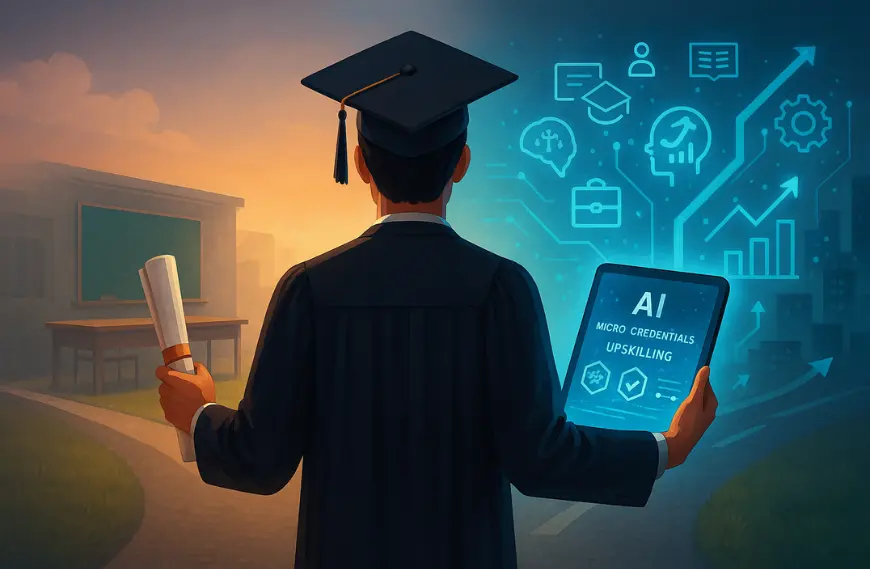
To address this crisis, education must evolve into lifelong learning ecosystems, dynamic, interconnected frameworks that integrate:
AI-Driven Upskilling: AI platforms like Coursera and UpGrad use adaptive learning to tailor courses to individual skill gaps. In 2025, India’s National Skill Development Corporation partnered with Google to offer free AI literacy courses to 10 million youth, boosting employability by 25% in pilot regions.
Micro-Credentials: Short, industry-recognized certifications in fields like cloud computing or renewable energy allow learners to stay relevant. Globally, 40% of employers now value micro-credentials over traditional degrees (Forbes, 2025).
Community Mentorship: Local mentorship networks, supported by platforms like LinkedIn, connect graduates with industry professionals. In India, initiatives like Mentor India have mentored 500,000 students since 2023, improving job placement by 15%.
Public-Private Partnerships: Governments and corporations must collaborate to align education with market needs. Singapore’s SkillsFuture program, a global benchmark, offers subsidies for continuous learning, inspiring India’s 2025 Skill India 2.0 initiative.
This ecosystem shifts the focus from one-time degrees to continuous, personalized learning, fostering resilience and adaptability in a volatile job market.
Global and Indian Impact
Globally, lifelong learning ecosystems could reduce youth unemployment by 20% by 2030 (ILO projection). In India, scaling such systems could address the 12 million annual job seekers entering the workforce. For instance, Karnataka’s 2025 pilot program, integrating AI upskilling with micro-credentials, increased employability among rural graduates by 30% in six months.
This approach also tackles cultural barriers. By promoting skill-based certifications over prestigious degrees, it challenges India’s obsession with traditional qualifications. Globally, it counters the “quick success” mindset by rewarding long-term skill development over short-term gains.
Challenges and Ethical Considerations
Access Inequality: In India, only 40% of rural areas have reliable internet for online learning (TRAI, 2025), risking exclusion of marginalized groups.
Cost Barriers: While micro-credentials are cheaper than degrees, affordability remains an issue for low-income learners globally.
Resistance to Change: Traditional institutions and employers may resist non-degree pathways, as seen in India’s slow adoption of vocational training.
Data Privacy: AI platforms collecting learner data must comply with GDPR and India’s Personal Data Protection Act (2024).
The Road Ahead
By 2030, the global lifelong learning market is projected to reach $1 trillion (Forbes). India, with its young population, could lead by integrating ecosystems into its National Education Policy (NEP) 2020. Partnerships with tech giants, like Microsoft’s 2025 collaboration with Indian universities, could scale AI-driven learning to 50 million students by 2028.
The employability crisis demands a bold reimagination of education. Lifelong learning ecosystems, blending AI, micro-credentials, and mentorship, offer a sustainable path to bridge the gap between degrees and jobs. For India, this approach aligns with its demographic dividend, while globally, it sets a precedent for future-proofing workforces. The question is not whether we can afford to build these ecosystems, but whether we can afford not to.
