



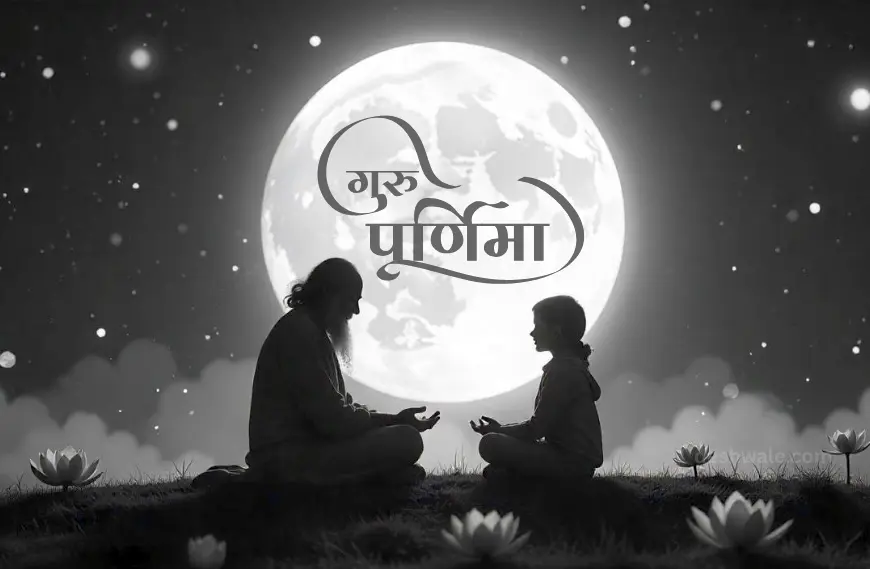
The Essence of Guru Purnima
- Guru Purnima is celebrated on the full moon of the Hindu month Ashadha.
- It marks the birth anniversary of Sage Ved Vyasa and honours the guru–disciple tradition.
- The day holds special importance in Hindu, Buddhist, and Jain faiths.
- It includes rituals like guru worship, recitation, and offering gratitude to teachers.
“Guru bina gyaan nahi”- this old Indian saying shows how important a guru is. Guru Purnima and its meaning lie in giving thanks to those who guide us. Celebrated on the full moon of Ashadha, this day honours not just spiritual teachers but schoolteachers too. In Sanskrit, “Gu” means darkness and “Ru” means one who removes it. So, a guru removes the darkness of ignorance.
This year, Guru Purnima falls on 10 July 2025. It gives us a moment to reflect on the value of teachers. But where did this tradition begin?
The origins of Guru Purnima
Guru Purnima is also known as Vyasa Purnima. It marks the birth of Sage Ved Vyasa. He was the son of Rishi Parashar and Satyavati. Ved Vyasa divided the Vedas into four parts… Rigveda, Yajurveda, Samaveda, and Atharvaveda. His work made ancient knowledge more organised and accessible. He also wrote the Mahabharata, the longest epic in the world, which includes the Bhagavad Gita. In some beliefs, he is seen as a form of Lord Vishnu.
The yogic connection
In yogic belief, Lord Shiva, called the Adiyogi, gave knowledge to the Saptarishis on this day. He became the first guru. This event happened over 15,000 years ago. The story shows that Guru Purnima celebrates the gift of knowledge, not just one person.
Across faiths: A day of unity
The meaning of Guru Purnima goes beyond Hinduism. In Buddhism, this is the day when Lord Buddha gave his first sermon at Sarnath. In Jainism, Lord Mahavira made Gautam Swami his first disciple on this day. Guru Purnima brings unity across spiritual paths, showing that respect for gurus is a shared value.
Celebrations in India
People across India celebrate Guru Purnima with deep respect. They offer flowers, sweets, and gifts to their teachers. In ashrams, spiritual talks and meditation sessions take place. For example, the Isha Foundation organises large gatherings with Sadhguru on this day.
In classical arts, students honour their gurus with performances. Schools and colleges organise special events to appreciate teachers. In Maharashtra and Gujarat, processions and cultural programs are held. Many also worship Lord Vishnu and Goddess Lakshmi for knowledge and prosperity.
Gurus who shaped India
A great example of the guru–disciple bond is between Ramakrishna Paramhansa and Swami Vivekananda. Ramakrishna gave spiritual knowledge to Vivekananda and inspired him to speak at the 1893 Parliament of World Religions in Chicago. That speech brought Hindu philosophy global attention. It shows how one teacher can change the world.
The Wisdom of Saints
Saint Kabir captured the essence of the guru in this famous couplet:
“Guru Govind dou khade, kake laagun paaye
Balihari Guru aapki, Govind diyo batay”
Means: When God and guru stand together, one should bow to the guru first, as he leads us to God.
An inner journey
Guru Purnima is not only about rituals. Many begin their spiritual path on this day. It also helps us recognise the inner teacher within. A verse from the Skanda Purana says:
“If your mind is not focused at your guru’s feet, then what use is anything?”
It reminds us of the deep surrender that true learning needs.
Why it still matters
In today’s digital age, information is everywhere. Still, a guru helps us turn information into wisdom. Teachers give us moral values and discipline. Spiritual mentors help us seek answers about life. On this day, we remember all those who taught us something meaningful.
Learning never stops
True learning is a lifelong process. Gurus teach us that failures are lessons too. The story of Chanakya and Chandragupta shows how a wise teacher can shape a leader. Chanakya trained him not just in war, but in politics and leadership. It shows the strength of good mentorship.
Regional traditions
In North India, people visit temples and recite the Guru Gita. In South India, disciples serve and bow to their gurus. In the West, especially Gujarat and Maharashtra, cultural programs and processions are common. Some observe fasts and pray for their teachers. This diversity reflects India’s rich traditions.
The message of gratitude
Today, Guru Purnima and its meaning hold new value. Teachers now include mentors, parents, managers, and coaches. Everyone who teaches us deserves our thanks. The values of humility, discipline, and service taught by gurus are timeless.
As the full moon sets, its glow stays in the form of wisdom. True knowledge shines brighter when shared. Every student becomes a light, carrying their teacher’s guidance into the future.
Guru Purnima in the modern world
The guru-disciple bond still lives on in new forms. In the corporate world, mentors are seen as modern gurus who guide career growth. In the tech space, ‘tech gurus’ help startups embrace digital change. Life coaches combine ancient wisdom with modern psychology to help people lead balanced lives.
Even online courses and webinars reflect this same tradition. So, Guru Purnima is no longer limited to temples and ashrams. It is now part of our daily lives.
For Indian readers especially, Guru Purnima is a moment to pause and honour all kinds of mentors… past and present. It reminds us to thank those who lit the way for us. Be it a schoolteacher, a parent, a manager, or a trainer, showing gratitude uplifts the spirit.
The values this festival teaches… humility, discipline, and service are timeless.
As the full moonlight fades, one message stays… true knowledge must be shared. Every student becomes a light, carrying the wisdom of their teacher into the future.
