



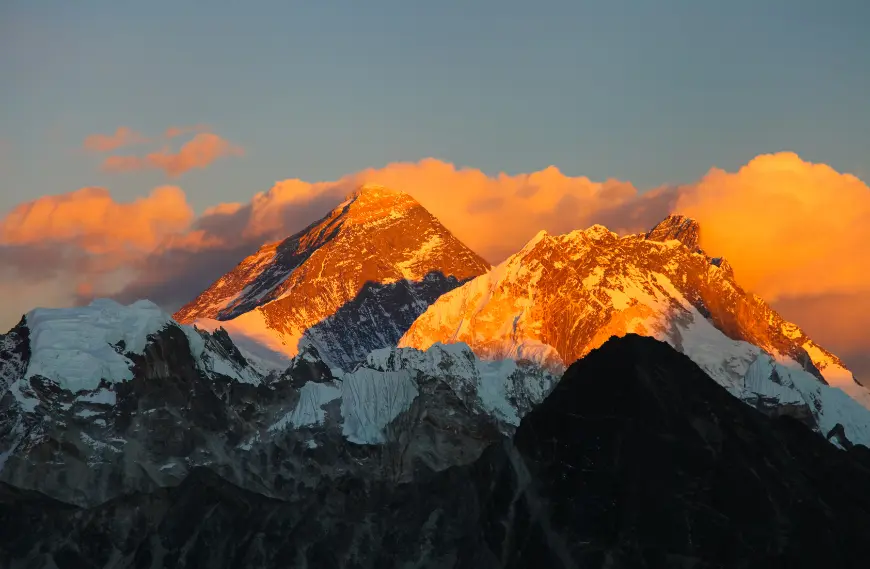
Towering above all other ranges, the Himalayas are not only the tallest mountains on Earth – they are also still growing. Every year, the Indian plate pushes north into the Eurasian plate, making the Himalayas rise by about 5 millimetres annually. This ongoing tectonic process triggers earthquakes, carves new valleys, and sustains some of Asia’s greatest rivers.
Birth of the Himalayas
About 50 million years ago, the Indian plate – moving at a speed of 15–20 cm per year – collided with the Asian continent. Unlike oceanic crust, both plates were made of light continental rock, so instead of one sinking below the other, they crumpled upward, forming the Himalayan arc stretching 2,400 km from Pakistan to Arunachal Pradesh.
Fossils of ancient seashells found in rocks high above sea level, such as in the Everest region, provide evidence of this collision’s marine past.
Ongoing Growth: The Ever-Rising Giants
Today, the Indian plate still moves north at about 5 cm per year. However, only part of this motion translates into uplift, as much of it is released through earthquakes and deformation. This forces the Himalayas higher, though erosion from wind, rain, glaciers, and rivers wears them down at nearly the same rate. The peaks remain mighty, but their exact heights keep changing.
For example, the 2015 Nepal earthquake raised parts of the Kathmandu Valley by nearly 1 metre in some areas, while other parts sank. It also caused landslides and altered river courses.
The Himalayas’ Tectonic Power
This colossal pressure makes the Himalayas one of Earth’s most earthquake-prone zones, with events such as the 2005 Kashmir earthquake and the 2015 Gorkha earthquake. Scientists study the Main Himalayan Thrust – the fault where India and Eurasia meet – to better predict and prepare for future quakes.
Meanwhile, mountain building continues: peaks like Nanda Devi, Kangchenjunga, and Everest inch ever higher into the sky.
A Barrier Shaping Climate
The Himalayas profoundly influence weather patterns. They block frigid winds from Siberia, keeping the Indian subcontinent warmer, and deflect the monsoon, forcing moist air upward to release rain. This feeds rivers like the Ganga, Indus, and Brahmaputra – lifelines for nearly a billion people.
Snow and glaciers act as natural water banks, releasing meltwater in dry months. However, climate change is reducing glacier mass and altering meltwater patterns, affecting long-term water security.
Glaciers: The Third Pole
The Himalayas hold one of the largest bodies of ice outside the Arctic and Antarctic, earning them the nickname “Third Pole.” These glaciers support rivers essential for drinking water, farming, and hydropower.
Recent studies show Himalayan glaciers are retreating faster than before, threatening water supplies and increasing the risk of floods from glacial lake outbursts.
The Himalayas are a dynamic masterpiece of geology, still sculpting themselves with every tectonic push. Understanding their restless rise helps us prepare for natural disasters and shows how these mountains sustain life far beyond their snowy peaks.
