 Deshwale
India’s AI Rise Is Being Powered by Classrooms, Not Just Code
In brief · AI summary India ranked third in the Stanford AI Vibrancy Index, and the article credits this mainly to a long-building education ecosystem that includes IITs, national research bodies and online learning platforms. It says AI talent now reaches beyond elite campuses through online courses, while many trained Indian workers are employed by global companies and labs. The article argues that this education base, rather than money or market size alone, explains India's position in the ranking.
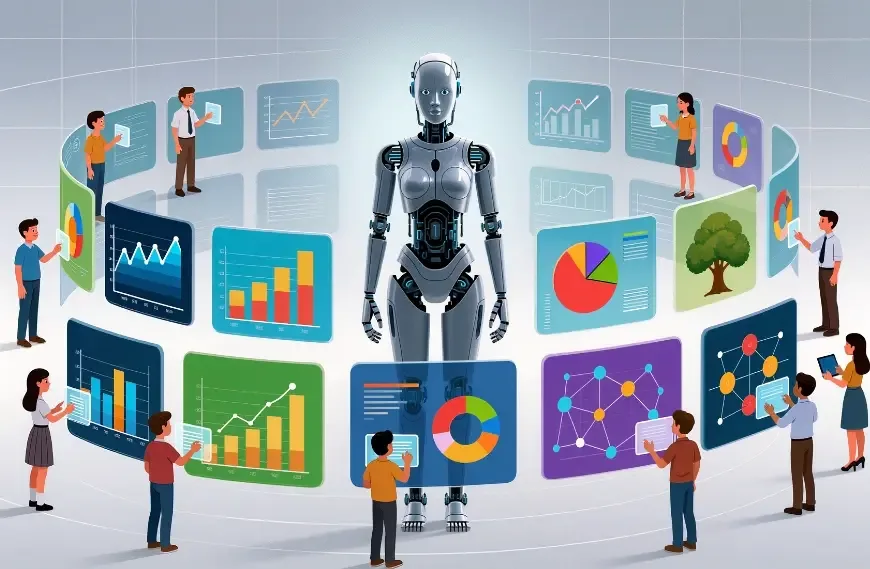
When India secured third place in the Stanford AI Vibrancy Index, the headlines quickly turned to startups, scale and global competition. But look a little closer and a quieter force stands out. The thing is, India’s surge in artificial intelligence is being driven not only by companies and capital, but by classrooms, campuses and a steadily expanding education ecosystem.
India AI education has become the backbone of the country’s growing credibility in the global AI race. And to be fair, this did not happen suddenly. It has been building for years, shaped by elite institutions, public research bodies and a new generation of online learning platforms feeding both domestic and international demand.
IITs and the research pipeline
At the centre of this ecosystem sit the Indian Institutes of Technology. For decades, IITs have supplied engineering talent to the world. Now, they are increasingly producing AI researchers, data scientists and machine learning specialists.
Dedicated AI centres at IIT Bombay, IIT Delhi, IIT Madras and IIT Hyderabad have expanded work in robotics, natural language processing, computer vision and applied AI systems. Collaboration with global universities and private industry has become routine, not experimental.
Why does this matter? Because rankings like the Stanford AI Index measure more than market buzz. They assess research output, talent concentration and long-term capacity. On those metrics, India AI education has clearly matured.
Research institutions step up
Beyond the IIT system, national research institutions have also played a critical role. Bodies such as the Indian Statistical Institute, IISc Bengaluru and several central universities have expanded AI-focused research programmes.
Government-backed initiatives have channelled funding into AI research, particularly in healthcare, agriculture, climate modelling and language technologies. These are not abstract use cases. They are practical deployments designed for Indian conditions, and that, surprisingly, is one reason India scores well on global vibrancy measures.
To be honest, the strength here lies in application, not spectacle. Indian researchers are trained to solve scale-heavy, real-world problems, and that training begins in academic settings.
The online learning boom
Now here’s the crazy part. India’s AI talent pipeline no longer depends only on elite campuses.
Online education platforms have transformed access to AI and data science training. From working professionals to final-year students in smaller cities, AI learning has become mainstream. Courses aligned with industry needs, often created with global tech firms, have significantly widened the talent base.
This matters because India AI education is no longer restricted by geography or income. The result is volume with depth, a rare combination in advanced technology fields.
And guess? Employers began treating Indian AI talent as immediately deployable, not just academically strong.
Feeding global demand
Believe it or not, a large share of India’s AI-trained workforce is now embedded in global companies, research labs and startups abroad. This outward flow often gets framed as brain drain.
But let’s be clear. It also reinforces India’s reputation as a trusted AI talent supplier. Global demand feeds back into domestic education systems through curriculum updates, partnerships and funding.
In effect, India AI education has become part of the global AI infrastructure, not an isolated national effort.
Policy and academic planning
For policymakers and education planners, India’s Stanford ranking carries a clear message. Sustaining AI momentum depends less on one-off schemes and more on institutional continuity.
AI courses are now being introduced at undergraduate levels, not just as specialised postgraduate options. Teacher training, compute access and interdisciplinary programmes are slowly becoming priorities.
The challenge, obviously, lies in scaling quality alongside access. Not every institution can become an IIT. But the broader system can be strengthened through standardised curricula, shared research resources and stronger industry-academia alignment.
Students at the centre
For students, the story is equally clear. AI is no longer a niche career path. It is becoming a core skillset across engineering, science, economics and even social sciences.
The Stanford AI Index ranking reinforces what many students already sense. Education choices made today are shaping India’s technological standing tomorrow. And that’s when it clicked for many families viewing AI not as hype, but as a long-term discipline.
Why education explains the ranking
So why did India rank third in AI vibrancy? The answer is not just money or market size.
It is the slow, structural expansion of India AI education, from elite institutes to online platforms, from research labs to classrooms across the country. This education engine feeds startups, strengthens public sector innovation and supplies global labour markets.
In other words, India’s AI rise is not accidental. It is taught, trained and tested every day.
That’s the truth.