 Deshwale
A Free Indo-Pacific: India’s Clear Message
In brief · AI summary At the ADMM-Plus meeting in Jakarta, Defence Minister Rajnath Singh said the Indo-Pacific should remain free, open, and inclusive, and free from coercion, guided by international law, sovereignty, and mutual cooperation rather than dominance or force. The article notes that over 60 percent of global trade passes through the region's sea lanes, which makes free and open navigation essential for India. It adds that India backs ASEAN's central role and promotes a rules-based order, such as the United Nations Convention on the Law of the Sea.
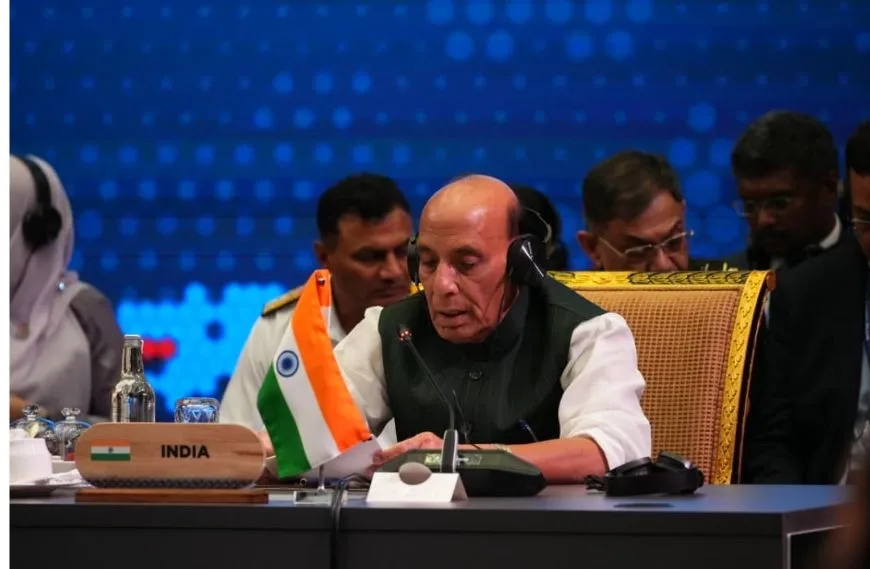
At a time when the Indo-Pacific is fast becoming the world’s most contested strategic region, India has once again underlined its stand that the area must remain free, open, inclusive, and free from any form of coercion.
Speaking at the ASEAN Defence Ministers’ Meeting Plus (ADMM-Plus) in Jakarta, Defence Minister Rajnath Singh sent a strong diplomatic message. He said the region should be guided by respect for international law, sovereignty, and mutual cooperation, not by dominance or force.
Singh’s remarks reflect India’s steady vision for a peaceful Indo-Pacific, where prosperity is shared and all countries, large or small, have equal space to grow.
Why the Indo-Pacific matters
The Indo-Pacific is more than just a collection of nations; it is the world’s busiest trade and energy corridor. Over 60 percent of global trade passes through these sea lanes, connecting the Indian Ocean with the Pacific Ocean through key routes like the Strait of Malacca.
For India, whose economy and energy needs rely heavily on these maritime routes, ensuring free and open navigation is essential. Any instability, coercion, or territorial control by a single power could directly affect India’s trade, security, and development.
By pushing for an open and rules-based Indo-Pacific, India is not only defending its own interests but also supporting a stable and secure maritime environment that benefits the entire world.
India’s vision: freedom, openness, inclusivity
Rajnath Singh’s statement emphasised three key values: freedom, openness, and inclusivity. These form the pillars of India’s Indo-Pacific strategy.
- Freedom means that all countries should have unrestricted access to sea routes and resources under international law.
- Openness stands for transparency and fair cooperation between nations.
- Inclusivity means that no region should be dominated or excluded by any single bloc or power.
India’s approach clearly rejects any form of coercion whether military, political, or economic that could harm regional peace.
ASEAN at the heart of regional security
India has always supported ASEAN’s central role in shaping the Indo-Pacific. Rajnath Singh reaffirmed that the ASEAN-led structure should remain the foundation for regional peace and cooperation.
Through initiatives such as the ADMM-Plus platform, India engages with ASEAN countries to build trust and work together on issues like maritime security, counterterrorism, cyber defence, and humanitarian aid.
This partnership reflects India’s Act East Policy, which focuses on deepening relations with Southeast Asian nations and ensuring that the region stays free from great-power rivalry.
Balancing power without confrontation
While Rajnath Singh did not name any specific country, his statement comes amid growing concerns about China’s increasing assertiveness in the South China Sea and parts of the Indian Ocean. Several nations have reported intimidation or obstruction in maritime navigation.
India’s response, however, remains calm and diplomatic. Instead of joining military blocs or taking a confrontational route, New Delhi favours an inclusive approach, where all countries cooperate under international law.
This strategy balancing engagement with strength shows how India wants to maintain peace while standing firm against coercion.
India’s expanding presence in the Indo-Pacific
In recent years, India has stepped up its presence and partnerships across the Indo-Pacific. It is an active member of the Quad alliance (with the United States, Japan, and Australia), which focuses on ensuring freedom of navigation, infrastructure cooperation, and disaster response.
India also conducts joint naval exercises such as Malabar and bilateral operations with ASEAN nations. These engagements build interoperability and trust among countries that share a vision of open seas.
Beyond security, India supports Blue Economy projects, climate initiatives, and digital cooperation across the Indo-Pacific, highlighting that its engagement goes beyond defence to development.
Rules-based order: The cornerstone of India’s policy
A central theme in India’s Indo-Pacific vision is a rules-based international order. Rajnath Singh stressed that all nations must follow international laws like the United Nations Convention on the Law of the Sea (UNCLOS), which governs freedom of navigation and maritime boundaries.
By standing for legal norms instead of power politics, India reinforces its image as a responsible and fair regional player, one that seeks peace through cooperation, not coercion.
A broader message to the world
Rajnath Singh’s statement is not only about the Indo-Pacific it also reflects India’s broader foreign policy philosophy. As a country that values sovereignty and non-interference, India promotes a global order built on equality, dialogue, and mutual respect.
In essence, India wants a world where progress is shared and power is not abused. Singh’s call for a coercion-free Indo-Pacific fits perfectly with this larger goal.
As global power shifts continue, the Indo-Pacific will remain central to future diplomacy, trade, and security. India’s consistent message that freedom, openness, and inclusivity must prevail sets a constructive tone for cooperation.
Through forums like ADMM-Plus, India will keep pushing for dialogue, shared development, and respect for international law. By doing so, it hopes to prevent conflict and preserve peace in one of the world’s most vital regions.
India’s clear message through Rajnath Singh’s speech is that the Indo-Pacific must remain a space of cooperation, not competition. The region should be guided by trust, respect, and fairness, not fear or force.
By upholding these principles, India is not only protecting its national interests but also contributing to global peace and stability ensuring that the Indo-Pacific truly remains free and open for all.
Subscribe Deshwale on YouTube