 Deshwale
Aging Gracefully: The Erosion of Joint Families in India
In brief · AI summary Only about 25 percent of India's elderly receive consistent family-based care, as urbanisation and economic migration leave many aging parents to manage alone, often with the help of an elderly spouse. Isolation raises the risk of depression, cognitive decline, and anxiety, which often go undiagnosed because of stigma. The article points to Japan's community support systems as an example and argues that India needs hybrid models that combine family, community, and professional care.
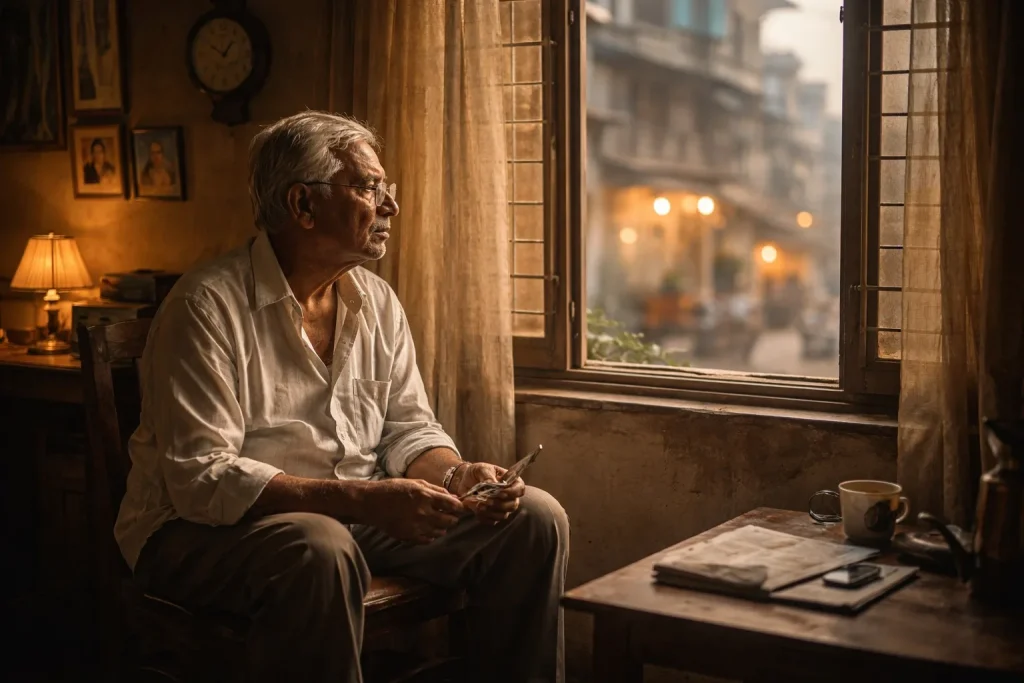
There is a particular kind of silence that settles into a home when the family has left. Not the peaceful quiet of a Sunday morning, but the hollow kind that an elderly person sitting alone in a two-room flat in Pune or Lucknow knows all too well. It is the silence left behind by children who moved to Bengaluru for work, or to Canada for a better future. It is the sound of a joint family coming undone.
For most of India’s modern history, the joint family was never just a living arrangement. It was a philosophy. Three generations under one roof meant that grandparents were never caregivers in isolation, nor were they ever truly dependent; they were simply part of the whole. Elders cooked, advised, told stories, and in doing so, remained woven into the daily fabric of life. Care was not a service rendered; it was a relationship lived.
That world is disappearing faster than most of us care to admit.
Today, only about 25 percent of India’s elderly population receives consistent family-based care. The joint family, once the default, is now the exception. In its place, a quieter and more difficult reality has taken root, one where the primary caregiver for an aging parent is often the spouse, themselves elderly, managing health conditions of their own. A 70-year-old woman caring for her 75-year-old husband is not an anomaly in urban India today. It is increasingly the norm.
The engine driving this unraveling is familiar: urbanisation and economic migration. India’s cities have drawn millions of young people away from their hometowns in search of opportunity, and rightly so. But the distance that separates a young professional in Hyderabad from their parents in a small town in Bihar is not merely geographical. It is a distance that WhatsApp video calls cannot truly bridge. The elderly left behind must now manage doctor’s appointments alone, navigate power cuts without help, and sit through long evenings with no one to speak to.
The consequences for mental health are significant and deeply underreported. Loneliness among India’s elderly is not simply an emotional inconvenience, it is a clinical risk factor. Depression, cognitive decline, and anxiety are measurably higher among seniors living in isolation. And because mental health remains stigmatised and under-resourced in much of the country, these conditions often go undiagnosed and untreated until they become crises.
The economic dimension is equally sobering. As family support structures weaken, the financial burden of elder care falls more squarely on individual households or on the elderly themselves, many of whom have limited savings and no formal pension. The absence of affordable, accessible care infrastructure means that families are often forced into impossible choices.
Japan, navigating a similar trajectory decades earlier, offers an instructive contrast. While Japan’s family bonds have also been tested by modernisation and migration, the country made a conscious decision not to let families carry the weight alone. Community support systems, neighbourhood care networks, and structured volunteer programmes were built to supplement not replace the family. The result is that elderly Japanese citizens are far less likely to fall through the cracks, even when their children live far away.
India has recognised the problem. The National Programme for Health Care of the Elderly, known as NPHCE, was designed to address gaps in geriatric care and bring services closer to those who need them. The intent is sound. But between policy and practice, between government announcements and the reality of an elderly woman sitting alone in a dimly lit room, the gap remains wide.
What India needs is not nostalgia for a joint family model that cannot be fully restored, but the imagination to build something new hybrid models that blend family involvement where it exists, community support where it doesn’t, and professional care where it is needed. The old system served its time well. The question now is what comes next.
That answer, increasingly, may lie in the innovations quietly transforming how Japan cares for its elderly at home, in communities, and with technology that places dignity at the centre.
Next in the series: Aging at Home Japan’s Home-Based Care Innovations and What India Can Learn.