 Deshwale
India’s Semiconductor Boom: A New Tech Powerhouse
In brief · AI summary India is positioning itself to become a global semiconductor hub, and in June 2025 the government approved three manufacturing units worth ₹1.5 lakh crore, including Tata's fab in Gujarat's Dholera. The push, backed by a ₹76,000 crore Production Linked Incentive scheme launched in 2021, faces challenges such as a scarcity of skilled talent, with only 3,000 engineers graduating annually in chip design, and power and water shortages in Dholera.
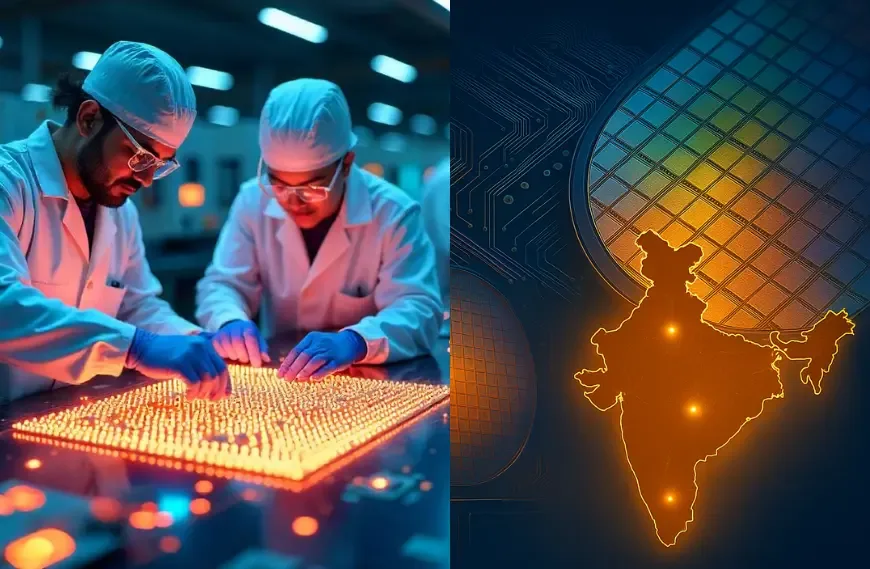
India is rewriting its tech destiny. Once reliant on imported chips, the nation is now poised to become a global semiconductor hub. In June 2025, the government approved three manufacturing units worth ₹1.5 lakh crore, including Tata’s fab in Gujarat’s Dholera. With global giants like Micron and TSMC investing, and China’s export curbs creating urgency, India’s semiconductor push is a game-changer. This is a tale of innovation, self-reliance, and India’s rise as a tech titan.
A Strategic Leap Forward
Semiconductors power everything. From smartphones to electric vehicles, these tiny chips are the backbone of modern technology. India’s dependence on imports, primarily from China and Taiwan, exposed vulnerabilities during global shortages in 2021. The government’s ₹76,000 crore Production Linked Incentive (PLI) scheme, launched in 2021, sparked a revolution. By July 2025, projects like Tata’s ₹91,000 crore fab and Micron’s ₹22,500 crore unit in Gujarat are transforming the landscape.
The timing is critical. China’s recent restrictions on rare earth magnets, essential for chip production, have raised costs globally. India’s push, backed by Commerce Minister Piyush Goyal’s call for supply chain diversification, positions it as a trusted alternative. As X user @TechIndia2025 enthuses, “India’s chip game is on fire!”
Key Projects and Players
Tata’s Dholera fab is the flagship. Set to produce 50,000 wafers monthly by 2026, it will cater to automotive and consumer electronics. Micron’s Sanand unit, operational by late 2025, targets memory chips. CG Power’s ₹7,600 crore facility in Gujarat focuses on power management chips. These projects, supported by the India Semiconductor Mission, aim to create 20,000 direct jobs and 60,000 indirect ones.
Global partnerships are key. TSMC’s collaboration with Tata brings cutting-edge technology. US-based Applied Materials is setting up an R&D centre in Bengaluru. The government’s talks with China to streamline rare earth supplies show diplomatic finesse. As Commerce Secretary Sunil Barthwal noted, “This is a global challenge, and India is stepping up”.
Economic and Geopolitical Impact
The semiconductor boom is a jobs engine. Gujarat’s Dholera Special Investment Region could employ 1 lakh people by 2030. It’s also a geopolitical win. With the US and EU seeking to diversify from China, India’s skilled workforce and low costs make it attractive. The industry could add ₹3 lakh crore to India’s GDP by 2030, per industry estimates.
This positions India as a supply chain stabiliser. The US-China chip war has disrupted markets. India’s neutrality and scale offer a safe haven. As X user @GlobalTechEye says, “India’s semiconductor rise is a middle finger to supply chain chaos.”
Challenges to Overcome
The road isn’t smooth. India lacks a mature semiconductor ecosystem. Skilled talent is scarce; only 3,000 engineers graduate annually in chip design. Power and water shortages in Dholera pose risks. Crisil Ratings warns that prolonged rare earth disruptions could delay EV launches.
The government is proactive. IITs and IISc are expanding chip design courses. The ₹10,000 crore India Semiconductor Research Centre is fostering innovation. Yet, X user @IndiaTechGuru cautions, “We need speed. China’s still years ahead.”
Cultural and Social Dimensions
India’s tech ambition resonates culturally. The chip industry aligns with the ethos of self-reliance, or Atmanirbhar Bharat. It’s a nod to India’s ancient legacy of innovation, from the zero to modern IT dominance. This is a story of pride. Young engineers in Bengaluru and Hyderabad are driving the change, inspired by role models like ISRO’s K Sivan.
The boom also empowers marginalised communities. Skill development programmes target rural youth and women, creating inclusive growth. As X user @TechForAll says, “Chips aren’t just tech, they’re hope for India’s youth.”
Global Lessons and Future Prospects
India’s semiconductor push offers lessons. The UK, facing its own chip shortage, could emulate India’s public-private model. Globally, the industry’s growth to $1 trillion by 2030 underscores the stakes. India aims to capture 10% of this market, a bold but achievable goal.
By 2030, India could rival Taiwan in chip production. The Dholera fab’s success will be a litmus test. As Piyush Goyal said, “India’s not just a market, it’s a maker”. This is a narrative of a nation rewriting its future, one chip at a time.