



By: Hiren Gandhi
A recent statement by Donald Trump regarding a possible refinery project in the United States involving investment from Reliance Industries has attracted considerable global attention. If such a project materialises, it would represent far more than a routine business investment. It could signal an important strategic development in the evolving global energy landscape. For India, cooperation of this nature has the potential to create long term advantages in trade, energy security, and global economic positioning.
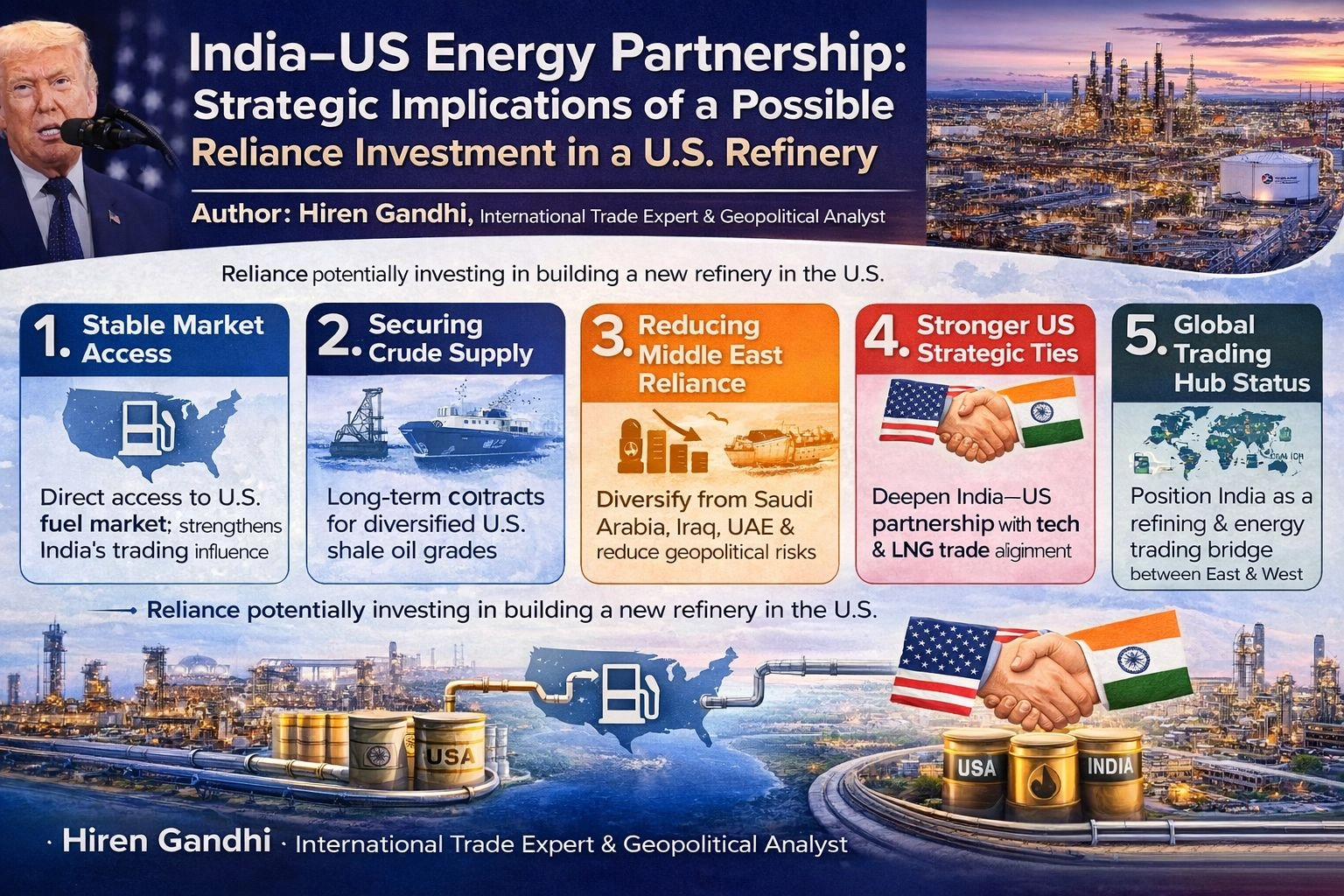
India is among the fastest growing energy consumers in the world, and the country currently imports nearly 85 per cent of its crude oil requirements. Because of this heavy dependence on imports, securing reliable and diversified sources of crude oil has always been a central priority for India’s energy policy. Stronger cooperation between India and the United States in the energy sector could help India diversify its crude supply sources and reduce excessive reliance on any single region.
At present, a significant share of India’s crude oil imports comes from Middle Eastern countries such as Saudi Arabia, Iraq, United Arab Emirates, and Kuwait. These nations remain valuable and long standing energy partners for India. However, geopolitical tensions in that region occasionally create uncertainty in global oil markets. Fluctuations in supply or price volatility can directly affect large importing economies such as India. By strengthening energy cooperation with the United States, India could create a more balanced import portfolio and enhance its long term energy resilience.
The United States has emerged as a major producer of crude oil, particularly through the development of shale resources. Several American crude grades have become important in international trade, including WTI or West Texas Intermediate, crude from the Permian Basin, Eagle Ford crude, and Mars crude produced in the Gulf of Mexico. Indian refineries are technologically advanced and capable of processing a wide range of crude grades. This operational flexibility allows Indian refiners to blend lighter American crude with heavier Middle Eastern crude, thereby improving refining efficiency and optimising profit margins.
If an Indian company such as Reliance Industries invests in a refinery project in the United States, it could open a new chapter in global energy cooperation. Such an investment would allow Indian companies to participate more directly in the American fuel market and expand their presence in the international petroleum product supply chain. It would also help strengthen India’s role in global energy trade and increase the strategic reach of Indian energy companies beyond domestic markets.
India already possesses strong capabilities in the refining sector. The Jamnagar refinery complex in Gujarat, developed by Reliance Industries, is widely recognised as the largest refining complex in the world. Indian companies have built significant expertise in refining technology, petrochemicals, and energy trading. Expanding these capabilities internationally would allow India to move beyond being merely a large energy consumer and position itself as a more influential participant in global energy markets.
Energy partnerships often carry broader geopolitical significance as well. Stronger cooperation between India and the United States in the energy sector could support collaboration in areas such as advanced technology, petrochemical investments, and supply chain security. In the rapidly changing global economic environment, countries that play an active role in shaping energy supply chains and trade flows gain important strategic advantages.
In conclusion, a refinery investment in the United States involving an Indian company could benefit India in several meaningful ways. It could support diversification of energy sources, enhance global market access for Indian companies, deepen economic ties between India and the United States, and strengthen India’s role in global energy trade. Developments of this nature demonstrate how economic cooperation between major economies can generate mutually beneficial outcomes while also contributing to greater stability in the global energy system.

Secretary — InGlobal Business Foundation (IBF)
Director — ReNis Agro International LLP, Ahmedabad, India
Subscribe Deshwale on YouTube
