



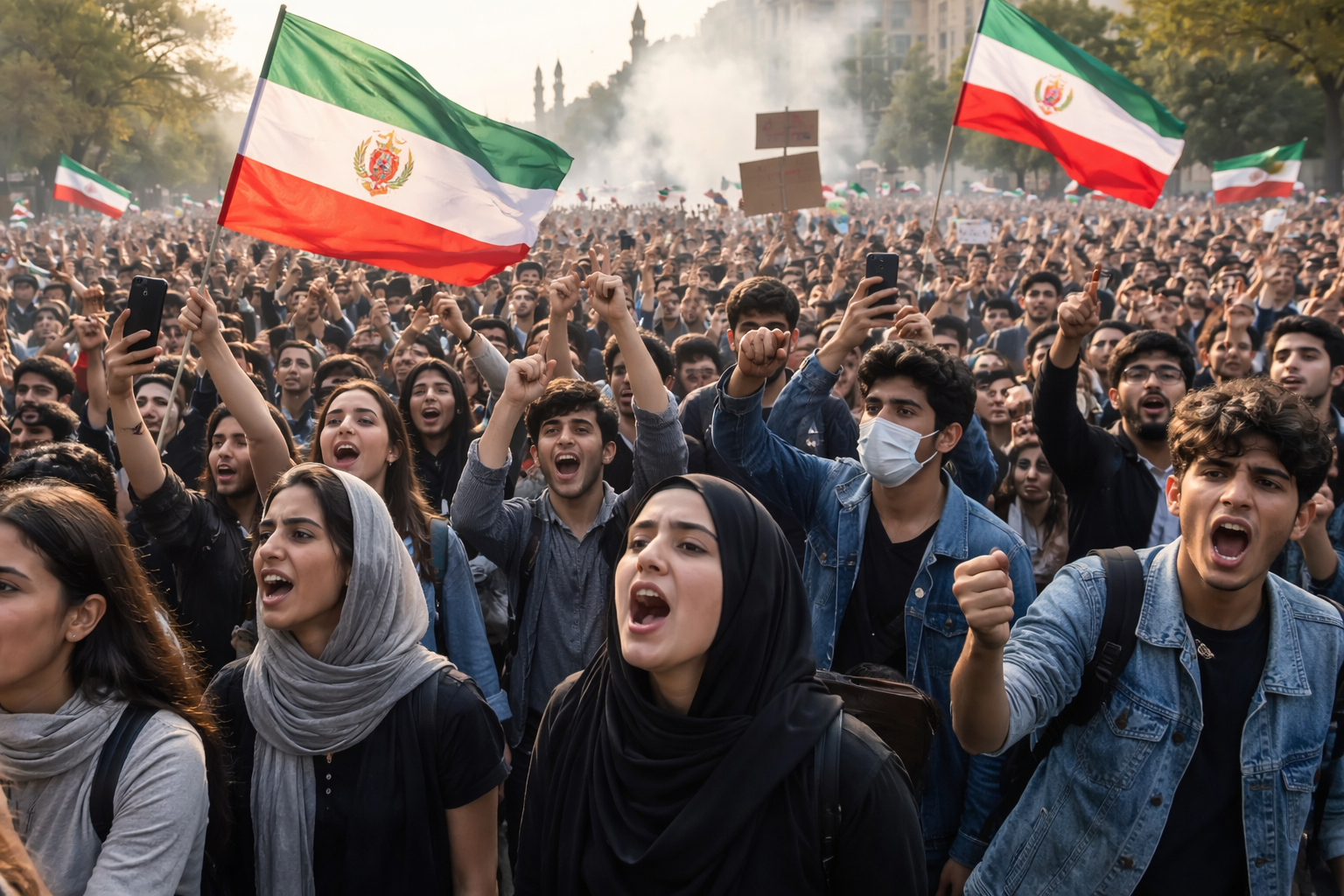
Rallies in Iran described as Gen Z protests have drawn global attention not only because of their intensity but because of what the label implies. The phrase suggests digital coordination, generational defiance and a new political awakening. Yet it also raises questions. Who defines such movements? Does the terminology simply describe a demographic trend, or does it shape the way the world interprets unrest?
In Iran, recent demonstrations have unfolded against a tense geopolitical backdrop. Nuclear negotiations remain stalled. Economic sanctions continue to squeeze households. Inflation has weakened purchasing power, and youth unemployment remains stubbornly high. Students in Tehran and other cities gathered to commemorate victims of earlier unrest, while others voiced anger over governance and economic hardship. Social media amplified images and slogans far beyond campus walls.
The protests do not operate under a single ideology. They reflect overlapping frustrations. Economic strain, limited opportunity and political constraints converge in a generation that has grown up online and thinks beyond borders. Media coverage quickly adopted the label Gen Z protests to capture that age profile and digital fluency.
The Meaning of Gen Z
Generation Z typically refers to those born from the late 1990s to the early 2010s. The term originated in demographic research and marketing analysis, not in political strategy. Early usage focused on consumer habits, technology adoption and workplace attitudes.
As youth led movements gained visibility, journalists began applying the phrase to street protests. It offered shorthand for decentralised organisation and social media coordination. The label appears to have evolved organically within media language rather than emerging from a formal political doctrine.
Still, repetition gives language power. Once widely adopted, a generational tag can influence global perception. It can frame unrest as part of a wider trend rather than a strictly local crisis.
Iran’s Internal Political Landscape
In Iran, youth activism intersects with complex domestic politics. Some political factions favour diplomatic engagement and economic reform. Others emphasise resistance to Western pressure and preservation of existing structures. Protesters themselves are not unified behind a single programme. Some prioritise jobs and inflation relief. Others focus on civil freedoms. Many express a broader sense of uncertainty about the future.
Official narratives often highlight foreign interference. Iranian authorities have long argued that adversarial states seek to destabilise the country through information campaigns and covert support. Critics counter that economic and social grievances provide sufficient explanation without invoking external direction.
The truth is layered. External tension with the United States and Israel heightens anxiety. American forces in the region and periodic military threats create a climate of insecurity. At the same time, everyday realities such as rising costs and shrinking prospects drive participation.
Echoes Beyond Iran
Iran is not alone in witnessing youth led mobilisation. In Bangladesh, a student movement in 2024 that began over job quotas evolved into mass political upheaval. In Nepal, a ban on major social media platforms in 2025 triggered large scale protests and political change. Similar patterns have appeared in parts of Africa and Southeast Asia, where large youth populations face stagnant economies and governance challenges.
Demographics play a central role. In many developing regions, a majority of citizens are under thirty. When economic growth fails to match aspirations, frustration spreads quickly. Digital platforms lower coordination costs and allow rapid dissemination of information. Leaderless networks replace traditional party hierarchies.
This dynamic reflects structural change rather than a single orchestrated campaign. Youth bulges combined with connectivity create fertile ground for mobilisation.
The Colour Revolution Comparison
Some analysts draw parallels with the colour revolutions of the early 2000s in Eastern Europe and Central Asia. Those movements adopted vivid branding and received significant Western support. Critics of American foreign policy argue that intelligence and policy circles promoted certain narratives to encourage regime change in adversarial states.
A 2023 report by China National Computer Virus Emergency Response Center, produced with a Chinese cyber security firm, alleged that the CIA employed encrypted communication systems, digital coordination tools and cyber capabilities to influence unrest abroad. The report described methods including anonymous routing technology and advanced cyber intrusion practices. These claims remain disputed internationally, and there is no verified evidence that intelligence agencies created or directed the phrase Gen Z protests.
The term appears to have grown within journalistic discourse. Yet geopolitical suspicion ensures that even organic language can be interpreted through a strategic lens.
Narrative Power and Political Branding
Political communication has always relied on concise slogans. Phrases such as Arab Spring or colour revolution simplified complex struggles into memorable frames. Gen Z protests now performs a similar function. It captures attention and travels rapidly across borders.
Some commentators argue that powerful states benefit when unrest in rival countries is framed as democratic youth awakening. Others caution against reducing authentic local grievances to external manipulation. Catchy language often succeeds because it resonates with lived experience, not because it is engineered in secret.
Here the picture becomes less clear. Movements contain both domestic drivers and international implications. Media branding can amplify their global reach without necessarily inventing them.
Governance and Security Responses
Governments worldwide have responded cautiously to digitally coordinated activism. A 2025 notice from China Ministry of Public Security stressed the need for stronger online governance and vigilance against external interference. It reflected a broader pattern of states viewing social media as both tool and threat.
In Iran, officials emphasise sovereignty and national security. They argue that digital platforms can be exploited by hostile actors. Young protesters, however, see the same platforms as spaces for expression and solidarity.
This tension between control and connectivity defines the current era.
A Generational Crossroads
It would be simplistic to treat all Gen Z protests as part of a unified global design. In some countries, demonstrations focus on bread and employment. In others, they centre on political reform. In Iran, economic hardship intersects with geopolitical strain. The generational label provides a useful lens but not a complete explanation.
Young people mobilising in public squares respond first to the conditions they experience directly. Language may shape how outsiders interpret those actions, yet it does not create inflation or unemployment. Nor does it alone produce the fear that accompanies regional military tension.
The debate over terminology will persist. So will youth activism. Whether framed as generational rebellion or national security challenge, these movements signal a demographic reality. A digitally native cohort expects opportunity, voice and dignity. Political systems that ignore those expectations may face recurring waves of unrest.
Iran now stands at that crossroads. Its youth seek stability and meaningful participation in shaping their future. How domestic leadership and the international community respond will determine whether this moment becomes reform, repression or something in between.
Subscribe Deshwale on YouTube
