



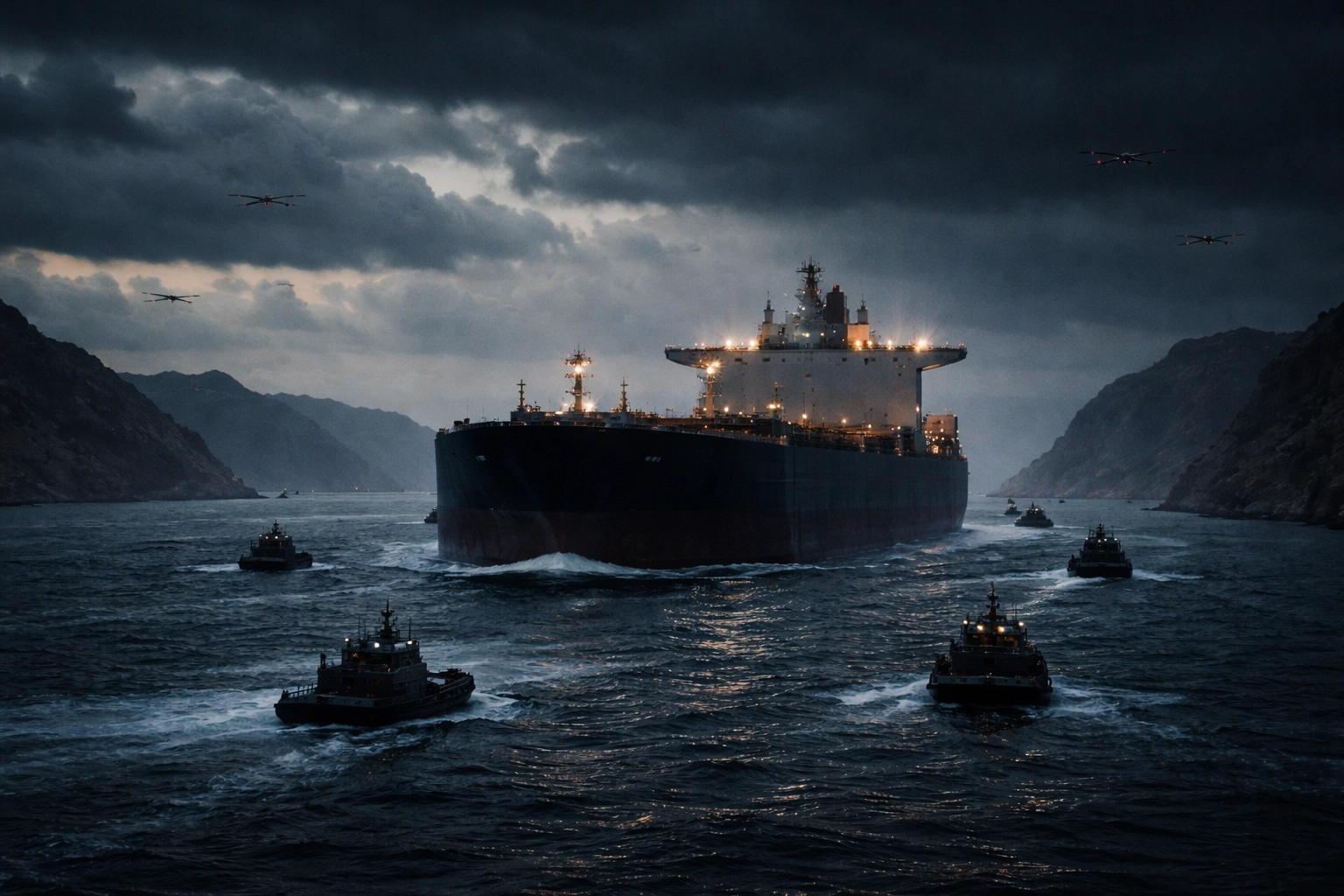
Twenty-one miles of water. A $1-per-barrel levy. Payments in Bitcoin, yuan, and stablecoins that vanish beyond the reach of Western sanctions. Iran has turned the world’s most critical oil chokepoint into a cash register and the question is no longer whether this is happening, but how permanent it becomes.
Picture a tollbooth. Not the kind you sail through at two in the morning with loose change in a cupholder. Something weightier. Something that sits at the narrowest point of a waterway through which one-fifth of the world’s oil supply moves every single day, with a radio message playing to ships in the Persian Gulf on loop: “If any vessels try to transit without permission, they will be destroyed.”
Then consider the payment method: Bitcoin, Chinese yuan, USDT stablecoins transferred in seconds all chosen for the same reason. They settle fast, they leave no trail a Western regulator can follow, and they cannot be frozen by a US Treasury sanction. The money is gone before the paperwork begins.
This is the Strait of Hormuz in April 2026. Iran has formalised what it has been quietly operating for weeks: a transit toll on the world’s most critical oil chokepoint, charging approximately $1 per barrel of crude up to $2 million per fully loaded supertanker payable in the financial instruments of a parallel economy that Washington cannot easily reach.
The question that matters not just to governments, shipping executives, and sanctions lawyers, but to the Indian refinery manager sweating over import costs, the Pakistani family rationing cooking gas, the Thai household counting diesel reserves is this: how much does Iran actually earn from this? And what happens if it becomes permanent?
The answer to the first question depends heavily on how much traffic flows. The answer to the second should concern every energy-importing nation on earth.
The Numbers, Plainly Stated
The Strait of Hormuz, at its narrowest, is 21 miles wide. Before this war, an average of 20 million barrels of crude oil transited daily roughly 20% of the world’s petroleum consumption across approximately 135 ships. Since Iran imposed its control and assessment regime, maritime intelligence firm EOS Risk estimates that only 10 to 15 ships can transit per day under current conditions. That compression matters enormously when projecting revenue.
The arithmetic works like this. At $1 per barrel, a fully loaded Very Large Crude Carrier (VLCC) carrying 2 million barrels of crude oil generates a $2 million transit fee. At the current reduced rate of 10 to 15 transits per day, Iran is collecting somewhere between $20 million and $30 million daily, call it $600 million to $900 million per month. CNN’s own calculations, which factor in LNG shipments alongside crude, estimate the monthly figure at above $800 million under partial normalisation. These are significant sums, but they are not the headline ceiling number.
If traffic were to return to pre-war levels of 135 ships per day, which requires a genuine and durable resolution to the conflict, the annual toll revenue would scale dramatically. Analysis by the House of Saud research group estimates $20 to $25 billion per year at full volume. That lower figure still exceeds Iran’s total oil export revenue under Western sanctions in a normal year, which ran between $15 and $20 billion annually. The important caveat: that ceiling assumes a normalisation of shipping that has not yet arrived, and that the ceasefire’s fragility makes uncertain. What Iran is earning today is meaningful but a fraction of what a permanent, normalised toll regime would generate.
For context on what those numbers mean: Egypt earns between $700 million and $800 million per month from the Suez Canal, a waterway that took a decade and enormous capital to construct. Iran is approaching comparable monthly revenues by controlling 21 miles of water that geography provides for free.
The Payment Architecture: More Than Bitcoin
Early reports emphasised Bitcoin, and Bitcoin is genuinely part of the picture. But the payment system Iran has built is broader and more deliberate than any single cryptocurrency.
The toll operates at its baseline through multiple rails: Chinese yuan via Kunlun Bank, USDT stablecoins on the Tron blockchain, and Bitcoin for transactions where speed and untraceability are the priority. Hamid Hosseini, a spokesperson for Iran’s Oil, Gas and Petrochemical Products Exporters’ Union, told the Financial Times that once Iran completes its cargo assessment, vessels are given a very brief window to complete payment — a timeline designed specifically to ensure funds move before sanctions enforcement can respond.
According to Bloomberg reporting, Iran’s Ministry of Defence Export Centre updated its systems to accept cryptocurrency for military export transactions as early as January 2026, a full month before the first American and Israeli strikes. The crypto payment infrastructure was in place well before it was needed for the strait. This was not improvisation. It was preparation.
The yuan option is equally deliberate. Payments routed through Kunlun Bank, a Chinese state-linked institution already operating outside dollar-clearing systems give Iran a second settlement rail that is entirely insulated from SWIFT. A single VLCC hauling two million barrels generates a two-million-dollar transit fee paid wholly outside the dollar system, unreachable by US sanctions enforcement. Bitcoin is highlighted in the headlines. The yuan, quieter and more institutional, may prove more durable.
Who Actually Pays
Here is the part that connects a geopolitical manoeuvre to an ordinary life.
The intuitive assumption is that Iran’s toll raises the global price of oil by $1 per barrel. The economic reality is more nuanced, and in some ways more troubling for the Gulf producers than for global consumers. Analysis by the Bruegel Institute finds that Gulf exporters Saudi Arabia, Kuwait, the UAE would absorb between 80% and 95% of the toll’s cost, because they are price-takers in a global market and cannot fully pass it on. The world oil price, ironically, rises only marginally by an estimated $0.05 to $0.40 per barrel relative to pre-war levels, because Iran is offering supply relief that the market desperately wants.
But this reassuring finding has a condition attached: it only holds if oil supply through Hormuz is actually restored. Right now, it has not been — not fully, not reliably. The ceasefire announced by President Trump is two weeks long, its permanence disputed, and as of Wednesday no vessel other than two linked to Iran had resumed transit. The current reality is that the global market is still absorbing the shock of a major supply disruption, with Brent crude prices having reached as high as $110 per barrel before settling back toward $90 on ceasefire news.
And the costs that have already cascaded through the global South are real and documented. India is acutely exposed: it imports approximately 85% of its crude oil, with a substantial share sourced from Gulf producers that transit Hormuz. Indian refiners are among those quietly absorbing dramatically higher costs, which ultimately feed through to petrol prices, transport costs, and inflation across an economy where fuel subsidies are politically sensitive and fiscal headroom is limited. Pakistan has told citizens to watch cricket from home to conserve fuel. There are reported shortages in Thailand. Hundreds of petrol stations in Australia have run dry. Carriers have cancelled flights from Vietnam to New Zealand. Diesel and jet fuel prices have at points exceeded $200 per barrel in Asian spot markets.
This is what a disrupted Hormuz costs not in the toll itself, but in the downstream weight of uncertainty. The Indian family paying more for cooking gas this month is not calculating VLCC transit fees. They are calculating whether the cylinder lasts until the end of the month.
The Strategic Architecture
What makes the toll genuinely consequential beyond its immediate revenue is what it does to the architecture of regional power.
For decades, the United States’ strategic presence in the Gulf rested on a single premise: freedom of navigation through Hormuz, enforced by the Fifth Fleet in Bahrain. Iran’s move does not directly challenge American military capability. It is more subtle than that. It converts the strait from a potential military threat which invites a military response into a commercial reality, which invites negotiation. The message is no longer “we will close Hormuz.” It is: “you may use Hormuz, on our terms, in our preferred currency, with our approval.”
President Trump’s own instincts cut straight through to this logic. Asked about the toll on ABC News on Wednesday morning, he said the United States might seek a share. “We’re thinking of doing it as a joint venture,” he said. “It’s a way of securing it and also securing it from lots of other people.” Within twenty-four hours of declaring a ceasefire conditional on Iran reopening the strait, the president had moved to contemplating a revenue sharing arrangement. Secretary of State Marco Rubio has called the tolling system “illegal” and “unacceptable.” He is correct that the Strait of Hormuz is an international waterway under UNCLOS, and Iran has no legal basis to charge transit fees. That legal correctness has not, so far, produced legal consequences.
Iran’s parliament is not treating this moment as temporary. The National Security and Foreign Policy Committee approved the “Strait of Hormuz Management Plan” on March 31, advancing it toward full legislative codification. If it passes into law, the toll stops being a wartime measure and becomes a permanent national revenue instrument as entrenched and institutionalised as any canal authority anywhere in the world, except without the canal authority’s legal standing.
The OPEC dimension is also significant. Analysts warn that a permanent Iranian toll regime would give Tehran a structural veto over the export volumes of rival OPEC members. Saudi Arabia, Kuwait, and the UAE cannot bypass Hormuz at full capacity; the East-West Pipeline moves roughly 2 million barrels per day, against Saudi export capacity of 10 to 12 million. The UAE and Kuwait have no comparable bypass at all. Every barrel they export passes through a corridor that Iran now prices and controls. A commentator close to the Saudi royal court put it plainly: “Giving Iran any control over the strait would be a red line.” Iran has already crossed it. The question is whether anyone will push it back.
The Precedent Problem
Beyond the revenue and the regional politics lies a quieter danger: the precedent.
If Iran successfully establishes a permanent toll on an international strait illegal under UNCLOS, condemned by the G7, and yet functionally in place the conversation in every capital that sits near a strategic waterway changes immediately. The Strait of Malacca, through which China’s energy imports travel. The Bosphorus. The Bab-el-Mandeb. Each has a coastal state. Each coastal state now has a working example of how a chokepoint can be monetised without military confrontation through a toll, payable in digital currency, backed by the implicit threat of force but dressed in the language of “secure passage protocols.”
US Secretary of State Rubio has noted this explicitly, warning that the world needs “a plan to confront” Iran’s tolling system. G7 foreign ministers have stressed the “absolute necessity” to restore “safe and toll-free freedom of navigation.” What that plan looks like in practice beyond statements remains undefined.
The Reckoning
Somewhere behind the revenue projections and the blockchain mechanics and the UNCLOS arguments, there is a simpler truth.
An elderly woman in Chennai is paying more for her cooking gas cylinder this month than she has in three years. A truck driver in Osaka is watching diesel prices climb and recalculating his route economics. A nurse in Nairobi is walking to work because the shared taxi she normally takes has doubled its fare. None of them have read the Financial Times report. None of them know what Kunlun Bank is, or what USDT on the Tron blockchain means, or what Article 37 of UNCLOS says about transit passage rights in international straits.
They know only what they feel the weight of a world in which a 21-mile stretch of water has been turned into a selective toll road, collecting payment in currencies no court can easily freeze, with a parliamentary bill in Tehran designed to make it permanent.
The Strait of Hormuz has always been the world’s most critical chokepoint. What is new is that it now operates under a commercial regime one backed by the Revolutionary Guard, payable in Bitcoin and yuan, and moving steadily from wartime improvisation toward institutionalised revenue. Whether the current ceasefire holds, whether traffic normalises, whether the legal arguments ever produce legal consequences all of that remains genuinely uncertain.
What is not uncertain is the direction of travel. Iran has found something more durable than a threat. It has found a business model.
Subscribe Deshwale on YouTube
