



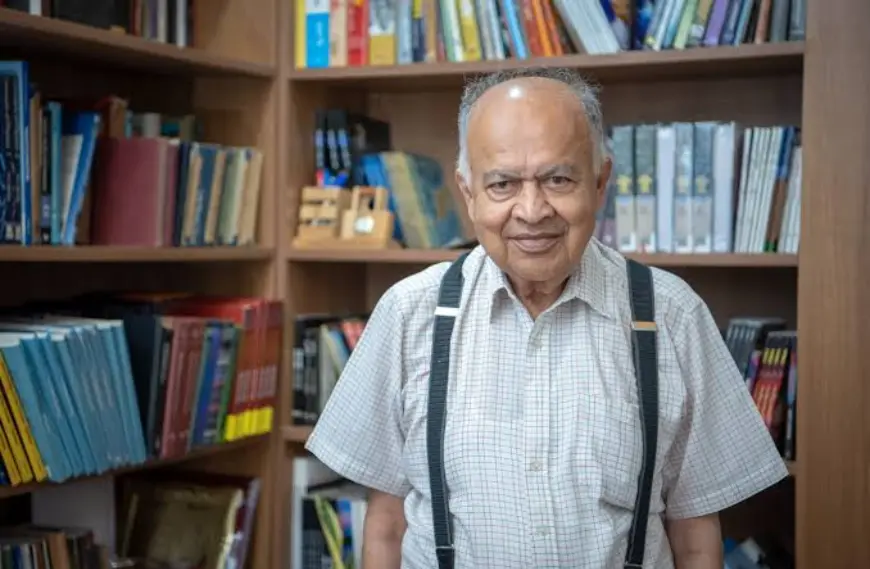
Renowned astrophysicist Jayant Vishnu Narlikar passed away in his sleep on May 20, 2025, at the age of 87, at his home in Pune. He had been recovering from recent hip surgery and succumbed to a brief illness, according to family members.
Born in Kolhapur in 1938, Narlikar grew up in a family of academics. His father, Vishnu Vasudeva Narlikar, was a respected mathematician and head of the Mathematics Department at Banaras Hindu University. Jayant completed his early education in Varanasi before heading to Cambridge University, where he excelled in mathematics. He won the prestigious Tyson Medal and earned a fellowship at King’s College.
It was at Cambridge that Narlikar collaborated with astrophysicist Fred Hoyle. Together, they developed the steady state theory of the universe, a rival hypothesis to the Big Bang theory. Though the Big Bang later gained broader scientific acceptance, their work remained a critical contribution to theoretical cosmology.
Returning to India in the 1970s, Narlikar joined the Tata Institute of Fundamental Research. His vision led to the founding of the Inter-University Centre for Astronomy and Astrophysics (IUCAA) in Pune in 1988. Under his leadership, IUCAA became a hub for cutting-edge research and academic collaboration in astrophysics.
Beyond academia, Narlikar was a passionate science communicator. He authored several science books in English, Hindi, and Marathi aimed at young readers and the general public. His writings and talks inspired generations to explore the universe and appreciate the role of science in daily life.
Narlikar received numerous honours during his career, including the Padma Vibhushan, India’s second-highest civilian award. He was also honoured with the Kalinga Prize by UNESCO for popularising science.
He is survived by his three daughters—Geeta, Girija, and Leelavati—all of whom are engaged in scientific and academic fields. His wife, Mangala Narlikar, a mathematician, passed away in 2023.
Narlikar’s death marks the end of an era in Indian science, but his legacy will continue to inspire scholars, students, and science lovers across the country.
