




JNU’s latest night of violence is not a campus story. It is a story about what Indian politics has decided universities are for.
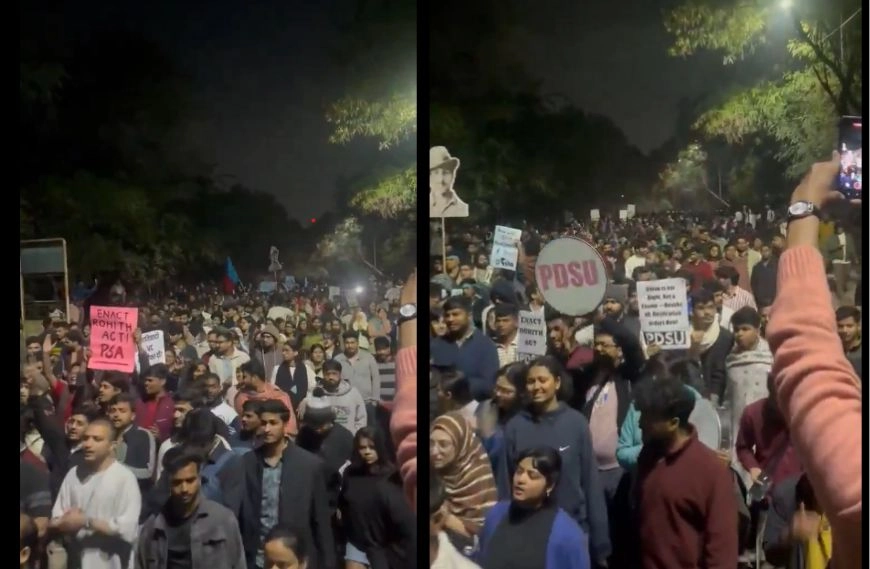
The School of Social Sciences building at Jawaharlal Nehru University does not usually lock its doors at 1:30 in the morning. But on the night of Sunday into Monday, a biotechnology student named Prateek Bhardwaj found himself barricaded inside a bathroom on one of its floors, listening to what he described as 150 people trying to break down the door. Before he ran, he says, someone had sprayed fire extinguisher powder into his eyes. By morning, he was in hospital.
That is the image this story must sit with before it goes anywhere else: a student locked inside a toilet cubicle at a university that was founded, in 1969, on the explicit principle that knowledge requires the freedom to breathe.
The Competing Accounts
The facts of what happened are, as they always are at JNU, contested in ways that tell you everything about the contest itself.
The JNUSU had called for a Samta Juloos an Equality March towards the East Gate, demanding the resignation of Vice-Chancellor Santishree Dhulipudi Pandit and the revocation of a rustication order against union members. The trigger was a set of remarks attributed to the VC in connection with UGC Equity Guidelines allegations of anti-Dalit and casteist remarks that Left and Dalit student groups had been protesting for several days.
Left-wing groups, including SFI and AISA, accused ABVP members of resorting to stone-pelting to disrupt the march. The ABVP offered a sharply different account: 300 to 400 masked individuals moving through the campus armed with hockey sticks, iron rods, stones, and knives, entering school areas and threatening students who were studying peacefully.
Delhi Police, for their part, said that following the incident, no major injuries were reported to them, two students had visited a government hospital for medical leave certificates, and no formal complaints had been filed.
That last sentence deserves to be read twice. A campus where depending on which side you believe either a masked mob of 400 lynched students in the library corridor, or stone-throwing militants attacked a peaceful equality march, and by morning: no formal complaints. No arrests. No university statement. The silence of institutions, in India in 2026, is itself a political statement.
The Political Lens That Precedes Every Fact
You cannot cover JNU violence without first acknowledging what JNU has become in the national political imagination and how that imagination shapes every single thing that happens on that campus, including what gets reported, amplified, and believed.
For the Sangh ecosystem and its media allies, JNU is Exhibit A in the case against the Indian Left: a taxpayer-funded hothouse of sedition, anti-national sentiment, and ideological extremism. For the Left and liberal intelligentsia, JNU is the last functioning redoubt of critical thought in an increasingly authoritarian public sphere. Neither of these is fully true. Both of these are fully believed by their respective constituencies.
The January 2020 JNU attack masked men with rods entering the campus, the image of JNUSU president Aishe Ghosh with blood streaming down her face became instantly and permanently unresolvable in the national discourse, with each side certain about who the perpetrators were and no consequence following for anyone. Six years later, the template has not changed. The hashtag has changed: from #JNUAttack to #LeftAttacksJNUAgain. But the grammar is identical.
What This Time Is Different
What is genuinely new this time and what the breaking news coverage is largely missing is the specific trigger.
This is not a fight over hostel fees, as in 2019. It is not a fight over a controversial speech or sedition charges, as in 2016. This confrontation grew out of a week-long agitation over remarks attributed to Vice-Chancellor Santishree Dhulipudi Pandit in connection with UGC Equity Guidelines which is to say, it grew out of caste.
That matters enormously. The VC, herself a Dalit scholar of some distinction, now stands accused by Dalit and Left student groups of making casteist remarks. The ABVP is defending the administration and by extension, the VC while the JNUSU and its Left affiliates are demanding her resignation on caste grounds. This is an inversion of the usual political geometry at JNU, where the Left attacks the administration as a Sangh proxy and the ABVP defends it.
That the caste dimension of this conflict has been largely submerged under the violence-counter-violence binary in most coverage is a failure of editorial judgment. The students who called the Equality March did so under the banner of caste equity. The rustication order they sought to overturn was, they alleged, issued against union members who raised caste-discrimination complaints. Whatever violence occurred on Sunday night, it occurred on ground that was already morally and politically charged by questions that Indian society and Indian universities have never adequately answered.
Three Things to Watch
Three things will determine whether this becomes a moment of accountability or another chapter in the JNU mythology cycle.
The FIR. As of Monday morning, no formal complaints had been filed with Delhi Police. The moment FIRs are lodged by whom, against whom, under which sections the political calculus will crystallise. If no FIR is filed at all, the administration and police will have effectively chosen a side through inaction. Watch the FIR.
The medical record. Prateek Bhardwaj’s condition described by ABVP as “critical” and by Delhi Police’s preliminary assessment as not involving major injuries is the evidentiary crux of the competing accounts. Hospital records don’t have political affiliations. What the medical examination actually documents will be more important than any social media post from either side.
The CCTV. JNU’s campus has camera infrastructure. The School of Social Sciences has access points. Whether that footage is preserved, accessed, and made public will tell you whether any institution involved the university, the police, or the government has any interest in establishing what actually happened. In past episodes of JNU violence, the answer to this question has always been: CCTV footage mysteriously unavailable or inconclusive. If that pattern repeats itself, it will be the most important story of all.
The Template That Never Changes
By Monday morning, the hashtag #LeftAttacksJNUAgain was trending. By Monday evening, the counter-narrative hashtag will probably be trending too. The television debate shows will have their panels ABVP spokespersons on one side, AISA leaders on the other, a retired police official moderating nothing in particular. The VC’s position will be discussed in terms of her political alignment rather than her administrative record. Someone will invoke 2020. Someone will invoke 1975. The injured student in the hospital will become an emblem rather than a person.
JNU has, over the decades, produced some of India’s finest economists, historians, linguists, scientists, and public intellectuals. It has also produced a specifically Indian form of campus warfare that is exhausting in its predictability and devastating in its repetition. The students who get hurt in these clashes are rarely the ones whose names are known before the violence begins. They are caught in a crossfire between organisations that have their own imperatives, their own national hierarchies, their own relationships with power structures far beyond the campus walls.
A biotechnology student hiding in a locked bathroom. An Equality March that became a midnight confrontation. A Vice-Chancellor who has not spoken. A police force that found nothing serious enough to file a case.
This is what politics looks like at 1:30 AM in the library
Subscribe Deshwale on YouTube
