 Deshwale
Justice Abhay S. Oka: Bail Is a Constitutional Right, Not a Judicial Favour
In brief · AI summary At the Annual Law Lecture hosted by Manipal Law School in Bengaluru, former Supreme Court judge Justice Abhay S. Oka said that "bail is the constitutional command, not a judicial favour," and warned that prolonged pre-trial detention is increasingly misused as a tool of arbitrary punishment. He stressed that bail decisions must be guided by the Constitution, particularly Articles 14, 19, and 21, and criticised unaffordable bail amounts and intrusive conditions such as continuous digital tracking. He also appealed to citizens to actively defend constitutional freedoms and understand their rights.
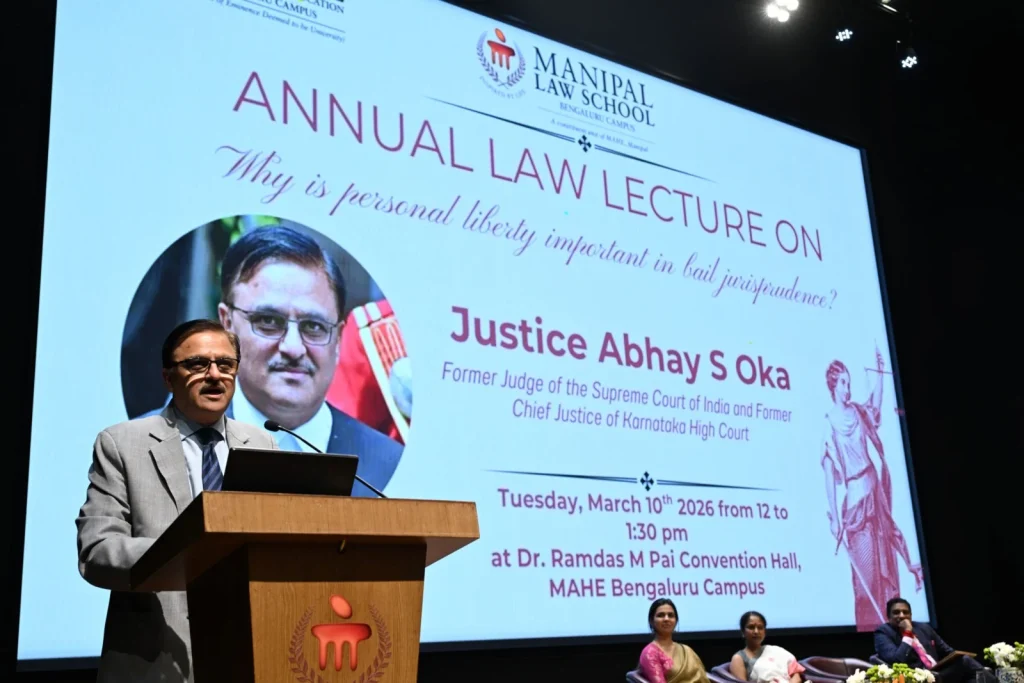
Bengaluru, March 11, 2026: At the Annual Law Lecture hosted by Manipal Law School, part of Manipal Academy of Higher Education (MAHE) Bengaluru, former Supreme Court judge Justice Abhay S. Oka highlighted that “bail is the constitutional command, not a judicial favour.” He stressed that every person accused of a crime has the right to bail and that pre-trial detention should never act as punishment for an unproven offence.
Addressing the theme “Why Personal Liberty is Important in Bail Jurisprudence,” Justice Oka emphasised that personal liberty must remain central to bail decisions in India’s criminal justice system. He warned that prolonged pre-trial detention is increasingly being misused as a tool of arbitrary punishment, undermining the principles of justice and fairness.
Invoking the landmark Supreme Court ruling in State of Rajasthan v. Balchand (1977), Justice Oka reaffirmed the principle that “bail is the rule, jail is the exception.” He stressed that the presumption of innocence is fundamental to criminal law, and denial of bail should never function as pre-trial punishment.
Justice Oka further explained that bail decisions must be guided by the Constitution of India, particularly Articles 14, 19, and 21, rather than merely by statutory provisions. Judges are reminded that the Constitution protects every citizen’s freedom, and this protection should inform all bail orders.
Highlighting systemic issues, he pointed out that many undertrial prisoners spend years in jail awaiting trial, causing immense hardship for both the accused and their families. Referring to Union of India v. K.A. Najeeb, he noted that prolonged pre-trial detention erodes justice and disproportionately impacts the poor.
Justice Oka also criticised certain practices in bail proceedings, including setting unaffordable bail amounts and imposing intrusive conditions such as continuous digital tracking. He cautioned that such measures could violate the right to privacy and dignity under Article 21 of the Constitution.
Concluding his lecture, Justice Oka appealed to citizens to actively defend constitutional freedoms, understand their rights, and help safeguard Indian democracy.
The event was attended by Dr. Madhu Veeraraghavan, Pro Vice-Chancellor of MAHE Bengaluru, and Dr. Sarasu Esther Thomas, Director of Manipal Law School. Winners of the National Constitution Day Essay Writing Competition were felicitated during the programme, recognising efforts to promote constitutional awareness among students.
Subscribe Deshwale on YouTube