




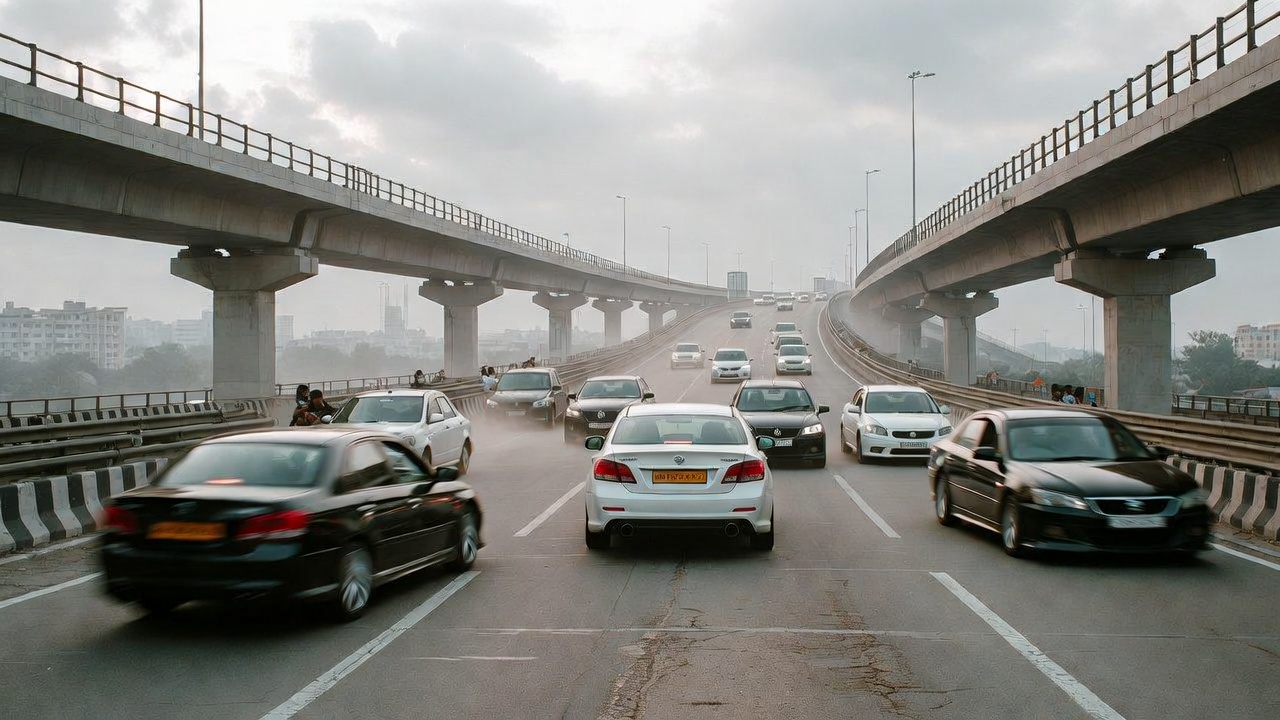
Five young persons were recently booked for performing a dangerous car stunt on the newly built Mothagaon–Mankoli flyover in Dombivli, near Kalyan in Maharashtra. According to police reports, the accused blocked traffic and carried out reckless manoeuvres while recording videos for social media reels. The incident occurred on January 26 when several vehicles were seen racing at high speed, posing a serious threat to other commuters.
Police identified the vehicles involved as a Jeep Thar, a Hyundai Verna (MH05-GD-0049) and a Mahindra Scorpio (MH05-CV-3988). The driver of the Thar, identified as Piyush Mhatre (21), was fined, while the drivers of the Verna and Scorpio — Vedant Mahesh Sawant (18) and Pradeep Dhakne (21) — were booked for racing and reckless driving. Two others, Vishal Vishwakarma (22) and Krishna Vishwakarma (19), were booked for recording the stunt. Many of these persons are wealthy with their parents being associated with the construction businesses.
The incident drew strong reactions not only from residents but also from local corporators, who publicly stressed the need for strict punishment. They said such behaviour is a blatant violation of traffic norms and endangers all road users. Officials warned that leniency would encourage similar stunts and send the wrong message to thrill seekers and aspiring content creators.
This episode is part of a concerning pattern seen in many Indian cities. Public infrastructure is increasingly treated as a backdrop for viral content. Roads, bridges, railway platforms and flyovers are used for stunts that prioritise online attention over safety. In this case, the Mothagaon–Mankoli flyover was meant to ease congestion and protect lives. Instead, it became the stage for a risky spectacle that could have ended in tragedy.
Such conduct reflects a deeper issue of civic sense. Civic sense means respecting shared spaces and understanding that public property belongs to everyone. When individuals block traffic to film stunts, they disregard the rights and safety of fellow citizens. Yet it would be unfair to paint all Indians with the same brush. Many citizens follow traffic rules, respect public property, and make responsible choices on the road. The contrast raises a difficult question: why do some act with such disregard?
Part of the answer lies in the culture of instant validation. Social media platforms reward dramatic and sensational acts with views, likes and followers. For some young people, online attention can feel more valuable than long-term consequences. There is also a psychological aspect of thrill seeking. High-risk behaviour delivers adrenaline and a sense of rebellion, especially where enforcement appears inconsistent. When such acts go unpunished, they begin to feel normal.
However, blaming social media alone would be simplistic. Civic education has often remained theoretical, with little emphasis on everyday responsibility. Urban growth has outpaced behavioural adaptation. Some individuals see empty flyovers as opportunities for experimentation rather than shared assets built with public funds.
Solutions must be firm and practical. Visible enforcement of traffic laws is essential. Schools and colleges should include civic training that emphasises empathy and responsibility. Media campaigns can promote positive examples rather than glorify recklessness.
The Mothagaon–Mankoli flyover incident shows that infrastructure alone cannot guarantee progress. Civic sense determines whether development truly serves society.
Subscribe Deshwale on YouTube
