




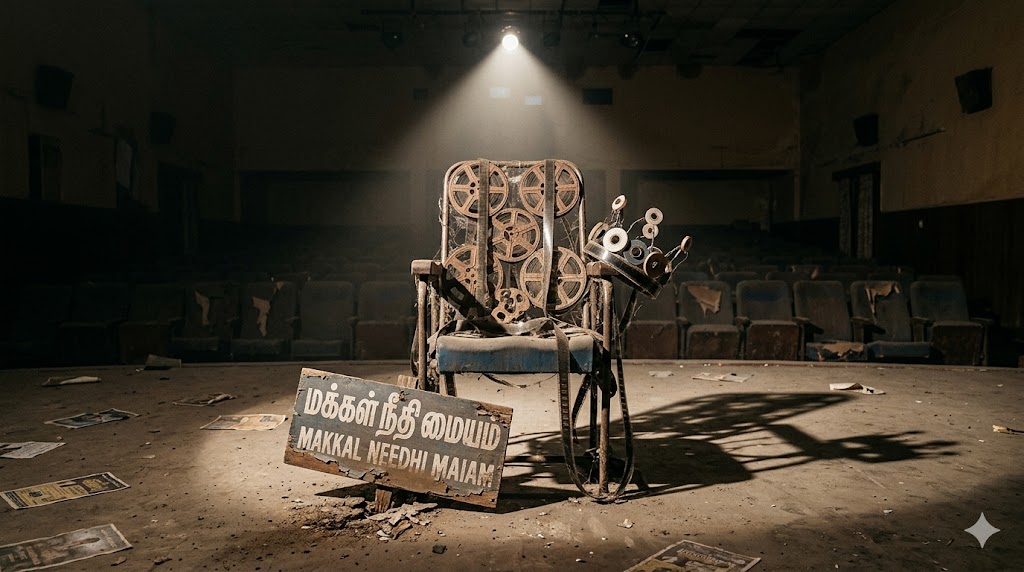
He entered politics as a centrist messiah promising to break the Dravidian duopoly. Seven years, two electoral routs, and one humiliating surrender later, Kamal Haasan stands exposed as a leader who had everything, stature, intellect, oratory, but lacked the one thing politics demands: the willingness to see it through.
I. The Night the Music Died
Coimbatore South, May 2, 2021, 11:47 PM.
The counting had been underway for seventeen hours. Kamal Haasan sat in his party office on Trichy Road, surrounded by aides who had spent three years convincing themselves, and anyone who would listen, that Tamil Nadu was ready for a new kind of politics. A centrist politics. A politics of ideas. A politics that would finally break the Dravidian duopoly that had strangled the state for half a century.
He had done everything right. Or so he believed.
He had toured the state. He had spoken at Jallikattu protests and Sterlite agitations. He had hosted Arvind Kejriwal at his home, signalling to the urban youth that he was the change they had been waiting for. He had positioned himself as the rationalist alternative to parties he called “corrupt” and “dynastic.” He had even, in a moment of theatrical genius that would later become an albatross around his neck, thrown a remote control at a television to signal his rejection of traditional politics.
When the results came, they were not just disappointing. They were humiliating.
Kamal Haasan lost his own constituency, Coimbatore South, to the BJP’s Vanathi Srinivasan by a margin of 1,540 votes. His Makkal Needhi Maiam (MNM), contesting 154 seats, drew a blank. Not a single MLA. Zero. The party’s statewide vote-share was a paltry 2.6 per cent, down from the already modest 3.72 per cent it had managed in its 2019 Lok Sabha debut.
For a man who had been called “Ulaga Nayagan,” the Global Hero, by his fans for decades, the numbers were unforgiving. The people had spoken. And they had said: we are not interested.
But here is the thing about Kamal Haasan. He did not learn from that night. He did not return to his party, rebuild from the grassroots, and fight another day with humility. Instead, he did what he has always done when things get difficult. He retreated. He went back to films. He revived Vikram, which became a blockbuster, produced by Udhayanidhi Stalin’s Red Giant Movies, the very dynasty he had once railed against. And somewhere in the chaos of his dual careers, the politician was slowly suffocated by the star.
II. The Electoral Record: A Story of Declining Relevance
Let the numbers do the talking. They are unforgiving.
In the 2019 Lok Sabha elections, MNM contested 37 seats. The party secured 3.72 per cent of the statewide vote. In the 2021 Assembly elections, that number dropped to 2.6 per cent. Two elections, two defeats, and a clear trajectory: downward.
What makes this worse is the context. Tamil Nadu has a long, storied history of actors becoming successful politicians. M.G. Ramachandran. J. Jayalalithaa. Even Vijayakanth, for all his limitations, managed to become Leader of the Opposition. The template was there. The blueprint was there. Kamal Haasan had everything those predecessors lacked, a towering intellect, a command over language, a pan-Indian reputation, and the kind of cultural capital that could have translated into political capital.
And yet, he failed.
Why? Because he treated politics like a film. He wanted the perfect script, the ideal arc, the climactic moment of triumph. But politics is not cinema. Politics is the slow, grinding work of building cadres, nurturing local leaders, and staying present when the cameras are not rolling. Kamal Haasan was brilliant when the lights were on. When they dimmed, he was elsewhere.
In 2022, senior party functionaries began resigning in droves. Some cited “personal reasons.” Others were more direct. Party vice-president Dr R. Mahendran issued a public statement denouncing Kamal’s leadership style, accusing him of lacking transparency in financial matters and concentrating too much power in a small cabal of favourites. Kamal responded by calling Mahendran a “betrayer.” It was a preview of the pattern that would define his politics: when criticised, retreat into victimhood; when challenged, accuse others of disloyalty.
By 2024, the party that was supposed to be a third force in Tamil Nadu was barely a footnote. In the Lok Sabha elections that year, MNM did not contest at all. Instead, Kamal Haasan joined the DMK-led Secular Progressive Alliance, offering “unconditional support” in exchange for a single Rajya Sabha seat. He was elected unopposed to the Upper House in 2025, not because of his political strength, but because the DMK needed to keep a potential spoiler quiet.
This is the man who once threw a remote at a television to signal his rejection of the DMK. Now he sits in Parliament because the DMK put him there.
III. Entitlement: The Word That Changes Everything
Here is the word that Kamal Haasan’s biographers will never use. The word that his fan clubs will scrub from the record. The word that explains everything about his political arc.
Entitlement.
Kamal Haasan entered politics believing that his stature in cinema would automatically translate into political capital. He believed that because he was brilliant, because he was articulate, because he had played Ram and God and a dozen other icons on screen, the people would simply hand him the state. He did not need to build. He did not need to serve. He only needed to arrive.
This is what the political analysts saw but were too polite to say. Raveendran Duraisamy, a political analyst quoted by ThePrint, put it bluntly: “Kamal had a support base who were an urban-educated crowd, lacking the understanding of the state’s social structure. Kamal, as a leader of a political party, could not politicise them, which costs him now, losing his ambition of becoming chief minister.”
Another analyst, Sunilkumar, was even more direct: actors who venture into politics are trying to replicate what M.G. Ramachandran did in 1977. “What they don’t remember is that, even MGR, before starting his own party in 1972, was part of the DMK and part of the Dravidian movement since his early cine days. All the Dravidian leaders have been part of politics much before they ventured into politics.”
Kamal Haasan skipped the apprenticeship. He believed he was above it. He believed that his genius exempted him from the slow, patient work of political organisation. And when the people failed to recognise his genius, when they failed to hand him the victory he believed he deserved, he did not ask what he had done wrong. He blamed the people. He blamed the system. He retreated to his films, where he was still God.
In a 2025 interview with The Week, Kamal was asked how he wanted the younger generation to remember him, as the action hero of Vikram or the sensitive artist of Guna and Anbe Sivam. His answer revealed everything: “I can want what I want, but they will choose what they want.”
This is the statement of a man who has spent his entire life being chosen. A man who has never had to work for a role, never had to audition, never had to prove himself in the way that ordinary mortals do. He cannot conceive of a world where his wanting is not enough. And so, when the people chose otherwise, when they chose Vanathi Srinivasan over him, when they chose the DMK over his centrist alternative, he could not process it. He could only retreat.
IV. The Ideological Whiplash: Centrism That Means Nothing
In 2018, Kamal Haasan was clear about what he stood against. He was against the DMK. He was against the AIADMK. He was against dynastic politics, against corruption, against what he called the “dynastic and corrupt Dravidian parties.” He positioned his MNM as the only centrist party in Asia, a claim so grandiose it bordered on self-parody.
“We are the only centrist party in Asia,” he told The Week in 2025, with the kind of confidence that only a man who has never had to govern can muster.
But here is the question: what does centrism mean when you have no power, no seats, and no plan to acquire either? Centrism, in Kamal’s hands, became a floating signifier, a word that sounded good in interviews but translated into nothing on the ground. He would say he was “neither Left nor Right,” but what he really meant was that he had no constituency, no ideology, and no willingness to make the kind of enemies that actual politics requires.
The most revealing moment came in 2024, when Kamal did what he had spent six years promising he would never do: he joined the DMK alliance. The same DMK he had called corrupt. The same DMK he had accused of dynastic politics. The same DMK he had said was part of the problem.
When questioned about the reversal, Kamal offered a justification so tortured it revealed everything about his political immaturity. “Any constraint or situation did not make us join the DMK alliance,” he said. “We joined them because our ideologies are similar.”
Let us pause here. For six years, he had built his entire political identity on being not the DMK. And now he was claiming their ideologies were similar. Either he had been lying for six years, or he was lying now. There is no third option.
The real explanation, of course, is simpler: Kamal Haasan wanted relevance without doing the work. He wanted a seat in Parliament without winning an election. He wanted the platform without the struggle. And the DMK, ever the pragmatists, were happy to give it to him, because a pacified Kamal Haasan is a Kamal Haasan who is not spoiling their seats.
The damage he had done in 2021 was still fresh in DMK minds. In Coimbatore South, Kamal’s 2.6 per cent vote-share had effectively acted as a spoiler, bleeding votes that would otherwise have gone to the DMK-led coalition. By bringing him into the fold, the DMK neutralised a nuisance and gained a star campaigner who could be trotted out for photo opportunities. It was a masterstroke, for the DMK. For Kamal, it was surrender dressed as strategy.
V. The Gaffe That Revealed the Man
In May 2025, at the audio launch of his film Thug Life in Chennai, Kamal Haasan made a remark that would provoke a political firestorm. Speaking in the presence of Kannada actor Shivarajkumar, he said: “Your language (Kannada) was born out of Tamil, so you too are included.”
The reaction from Karnataka was immediate and furious. BJP state president B.Y. Vijayendra called the remark “uncultured” and accused Kamal of insulting the self-respect of 6.5 crore Kannadigas. Karnataka Chief Minister Siddaramaiah, no friend of the BJP, nonetheless agreed: “Kannada language has a very long history. He doesn’t know.”
What is instructive here is not the gaffe itself. Politicians make foolish statements all the time. What is instructive is Kamal’s response.
He did not apologise. He did not acknowledge that he had been insensitive. Instead, he doubled down. “This is not an answer, an explanation,” he told reporters. “Love will never apologise.”
The translation of what he actually said is this: “I am too proud to admit I made a mistake. My ego is more important than the feelings of millions of Kannadigas who have welcomed my films and supported my career for decades.”
This is not the behaviour of a leader. This is the behaviour of a man who has spent sixty years being told he is a genius, who has never had to answer to anyone, and who believes that his intentions, however clumsily expressed, are always pure. It is the arrogance of the artist who mistakes his own conviction for universal truth.
But politics is not art. In politics, when you insult a language, you do not get to retreat into “love will never apologise.” You apologise. You humble yourself. You show that you are capable of growth. Kamal Haasan did none of these things. And in doing so, he revealed the fundamental flaw in his political character: he does not know how to be wrong.
VI. The Final Surrender: March 2026
On March 24, 2026, the inevitable finally happened. With the Tamil Nadu Assembly elections just weeks away, Kamal Haasan announced that MNM would not contest a single seat. Instead, he offered “unconditional support” to the DMK-led alliance.
The announcement was couched in the language of sacrifice. “This is not a sacrifice; it is a duty,” Kamal told reporters after meeting Chief Minister M.K. Stalin. He spoke of “sowing the seeds of a new political culture.” He invoked the need to protect Tamil Nadu from “communal forces.”
But the political class saw it for what it was. The AIADMK, never one to miss an opportunity, delivered the most damning assessment. “Kamal Haasan is incompetent,” the party declared. “Actors from the silver screen lack the political acumen and leadership qualities required for public life.”
The AIADMK was not being charitable. But they were not wrong either.
Consider what Kamal has achieved in seven years of active politics. Zero electoral victories. A party that has gone from contesting 154 seats to contesting none. A cadre that has largely evaporated, with the 5,500 office-bearers he once commanded having dwindled to a skeleton crew. A political career that began with the promise of a third alternative and ended with him begging for scraps from the very party he once called corrupt.
He now sits in the Rajya Sabha, in a seat he did not win, with a mandate he did not earn, in a position that belongs to him only because the DMK decided it was cheaper to accommodate him than to fight him. He will speak in Parliament. He will make lofty statements. He will pose for photographs. But he will never be a leader. Because leadership is not about speeches. It is about the willingness to stand alone, to fight when fighting is hard, to lose and lose again and still keep going.
Kamal Haasan did not have that in him. He had everything else, intellect, charisma, the kind of cultural capital that most politicians would kill for. But when the moment came to do the hard work of building a political movement, he blinked. He retreated. He went back to films. And when that did not work, he surrendered.
VII. The Verdict
Let us be clear about what Kamal Haasan’s political career represents.
It is not a tragedy. Tragedies require greatness that is undone by a fatal flaw. Kamal Haasan’s political journey was never great enough to be tragic.
It is not a cautionary tale. Cautionary tales imply that someone might repeat his mistakes. But Kamal’s mistakes were so specific to his own ego, the refusal to delegate, the inability to apologise, the habit of retreating when challenged, that they belong to him alone.
No, Kamal Haasan’s political career is something simpler and sadder. It is a story of potential never realised, of a man who had every advantage and squandered it, of a star who wanted to be a leader without paying the price that leadership demands.
He threw a remote at a television to signal his rejection of the old politics. Seven years later, he sits in Parliament because the old politics gave him a seat.
He called the DMK corrupt and dynastic. Then he joined them.
He claimed to be Asia’s only centrist. Then he became indistinguishable from the very forces he claimed to oppose.
He insulted an entire language and refused to apologise because “love will never apologise.”
And now, he does not even have a party that can contest elections.
The AIADMK called him incompetent. The numbers do not lie: 3.72 per cent, then 2.6 per cent, then zero. That is not a political movement. That is a decline.
VIII. Coimbatore South, Again
It is 2026 now. Another election season is upon Tamil Nadu. Kamal Haasan will not be on the ballot. He will be in Delhi, in Parliament, in a seat he never had to fight for. His party, what remains of it, will be reduced to distributing pamphlets for DMK candidates.
In Coimbatore South, the constituency where he lost by 1,540 votes, the people will go to the polls again. Some will vote for the DMK. Some for the AIADMK. Some for the BJP. Some will not vote at all.
And somewhere in that constituency, there is a young man or woman who marched with Kamal in 2018. Who believed, for a brief moment, that Tamil Nadu could be different. Who invested their hope in a man who promised to break the system and then became the system’s most eager supplicant.
That young person is not angry. They are disappointed. And disappointment, in politics, is worse than anger. Anger can be mobilised. Disappointment just walks away.
Kamal Haasan wanted to be M.G.R. He wanted to be Jayalalithaa. Instead, he became a footnote, a man who started with a revolution and ended with a surrender. A man who had everything and gave it all away because he could not bear to do the work.
The Global Hero became a political zero. Not because the people rejected him. But because he rejected the work. And in politics, there is no forgiveness for that.
He remains a great actor. Perhaps the greatest Indian cinema has produced. But greatness in art does not translate to greatness in politics. And the thousands who marched with him in 2018, who believed he was different, who invested their hope in a man who then walked away, they are the ones who paid the price for his vanity. When the history of this political moment is written, that is what will be remembered: not the speeches, not the films, not the remote thrown at a television. Just a long, slow surrender, and the silence that followed.
