



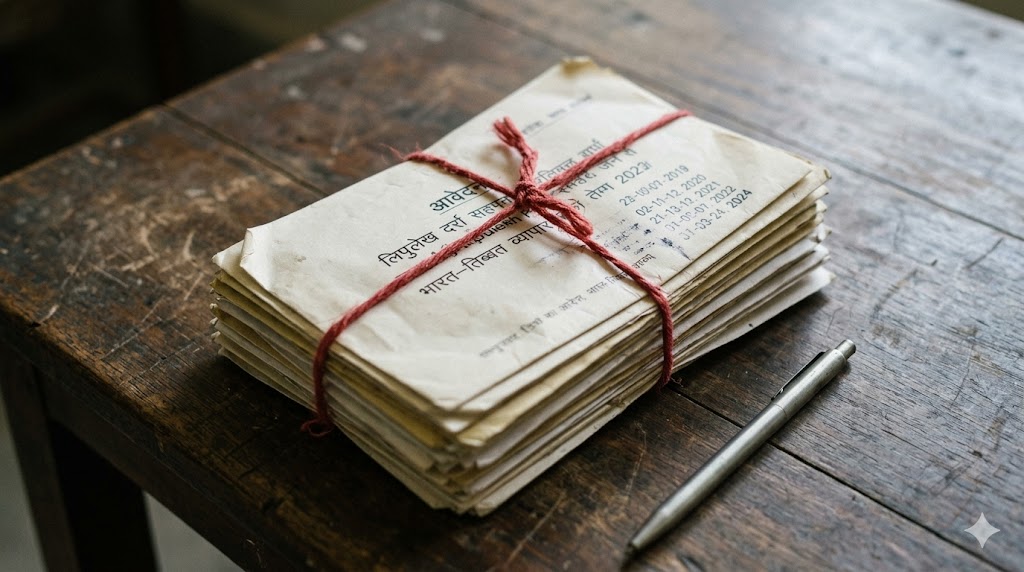
India and China are reopening Lipulekh Pass after six years. The traders of Dharchula sent twenty-two letters asking for it back. They received no reply, until geopolitics found it convenient.
Rongkali is the president of the Bharat Tibbat Vyapar Sangh, the India-Tibet Trade Association, and he keeps a file. Not a digital one, not a shared folder, not something that pings and syncs and stores itself in a cloud over servers he will never see. A physical file, the kind a man keeps when he knows that without paper there is no proof, and without proof there is no argument, and without argument there is nothing left between himself and the state’s indifference. The file contains twenty-two letters. Twenty-two requests, sent between 2019 and 2024, addressed to the Government of India, asking one simple thing: reopen the Lipulekh Pass so that the Bhotiya traders of Pithoragarh can go back to Tibet and do what their people have done for longer than India has been a country. Twenty-two letters. Not one reply. Not an acknowledgement, not a holding response, not even a printed note on government letterhead saying we have received your correspondence and are considering the matter. Nothing. A man who represents 450 tribal traders, whose goods, fifteen lakh rupees’ worth of woollen items, have been sitting in plywood covers at the Taklakot Mart in Tibet since 2019, sent twenty-two letters into the silence of the state and heard only himself.
This month, after six years, Delhi stirred. Foreign Secretary Vikram Misri wrote to the Uttarakhand Chief Secretary. The Ministry of External Affairs issued a No Objection Certificate. The Ministry of Home Affairs and the Ministry of Commerce and Industry issued their permissions. The District Magistrate at Pithoragarh convened a meeting, called it a milestone, and instructed the State Bank of India to position currency-exchange facilities in Dharchula. The trade, closed since COVID sealed the world in 2019, is expected to resume by June 2026. Officials used words like “historic” and “landmark” and “a new chapter in India-China ties.” They did not mention the twenty-two letters. They did not mention Rongkali at all.
When a state finally does the right thing and immediately reaches for the word “milestone,” it is not celebrating a beginning. It is erasing an abandonment.
To understand what is at stake at Lipulekh, you have to forget the modern map entirely. Forget the straight lines drawn by British surveyors, the disputed trijunction coordinates, the diplomatic notes of 2019 and 2020 and 2025. Go back further, to the Bhotiya communities of Kumaon, the Byansi and Chaudansi clans, sometimes called the Rung or Shauka, whose relationship with this pass was not a trade route but a way of life, as essential to them as the monsoon is to the plains below. They walked north through the high valleys of the Kali, Gori, and Darma rivers, crossed the 5,334-metre saddle of Lipulekh, and descended into the Tibetan plateau to the market town of Taklakot, called Purang in Tibetan. They carried up what the plains gave: ghee, jaggery, spices, tobacco, cotton fabric, woven shawls. They brought back what Tibet offered: rock salt, pashmina, borax, yak butter, raw silk, wool. This was not commerce in the modern sense, not margins and invoices and quarterly returns. It was a circulatory system. Blood moving between two bodies that could not survive properly without each other.
The Bhotiyas had a ritual for it. When an Indian trader wanted to establish a lasting relationship with a Tibetan village, he would enter into something called a Dheba, a bond of mutual trust sealed with ceremony and obligation. The Tibetan village then became his commercial family: they stored his goods, guaranteed his credit, vouched for his character in disputes. The Indian trader returned the obligations on the southern side of the pass. It was governance, of a kind, conducted entirely without the state. A parallel legal system built on altitude and reciprocity, predating every treaty these mountains have witnessed.
The British saw it and recorded it with the careful ambivalence of colonisers who needed the trade to function but could not resist reorganising it. In 1816, after the Anglo-Nepalese War, Captain W.J. Webb surveyed the Kali River region and met the Chinese governor of Taklakot at Lipulekh, a meeting the Chinese official marked by bringing his own teapot, reportedly finding Webb an inadequate host. The pass was already ancient with use before Webb climbed it. The 1816 Treaty of Sugauli then drew the line that still haunts the map today, declaring the Kali River the boundary between British Kumaon and Nepal. It was a line on paper. On the ground, the Bhotiyas of Tinkar Valley, now technically Nepalese, kept using Lipulekh because the alternative pass at Tinkar simply could not support their volume of trade. The border, in practice, did not exist. The trade, in practice, did not care.
A route that predates every nation claiming it is not a privilege to be restored. It is a right being returned, six years late and dressed, obscenely, as a gift.
India formalised the route in 1954 in an agreement with China. It closed it after the 1962 war. It reopened it in 1992. The Bhotiyas traded through it for nearly three decades, adapting as best they could to changed times, the old barter economy now mediated by rupees and trade passes and customs officers from Bareilly. Then COVID arrived in 2019, the pass closed, the traders returned to Dharchula without their goods, and in June 2020, twenty Indian soldiers died in the Galwan Valley and the bilateral relationship entered the longest freeze since 1962. The pass stayed shut. The file grew thicker. The plywood covers in Taklakot held, or rotted. Rongkali did not know which.
What broke the freeze was not justice. It was Donald Trump.
When the United States announced 26-per-cent tariffs on India in April 2025, later raised to fifty per cent, Delhi began recalculating its options with the speed that only economic pressure can induce. China, simultaneously facing its own American trade war, had precisely the same incentive. The August 2025 meeting between NSA Ajit Doval and Chinese Foreign Minister Wang Yi, the 24th round of Special Representatives’ Dialogue, produced an agreement to reopen three Himalayan trade passes: Lipulekh, Shipki La in Himachal Pradesh, and Nathu La in Sikkim. The language around it was studiously warm, all reset and normalisation and people-to-people ties. In reality, two countries facing a common adversary decided that the border between them should earn its keep again.
This is not a cynical reading. It is the only honest one. And here is the thing: even if the motive was entirely transactional, the outcome for Rongkali and his 450 traders should be the same, the pass reopens, the trade resumes, the goods are retrieved or acknowledged as lost. The problem is not that Delhi acted for strategic reasons. The problem is that Delhi could have acted for human reasons, years earlier, and chose not to. The twenty-two letters arrived in ministries that were fully capable of reading them. The decision not to respond was not an oversight. It was a priority. The Bhotiya traders of Dharchula were simply not one.
The state did not fail to notice. It noticed, weighed the matter, and found it insufficiently important. That is a different kind of failure, and a worse one.
And then there is Nepal, which no one in Delhi or Beijing seems to want to discuss for longer than it takes to say “bilateral matter.”
Nepal’s claim over the Kalapani-Lipulekh corridor is not a diplomatic tantrum. It rests on the same 1816 Treaty of Sugauli that India uses to justify its own boundary, and on a reading of that treaty, not unreasonable, that the Kali River’s true source lies at Limpiyadhura, well to the northwest, which would place the entire Kalapani region east of the river, inside Nepal. Around 1865, the British made a quiet adjustment, shifting the border near Lipulekh to the watershed of the Kalapani stream rather than the stream itself, annexing a 35-square-kilometre area without, as far as historians can tell, ever informing Nepal or issuing a single document explaining the change. There are no extant communications. The adjustment simply happened, the way British India made many of its adjustments, with the confidence of a power that did not expect to be questioned.
It is being questioned now, and has been since 1954, when India and China first signed their trade agreement naming Lipulekh without consulting Kathmandu. Nepal raised it then. It raised it in 1991 when the route reopened. It raised it in 2015 when Narendra Modi and Xi Jinping agreed to include Lipulekh as a bilateral trading point during Modi’s state visit to China. It raised it in 2020 when Rajnath Singh inaugurated the link road to the pass and Nepal published a new political map incorporating Lipulekh, Kalapani, and Limpiyadhura within its borders. India called that map an “unjustified cartographic assertion.” In August 2025, when Doval and Wang Yi agreed to reopen the trade, Nepal’s Prime Minister KP Sharma Oli protested to both countries. China told him to sort it out bilaterally with India. India told him, politely, firmly, that its border trade through Lipulekh was grounded in historical fact and that Nepal’s claims were not.
A former Nepali diplomat who served in New Delhi put it plainly: “Lipulekh offers one of the shortest routes between India and China for trading, people-to-people contact and pilgrimage, so both nations keep updating past agreements without informing us.” The Joint Technical Boundary Committee, which exists precisely to resolve such disputes, last met in the early 2000s. It has not convened since. The unresolved question sits there like a stone in the river, not going anywhere, not being moved, periodically stubbing the toe of whoever walks past.
Nepal has been objecting to Lipulekh since 1954. It has been objecting in the same room, to the same indifference, through seventy years of governments and agreements and diplomatic notes, and the room has never once rearranged itself to include a third chair.
The word at the centre of this story, the word that the official version of events is constitutionally incapable of using, is dispensable.
The Bhotiya traders of Dharchula were dispensable for six years. Their livelihoods, their goods mouldering under plywood in a foreign market, their twenty-two letters: dispensable. Nepal’s objections have been treated as dispensable since 1954. The Joint Technical Boundary Committee’s work: dispensable, perpetually postponable, something to be addressed after the urgent geopolitical business is settled, which is to say, never. The communities at the actual trijunction, Gunji village, the Byansi people who use both Lipulekh and Tinkar, are mentioned in anthropological footnotes and administrative reports, but they are dispensable too: their existence is the justification for the trade, but their voices play no part in whether the trade happens or when it stops or when it resumes.
Dispensable is the operating logic of border policy everywhere, but it has a particular texture in the Himalayas, where the people living nearest to the boundaries are also the people furthest from the centres of power, Dharchula to Delhi is not merely a distance in kilometres, it is a distance in attention, and where the smallness of the communities involved makes it easy for strategic calculation to proceed as though human lives were simply factors in an equation the capitals are running for their own purposes.
What makes this especially cutting is that the communities at Lipulekh are not strangers to dispensability. They have lived it through every era. The Bhotiyas of Tinkar Valley lost their valley to the British boundary adjustment of 1865 and simply kept using the pass anyway, because the alternative was impossible. When India closed the pass after 1962, the Kumaon Bhotiyas switched to farming and labour, trades they had never cultivated, on land ill-suited to cultivation, in valleys that had been organised around commerce with Tibet for generations. When the route reopened in 1992, volumes were a fraction of their historical level, because three decades of closure had broken the commercial relationships, and the markets had changed, and Wai Wai noodles were already on Tibetan roadside kiosks. The communities adapted, as communities always do when states abandon them. Adaptation is not resilience. It is what people do when they run out of other options.
The pass will open in June. Around 265 traders were issued passes in 2025, and this year officials expect more applicants, infected by the optimism of a long wait ending. The SBI will set up currency exchange in Dharchula. Customs officers will come up from Bareilly. The link road that Rajnath Singh inaugurated in 2020, the road that provoked Nepal’s cartographic protest, will carry jeeps and mules northward. The Kailash Mansarovar Yatra, suspended since 2019, is being expanded from 2026: Hindu pilgrims will again walk to their sacred mountain across the same disputed ground that Nepal considers its own and that India administers without acknowledgement of any contest. They will not be asked to think about that. Why would they be? This has been managed, across decades, precisely so that they would not need to.
Rongkali will almost certainly make the crossing. His goods, stored in plywood since 2019, may or may not survive inspection, five Himalayan winters are not kind to fabric. He will walk the same trail his ancestors walked, past the same peaks, through the same altitude that makes the body ache and the mind go quiet, and he will reach Taklakot and see what remains. He is not, as far as any record shows, bitter about the wait in the way that produces rage. He is pragmatic in the way that men become pragmatic when their pragmatism is the only thing between their community and economic collapse. He asked twenty-two times. He is not asking any more. He is preparing his goods, applying for his pass, and going.
But the twenty-two letters remain. They are not dissolved by a Foreign Secretary’s letter to Lucknow, not expunged by an NOC from the MEA, not redeemed by a District Magistrate calling a meeting and using the word “milestone.” They are still in that file, and they mark, more precisely than any boundary survey, more honestly than any bilateral agreement, exactly how much the people of these valleys are worth to the governments that claim to govern them. Twenty-two times, a man asked for what was his. Twenty-two times, the answer was silence. The trade is resuming now because two governments found it useful. Not because it was right. Not because those letters deserved a response.
India did not open Lipulekh Pass. India stopped closing it. The distinction matters more than any press release will ever admit.
The pass has been there for longer than these nations. It will be there after them. The question is not whether the Bhotiyas of Pithoragarh will walk it this June, they will. The question is whether the governments that control their access to it will ever treat that access as an obligation rather than a concession, a right rather than a gift, a baseline rather than a milestone. Until they do, the file stays open. The letters stay unanswered. And somewhere in Dharchula, a man is doing arithmetic, counting years, counting letters, counting the difference between a state that sees its people and one that sees, in the end, only the pass.
