



The Rise of Mamata Banerjee and the Fall of the Left Citadel
The Long Dominance of the Left
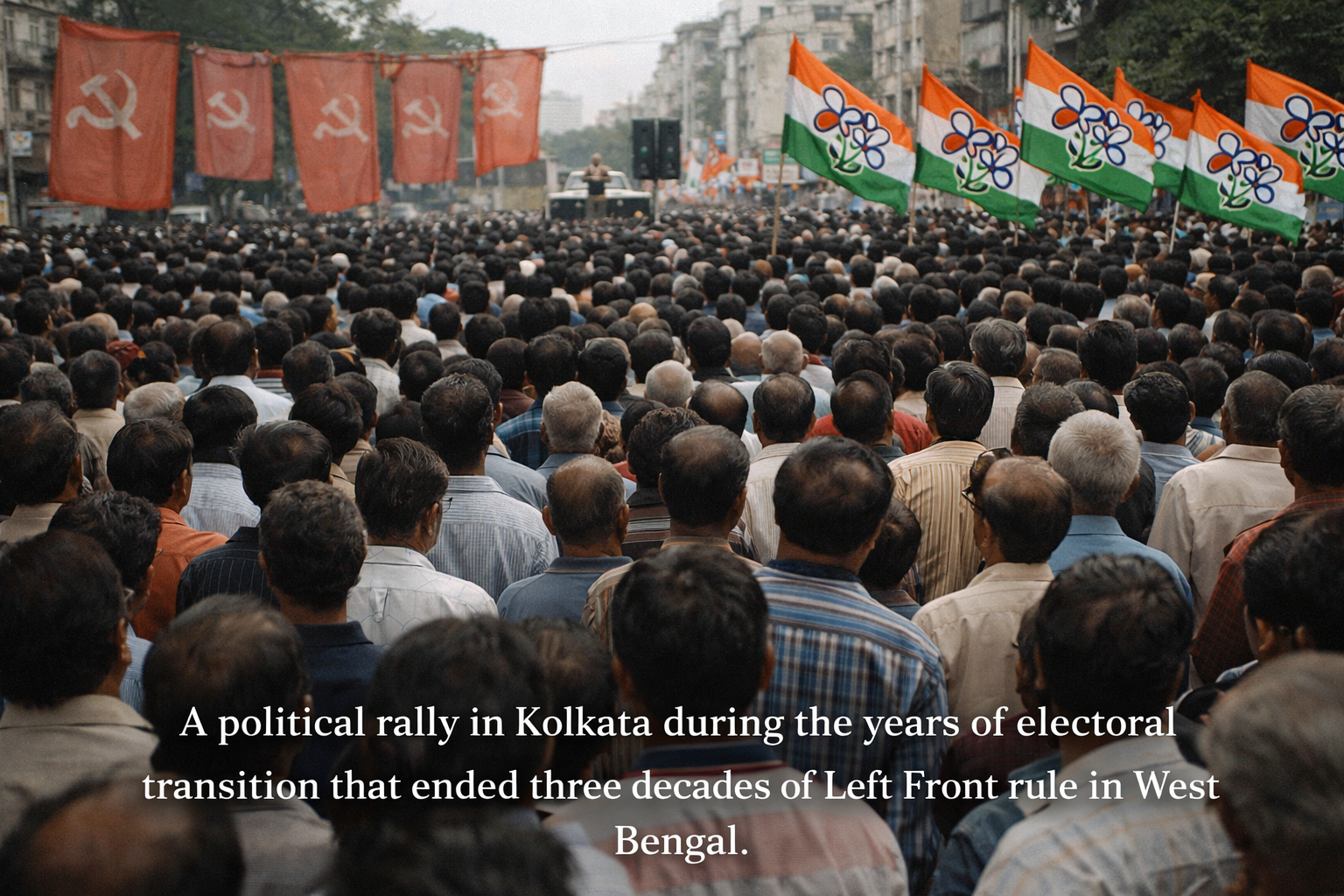
For more than three decades, the politics of West Bengal appeared frozen in ideological time. The state was governed continuously by the Left Front led by the Communist Party of India (Marxist), a political formation whose organisational reach extended from the state secretariat to the smallest village council. Few observers believed that this entrenched system could be dislodged through electoral politics. Yet in 2011, the seemingly impregnable red citadel collapsed. At the centre of this transformation stood Mamata Banerjee, a leader whose political ascent reshaped Bengal’s political order and fundamentally altered the balance of power in the state.
The story of Banerjee’s rise is not merely the biography of an individual politician. It is the account of how a determined challenger exploited the fatigue of a long-ruling regime, mobilised discontent across social groups, and ultimately dismantled one of the most durable political establishments in democratic history.
When the Left Front first came to power in 1977, it did so amid widespread rural unrest and political turbulence. Under the leadership of figures such as Jyoti Basu, the communists initiated land reforms that dramatically altered rural power structures. Programmes such as Operation Barga granted tenant farmers greater security and helped consolidate a durable political alliance between the Left and Bengal’s agrarian electorate.
Equally significant was the party’s disciplined organisational machinery. The Communist Party of India (Marxist) built a dense network of cadres embedded in trade unions, cooperatives, and local administrative institutions. Politics in Bengal came to be described by scholars as “party society”, a system in which political allegiance permeated everyday governance.
For decades, this structure ensured repeated electoral victories. Opposition parties struggled to compete with the Left’s organisational depth and ideological cohesion. The Indian National Congress, which had once dominated Bengal politics in the early decades after independence, steadily lost influence due to internal factionalism and weak state-level leadership.
It was within this environment that Mamata Banerjee began her political journey.
The Emergence of a Relentless Challenger
Banerjee entered politics through the ranks of the Indian National Congress, quickly establishing a reputation as a combative, grassroots organiser. Her style differed markedly from the cautious approach of the Congress leadership in Bengal. She relied on relentless agitation, street demonstrations, and direct engagement with voters.
Her political profile rose dramatically in 1984, when she defeated veteran communist leader Somnath Chatterjee in a parliamentary election. Although the victory did not immediately transform the state’s political landscape, it demonstrated that the Left’s dominance was not entirely invulnerable.
Yet Banerjee’s ambitions soon collided with the limitations of the Congress organisation in Bengal. The party appeared unable to mount a sustained challenge against the Left Front. Disillusioned with the inertia of her own party, Banerjee concluded that confronting the communist establishment required a new political platform.
Birth of a Regional Force
In 1998, she founded the All India Trinamool Congress. The creation of this party marked a turning point in Bengal’s political trajectory. Unlike the Congress, which remained entangled in internal rivalries, the Trinamool Congress was constructed around a singular objective: ending the prolonged rule of the Left Front.
Banerjee’s political strategy combined grassroots mobilisation with tactical alliances at the national level. At various stages, she cooperated with the Bharatiya Janata Party in order to enhance her leverage in national politics while retaining her regional identity within Bengal.
More importantly, she cultivated an image of austere populism. Dressed in simple cotton saris and frequently leading protests on the streets of Kolkata, Banerjee projected herself as a leader standing in contrast to what many perceived as the bureaucratic rigidity of the long-ruling communist establishment.
The Crisis of the Left
By the early 2000s, the Left Front faced a dilemma. After decades of governance, Bengal’s economy had stagnated relative to other Indian states. Seeking to revive industrial growth, the government led by Chief Minister Buddhadeb Bhattacharjee began promoting industrialisation and attracting private investment.
This policy shift, however, generated a profound political contradiction. The Left, historically associated with peasant rights and agrarian reform, now found itself acquiring farmland for industrial projects.
The controversy reached its peak during the land-acquisition dispute involving a proposed automobile factory by Tata Motors in Singur. Protests soon spread to Nandigram, where clashes between villagers and authorities intensified political tensions across the state.
Banerjee seized the moment with remarkable political instinct. Positioning herself as the defender of farmers and rural livelihoods, she transformed localised grievances into a statewide political movement.
The Turning of the Tide
The Singur and Nandigram agitations severely damaged the Left Front’s political credibility. For many voters, the spectacle of a communist government forcibly acquiring agricultural land contradicted the ideological foundations upon which its legitimacy had been built.
Meanwhile, Banerjee’s movement drew support from a broad coalition of social groups: farmers fearing displacement, minority communities seeking political representation, and urban voters dissatisfied with economic stagnation.
By the end of the decade, the political momentum had unmistakably shifted. In the parliamentary elections of 2009, Banerjee’s party registered significant gains in West Bengal. Two years later, the decisive breakthrough arrived.
The End of an Era
In the 2011 state elections, the All India Trinamool Congress defeated the Left Front, bringing an end to thirty-four uninterrupted years of communist rule. Mamata Banerjee was sworn in as Chief Minister of West Bengal, marking one of the most dramatic political transitions in modern Indian history.
The electoral defeat of the Left was not merely the fall of a government. It represented the collapse of an entire political system that had dominated Bengal for a generation.
A Political Landscape Transformed
Banerjee’s victory also altered the balance of opposition politics in the state. As the Trinamool Congress expanded, it absorbed much of the traditional support base of the Indian National Congress, reducing that once-dominant party to a marginal force in Bengal.
By the early 2010s, a new political order had emerged, one in which Mamata Banerjee and her party stood at the centre of the state’s political life.
Yet the transformation of Bengal politics did not end with the fall of the Left. In the years that followed, new challenges and rivalries began to reshape the state’s electoral landscape once again.
Part II of this series examines how the organisational machinery of the Communist Party of India (Marxist), once considered the strongest political network in India, gradually weakened and eventually disintegrated.
